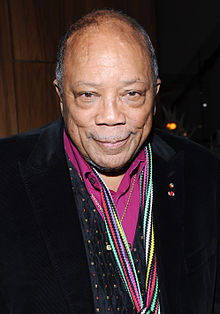
其職業生涯橫跨五個年代,創紀錄地獲得79個格萊美獎提名和27次獲獎,包括1991年他獲得的格萊美傳奇藝人大獎以及4次有色人種民權促進協會形象獎傑出爵士藝人獎。昆西·瓊斯曾與麥可·傑克森合作錄製數張大受歡迎的專輯,包括《Off the Wall》、《Thriller》。1985年製作和指揮了著名的公益歌曲 《We Are the World》。
Jones came to prominence in the 1950s as a jazz arranger and conductor before producing pop hit records for Lesley Gore in the early 1960s (including "It's My Party") and serving as an arranger and conductor for several collaborations between the jazz artists Frank Sinatra and Count Basie. Jones produced three of the most successful albums by pop star Michael Jackson: Off the Wall (1979), Thriller (1982), and Bad (1987). In 1985, Jones produced and conducted the charity song "We Are the World", which raised funds for victims of famine in Ethiopia.[3]
Quincy Delight Jones Jr. was born in the South Side of Chicago on March 14, 1933, the elder of two sons to Sara Frances (née Wells; 1904–1999[4]), a bank officer and apartment complex manager,[5] and Quincy Delight Jones (1895–1971), a semi-professional baseball player and carpenter from Charleston, South Carolina. Quincy Jr.'s paternal grandmother was an ex-slave from Louisville,[5] and he later discovered that his paternal grandfather was Welsh.[6][7]
Jones said, "He had a baby with my great-grandmother [a slave], and my grandmother was born there [on a plantation in Kentucky]. We traced this all the way back to the Laniers, the same family as Tennessee Williams."[5] Learning that the Lanier immigrant ancestors were French Huguenots who had court musicians among their ancestors, Jones attributed some of his musicianship to them.[5]
For the 2006 PBS television program African American Lives, Jones had his DNA tested, and genealogists researched his family history again. His DNA revealed he is mostly African, but also has 34% European ancestry on both sides of his family. Research showed that he has English, French, Italian, and Welsh ancestry through his father. His mother's side is of West and Central African descent, specifically the Tikar people of Cameroon.[8] His mother also had European ancestry, including Lanier male ancestors who fought for the Confederacy, making him eligible for membership in the Sons of Confederate Veterans. Among his ancestors is Elizabeth Washington Lewis, a sister of president George Washington.[9]
Jones's family moved to Chicago during the Great Migration. Jones had a younger brother, Lloyd, who was an engineer for the Seattle television station KOMO-TV until his death in 1998. Jones was introduced to music by his mother, who always sang religious songs, and next-door neighbor Lucy Jackson. When Jones was five or six, Jackson played stride piano next door, and he would listen through the walls. Jackson recalled that after he heard her one-day, she could not get him off her piano.[10]
When Jones was young, his mother had a schizophrenic breakdown and was sent to a mental institution.[5][11] His father divorced her and married Elvera Jones, who already had three children of her own: Waymond, Theresa, and Katherine.[11] Elvera and Quincy Sr. later had three children together: Jeanette, Margie, and Richard.[11][12] The family moved to Bremerton, Washington, in 1943. Jones's father took a wartime job at the Puget Sound Naval Shipyard.[11]
After the war, the family moved to Seattle, where Jones attended Garfield High School and developed his skills as a trumpeter and arranger.[5] His classmates included Charles Taylor, who played saxophone and whose mother, Evelyn Bundy, was one of Seattle's first society jazz bandleaders. Jones and Taylor began playing music together,[11] and at the age of fourteen, they played with a National Reserve band. Jones said he acquired more experience with music growing up in a smaller city due to the lack of competition.[5]
Jones cited Ray Charles as an early inspiration for his own music career, noting that Charles overcame his blindness to achieve his musical goals. Jones credited his father's sturdy work ethic with giving him the means to proceed, and his loving nature with holding the family together. Jones cited his father's rhyming motto: "Once a task is just begun, never leave until it's done. Be the labor great or small, do it well or not at all."[11]
uincy_Jones_1997.jpg" class="mw-file-description" style="text-decoration-line: none; color: var(--color-progressive,#36c); background: none; border-radius: 2px; display: block; position: relative; border: 0px;">Jones at the Watergate Hotel in Washington, D.C., 1997
Jones's social activism began in the 1960s with his support of Martin Luther King Jr. Jones was one of the founders of the Institute for Black American Music (IBAM), whose events aim to raise enough funds for the creation of a national library of African-American art and music. Jones was also one of the founders of the Black Arts Festival in his hometown of Chicago. In the 1970s, Jones formed the Quincy Jones Workshops. Meeting at the Los Angeles Landmark Variety Arts Center, the workshops educated and honed the skills of inner-city youth in musicianship, acting, and songwriting. Among its alumni were Alton McClain, who had a hit song with Alton McClain and Destiny, and Mark Wilkins, who co-wrote the hit song "Havin' a Love Attack" with Mandrill and became National Promotion Director for Mystic Records.[48]
For many years, Jones worked closely with Bono of U2 on a number of philanthropic causes. He was the founder of the Quincy Jones Listen Up Foundation,[3] a nonprofit organization that built more than 100 homes in South Africa and which aims to connect youths with technology, education, culture, and music.[49] One of the organization's programs is an intercultural exchange between underprivileged youths from Los Angeles and South Africa.[50]
In 2004, Jones helped launch the We Are the Future (WAF) project, which gives children in poor and conflict-ridden areas a chance to live their childhoods and develop a sense of hope. The program is the result of a strategic partnership between the Global Forum, the Quincy Jones Listen Up Foundation, and Hani Masri, with the support of the World Bank, UN agencies, and major companies. The project was launched with a concert in Rome, Italy, in front of an audience of half a million people.[51]
Jones supported a number of other charities, including the NAACP, GLAAD, Peace Games, AmfAR, and the Maybach Foundation.[52] He served on the advisory board of HealthCorps. In July 2007, he announced his endorsement of Hillary Clinton for president. With the election of Barack Obama, Jones said that his next conversation "with President Obama [will be] to beg for a secretary of arts."[53] This prompted the circulation of an internet petition, asking Obama to create such a Cabinet-level position in his administration.[54][55]
In 2001, Jones became an honorary member of the board of directors of the Jazz Foundation of America. He worked with the foundation to save the homes and lives of America's elderly jazz and blues musicians, including those who survived Hurricane Katrina.[56] Jones was a spokesperson for the Global Down Syndrome Foundation,[57] co-founded by his friend John Sie,[58] which annually awards the Quincy Jones Exceptional Advocacy Award.[59] He was also involved in the Linda Crnic Institute, improving the lives of people with down syndrome through advanced biomedical research.[60]
Personal life
Marriages and family
Jones was married three times and had seven children with five different women.[11][61] He was married to Jeri Caldwell from 1957 to 1966, and they had a daughter named Jolie. He had a brief affair with Carol Reynolds, and they had a daughter named Rachel. He was later married to Swedish actress Ulla Andersson from 1967 to 1974, and they had a daughter named Martina and a son named Quincy, who also became a music producer.[62][63][64]
The day after his divorce from Andersson, Jones married American actress Peggy Lipton. They had two daughters, Kidada, who was born before they were married, and Rashida, both of whom became actresses. Jones and Lipton divorced in 1990.[65][66][67] He later dated and lived with German actress Nastassja Kinski from 1991 to 1995, and they had a daughter named Kenya, who became a fashion model. In an interview with New York Magazine Jones stated that he dated Ivanka Trump.[68]
In 1994, rapper Tupac Shakur criticized Jones for having relationships with white women, prompting Jones's daughter Rashida to pen a scathing open letter in response, which was published in The Source.[69] Jones's daughter Kidada developed a romantic relationship with Shakur and had been living with him for four months at the time of his death, and they were engaged.[69]
Interests and beliefs
Jones never learned to drive, citing his involvement in a car crash at age 14 as the reason. During this time, he and a group of friends were heading to a rodeo in Yakima when a bus hit them. He said everybody in the car died except him—the scene was gruesome and left him traumatized. He attempted to take driving lessons a few years later but he "just couldn't do it" and never drove again.[70][71]
uincy_Jones_and_the_Slaight_Family_Music_Lab_(14167860742).jpg" class="mw-file-description" style="text-decoration-line: none; color: var(--color-progressive,#36c); background: none; border-radius: 2px; display: block; position: relative; border: 0px;">Jones in May 2014
Jones revealed that Ray Charles introduced him to heroin at the age of 15, although he stopped using after five months.[72] He was a believer in astrology. In regard to religion, he stated in February 2018 that he believed in a God that opposes the love of money but dismisses the notion of an afterlife. He held a negative opinion of the Catholic Church, believing it is built upon the notions of money and "fear, smoke, and murder".[73]
Jones claimed to have knowledge of the truth of the Kennedy assassination, stating his belief that mobster Sam Giancana was responsible, as well as outing sexual relationships Marlon Brando had with James Baldwin, Richard Pryor, and Marvin Gaye.[73] In 1974, Jones developed a life-threatening brain aneurysm, leading to a decision to reduce his workload to spend time with his friends and family.[74] Since his family and friends believed Jones's life was coming to an end, they started to plan a memorial service for him. He attended his own service with his neurologist by his side, in case the excitement overwhelmed him. Some of the entertainers at his service were Richard Pryor, Marvin Gaye, Sarah Vaughan, and Sidney Poitier.[75]
Health and legal issues
He had two brain surgeries, and after the second was warned to never play the trumpet again, because "if he blew a trumpet in the ways that a trumpet player must, the clip would come free and he would die". He ignored that advice, went on tour in Japan, and one night after playing trumpet had a pain in his head. Doctors said the clip in his brain had nearly come loose, as they'd warned, and Jones never played trumpet again.[76]
In October 2013, the BBC and The Hollywood Reporter said Jones planned to sue Michael Jackson's estate for $10 million. Jones said that MJJ Productions, a song company managed by Jackson's estate and Sony Music Entertainment, improperly re-edited songs to deprive him of royalties and production fees and breached an agreement giving him the right to remix master recordings for albums released after Jackson's death.[77] The songs Jones produced for Jackson were used in the film This Is It. Jones was reported to be filing the suits against the Michael Jackson Cirque du Soleil shows and the 25th-anniversary edition of the Bad album.[78] He believed he should have received a producer credit in the film.[77][79][80]
Death and legacy
On November 3, 2024, Jones died at his home in the Bel Air neighborhood of Los Angeles at the age of 91.[81][82][83] His publicist confirmed his death. The cause of death was not immediately disclosed.[84]
uincy_Jones_receiving_his_National_Medal_of_Arts._(5492097659)_(cropped).jpg" class="mw-file-description" style="text-decoration-line: none; color: var(--color-progressive,#36c); background: none; border-radius: 2px; display: block; position: relative; border: 0px;">President Barack Obama presenting Jones with the National Medal of Arts, March 2011
In 1968, Jones became the first African American to be nominated for an Academy Award for Best Original Song for "The Eyes of Love" from the film Banning. Jones was also nominated for an Academy Award for Best Original Score for his work on the 1967 film In Cold Blood, making him the first African American to be nominated twice in the same year. Jones became the first African American to be the musical director and conductor of the Academy Awards in 1971. He was the first African American to receive the academy's Jean Hersholt Humanitarian Award in 1995. He is tied with sound designer Willie D. Burton as the second most Oscar-nominated African American, with seven nominations each. Jones was inducted into the Rock & Roll Hall of Fame in the Ahmet Ertegun Award category in 2013.[90]
Honorary Doctorate of Music from Berklee College of Music (1983)[91]


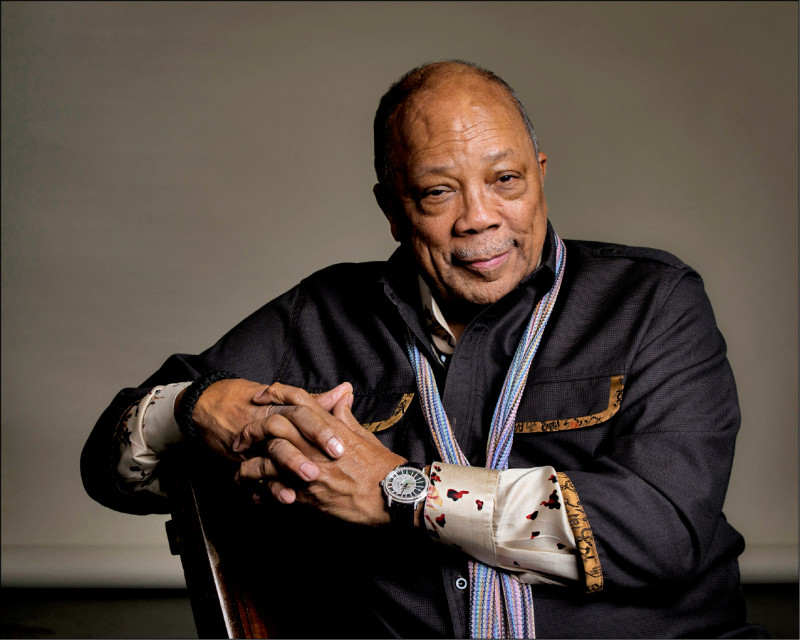 昆西瓊斯是小號演奏家、作曲家,堪稱全方位音樂教父。(美聯社)
 已故天王麥可傑克森(左)熱賣1億張的經典專輯《戰慄》出自昆西瓊斯之手。(美聯社)