Life and career
Origins and musical beginnings

Zimmerman family home in Hibbing, Minnesota
Bob Dylan was born Robert Allen Zimmerman (Hebrewname שבתאי זיסל בן אברהם [Shabtai Zisl ben Avraham])[3][4]in St Mary's Hospital on May 24, 1941, in Duluth, Minnesota,[5][6] and raised in Hibbing, Minnesota, on theMesabi Range west of Lake Superior. He has a younger brother, David. Dylan's paternal grandparents, Zigman and Anna Zimmerman, emigrated from Odessa, in the Russian Empire (now Ukraine), to the United States following the anti-Semitic pogroms of 1905.[7] His maternal grandparents, Ben and Florence Stone, wereLithuanian Jews who arrived in the United States in 1902.[7] In his autobiography,Chronicles: Volume One, Dylan wrote that his paternal grandmother's maiden name was Kirghiz and her family originated from Kağızman district of Kars Province in northeastern Turkey.[8]
Dylan's parents, Abram Zimmerman and Beatrice "Beatty" Stone, were part of a small, close-knit Jewish community. They lived in Duluth until Robert was six, when his father hadpolio and the family returned to his mother's hometown, Hibbing, where they lived for the rest of Robert's childhood. In his early years he listened to the radio—first to blues andcountry stations from Shreveport, Louisiana and later, when he was a teenager, to rock and roll.[9] He formed several bands while attending Hibbing High School. In the Golden Chords, he performed covers of songs by Little Richard[10] and Elvis Presley.[11] Their performance of Danny & the Juniors' "Rock and Roll Is Here to Stay" at their high school talent show was so loud that the principal cut the microphone.[12] In 1959, his high school yearbook carried the caption "Robert Zimmerman: to join 'Little Richard'."[10][13] The same year, as Elston Gunnn [sic], he performed two dates with Bobby Vee, playing piano and clapping.[14][15][16]
Zimmerman moved to Minneapolis in September 1959 and enrolled at the University of Minnesota. His focus on rock and roll gave way to American folk music. In 1985, he said:
The thing about rock'n'roll is that for me anyway it wasn't enough... There were great catch-phrases and driving pulse rhythms... but the songs weren't serious or didn't reflect life in a realistic way. I knew that when I got into folk music, it was more of a serious type of thing. The songs are filled with more despair, more sadness, more triumph, more faith in the supernatural, much deeper feelings.[17]
He began to perform at the Ten O'Clock Scholar, a coffeehouse a few blocks from campus, and became involved in the Dinkytown folk music circuit.[18][19]
During his Dinkytown days, Zimmerman began introducing himself as "Bob Dylan".[20][a 1] In his memoir, Dylan acknowledged that he had been influenced by the poetry of Dylan Thomas.[21] Explaining his change of name in a 2004 interview, Dylan remarked, "You're born, you know, the wrong names, wrong parents. I mean, that happens. You call yourself what you want to call yourself. This is the land of the free."[22]
1960s
Relocation to New York and record deal
In May 1960, Dylan dropped out of college at the end of his first year. In January 1961, he traveled to New York City, to perform there and visit his musical idol Woody Guthrie,[23]who was seriously ill with Huntington's disease in Greystone Park Psychiatric Hospital.[24]Guthrie had been a revelation to Dylan and influenced his early performances. Describing Guthrie's impact, he wrote: "The songs themselves had the infinite sweep of humanity in them... [He] was the true voice of the American spirit. I said to myself I was going to be Guthrie's greatest disciple."[25] As well as visiting Guthrie in hospital, Dylan befriended Guthrie's acolyte Ramblin' Jack Elliott. Much of Guthrie's repertoire was channeled through Elliott, and Dylan paid tribute to Elliott in Chronicles: Volume One.[26]
From February 1961, Dylan played at clubs around Greenwich Village. He befriended and picked up material from folk singers there, including Dave Van Ronk, Fred Neil, Odetta, theNew Lost City Ramblers, and Irish musicians the Clancy Brothers and Tommy Makem.[27]In September, Dylan gained public recognition when Robert Shelton wrote a review in The New York Times of a show at Gerde's Folk City.[28] The same month Dylan played harmonica on folk singer Carolyn Hester's third album, which brought his talents to the attention of the album's producer, John Hammond.[29] Hammond signed Dylan to Columbia Records in October. The performances on his first Columbia album—Bob Dylan—in March 1962,[30] consisted of familiar folk, blues and gospel with two original compositions. The album sold only 5,000 in its first year, just enough to break even.[31] Within Columbia Records, some referred to the singer as "Hammond's Folly"[32] and suggested dropping his contract, but Hammond defended Dylan and was supported by Johnny Cash.[31] In March 1962, Dylan contributed harmonica and back-up vocals to the album Three Kings and the Queen, accompanying Victoria Spivey and Big Joe Williams on a recording for Spivey Records.[33] While working for Columbia, Dylan recorded under the pseudonym Blind Boy Grunt,[34] for Broadside, a folk magazine and record label.[35] Dylan used the pseudonym Bob Landy to record as a piano player on The Blues Project, a 1964 anthology album byElektra Records.[34] As Tedham Porterhouse, Dylan played harmonica on Ramblin' Jack Elliott's 1964 album, Jack Elliott.[34]

Bob Dylan in November 1963
|
|
" Blowin' in the Wind" was, according to critic Andy Gill, "the song with which Dylan's name is most inextricably linked, and safeguarded his reputation as a civil libertarian through any number of changes in style and attitude". [36]
|
| Problems playing this file? See media help. |
Dylan made two important career moves in August 1962: he legally changed his name to Robert Dylan,[37] and he signed a management contract with Albert Grossman.[38](In June 1961, Dylan had signed an agreement with Roy Silver. In 1962, Grossman paid Silver $10,000 to become sole manager.)[39] Grossman remained Dylan's manager until 1970, and was notable for his sometimes confrontational personality and for protective loyalty.[40]Dylan said, "He was kind of like a Colonel Tom Parkerfigure ... you could smell him coming."[19] Tensions between Grossman and John Hammond led to Hammond's being replaced as producer of Dylan's second album by the young African-American jazz producer, Tom Wilson.[41]
Dylan made his first trip to the United Kingdom from December 1962 to January 1963.[42] He had been invited by TV directorPhilip Saville to appear in a drama, Madhouse on Castle Street, which Saville was directing for BBC Television.[43] At the end of the play, Dylan performed "Blowin' in the Wind", one of its first public performances.[43] The film recording of Madhouse on Castle Street was destroyed by the BBC in 1968.[43] While in London, Dylan performed at London folk clubs, including the Troubadour, Les Cousins, and Bunjies.[42] He also learned material from UK performers, including Martin Carthy.[43]
By the time of Dylan's second album, The Freewheelin' Bob Dylan, in May 1963, he had begun to make his name as a singer and a songwriter. Many songs on this album were labeled protest songs, inspired partly by Guthrie and influenced by Pete Seeger's passion for topical songs.[44] "Oxford Town", for example, was an account of James Meredith's ordeal as the first black student to risk enrollment at the University of Mississippi.[45]
The first song on the Freewheelin' album, "Blowin' in the Wind", partly derived its melody from the traditional slave song, "No More Auction Block",[46] while its lyrics questioned the social and political status quo. The song was widely recorded by other artists and became a hit for Peter, Paul and Mary.[47] Another Freewheelin' song, "A Hard Rain's a-Gonna Fall" was based on the folk ballad "Lord Randall". With veiled references to an impending apocalypse, the song gained more resonance when the Cuban Missile Crisis developed a few weeks after Dylan began performing it.[48][a 2] Like "Blowin' in the Wind", "A Hard Rain's a-Gonna Fall" marked a new direction in songwriting, blending a stream-of-consciousness,imagist lyrical attack with traditional folk form.[49]
Dylan's topical songs enhanced his early reputation, and he came to be seen as more than just a songwriter. Janet Maslin wrote of Freewheelin': "These were the songs that established [Dylan] as the voice of his generation—someone who implicitly understood how concerned young Americans felt about nuclear disarmament and the growing movement forcivil rights: his mixture of moral authority and nonconformity was perhaps the most timely of his attributes."[50][a 3] Freewheelin' also included love songs and surreal talking blues. Humor was an important part of Dylan's persona,[51] and the range of material on the album impressed listeners, including The Beatles. George Harrison said of the album, "We just played it, just wore it out. The content of the song lyrics and just the attitude—it was incredibly original and wonderful."[52]
The rough edge of Dylan's singing was unsettling to some but an attraction to others. Joyce Carol Oates wrote: "When we first heard this raw, very young, and seemingly untrained voice, frankly nasal, as if sandpaper could sing, the effect was dramatic and electrifying."[53] Many early songs reached the public through more palatable versions by other performers, such as Joan Baez, who became Dylan's advocate as well as his lover.[54]Baez was influential in bringing Dylan to prominence by recording several of his early songs and inviting him on stage during her concerts.[55]
Others who had hits with Dylan's songs in the early 1960s included the Byrds, Sonny & Cher, the Hollies, Peter, Paul and Mary, the Association, Manfred Mann and the Turtles. Most attempted a pop feel and rhythm, while Dylan and Baez performed them mostly as sparse folk songs. The covers became so ubiquitous that CBS promoted him with the slogan "Nobody Sings Dylan Like Dylan."[56]
"Mixed-Up Confusion", recorded during the Freewheelin' sessions with a backing band, was released as a single and then quickly withdrawn. In contrast to the mostly solo acoustic performances on the album, the single showed a willingness to experiment with a rockabillysound. Cameron Crowe described it as "a fascinating look at a folk artist with his mind wandering towards Elvis Presley and Sun Records."[57]
Protest and Another Side
In May 1963, Dylan's political profile rose when he walked out of The Ed Sullivan Show. During rehearsals, Dylan had been told by CBS television's head of program practices that "Talkin' John Birch Paranoid Blues" was potentially libelous to the John Birch Society. Rather than comply with censorship, Dylan refused to appear.[58]
|
|
Dylan said of "The Times They Are a-Changin'": "This was definitely a song with a purpose. I wanted to write a big song, some kind of theme song, with short concise verses that piled up on each other in a hypnotic way. The civil rights movement and the folk music movement were pretty close and allied together at that time." [17]
|
| Problems playing this file? See media help. |
By this time, Dylan and Baez were prominent in the civil rights movement, singing together at theMarch on Washington on August 28, 1963.[59]Dylan's third album, The Times They Are a-Changin', reflected a more politicized and cynical Dylan.[60] The songs often took as their subject matter contemporary stories, with "Only A Pawn In Their Game" addressing the murder of civil rights worker Medgar Evers; and the Brechtian"The Lonesome Death of Hattie Carroll" the death of black hotel barmaid Hattie Carroll, at the hands of young white socialite William Zantzinger.[61] On a more general theme, "Ballad of Hollis Brown" and "North Country Blues" addressed despair engendered by the breakdown of farming and mining communities. This political material was accompanied by two personal love songs, "Boots of Spanish Leather" and "One Too Many Mornings".[62]
By the end of 1963, Dylan felt both manipulated and constrained by the folk and protest movements.[63] Accepting the "Tom Paine Award" from the National Emergency Civil Liberties Committee shortly after the assassination of John F. Kennedy, an intoxicated Dylan questioned the role of the committee, characterized the members as old and balding, and claimed to see something of himself and of every man in Kennedy's assassin, Lee Harvey Oswald.[64]
Another Side of Bob Dylan, recorded on a single evening in June 1964,[65] had a lighter mood. The humorous Dylan reemerged on "I Shall Be Free No. 10" and "Motorpsycho Nightmare". "Spanish Harlem Incident" and "To Ramona" are passionate love songs, while "Black Crow Blues" and "I Don't Believe You (She Acts Like We Never Have Met)" suggest the rock and roll soon to dominate Dylan's music. "It Ain't Me Babe", on the surface a song about spurned love, has been described as a rejection of the role of political spokesman thrust upon him.[66] His newest direction was signaled by two lengthy songs: theimpressionistic "Chimes of Freedom", which sets social commentary against a metaphorical landscape in a style characterized by Allen Ginsbergas "chains of flashing images,"[67] and "My Back Pages", which attacks the simplistic and arch seriousness of his own earlier topical songs and seems to predict the backlash he was about to encounter from his former champions as he took a new direction.[68]
In the latter half of 1964 and 1965, Dylan moved from folk songwriter to folk-rock pop-music star. His jeans and work shirts were replaced by a Carnaby Street wardrobe, sunglasses day or night, and pointed "Beatle boots". A London reporter wrote: "Hair that would set the teeth of a comb on edge. A loud shirt that would dim the neon lights of Leicester Square. He looks like an undernourished cockatoo."[69] Dylan began to spar with interviewers. Appearing on the Les Crane television show and asked about a movie he planned, he told Crane it would be a cowboy horror movie. Asked if he played the cowboy, Dylan replied, "No, I play my mother."[70]
Going electric

Bob Dylan making an impromptu guest appearance with the Byrds at Ciro's nightclub, March 26, 1965
Dylan's late March 1965 album Bringing It All Back Homewas another leap,[71] featuring his first recordings with electric instruments. The first single, "Subterranean Homesick Blues", owed much to Chuck Berry's "Too Much Monkey Business";[72] its free association lyrics described as harkening back to the energy of beat poetry and as a forerunner of rap and hip-hop.[73] The song was provided with an early video, which opened D. A. Pennebaker'scinéma vérité presentation of Dylan's 1965 tour of Great Britain, Dont Look Back.[74] Instead of miming, Dylan illustrated the lyrics by throwing cue cards containing key words from the song on the ground. Pennebaker said the sequence was Dylan's idea, and it has been imitated in music videos and advertisements.[75]
The second side of Bringing It All Back Home contained four long songs on which Dylan accompanied himself on acoustic guitar and harmonica.[76] "Mr. Tambourine Man" became one of his best known songs when The Byrds recorded an electric version that reached number one in the US and UK .[77][78] "It's All Over Now, Baby Blue" and "It's Alright Ma (I'm Only Bleeding)" were two of Dylan's most important compositions.[76][79]
In 1965, heading the Newport Folk Festival, Dylan performed his first electric set since high school with a pickup group mostly from the Paul Butterfield Blues Band, featuring Mike Bloomfield (guitar), Sam Lay (drums) and Jerome Arnold (bass), plus Al Kooper (organ) andBarry Goldberg (piano).[80] Dylan had appeared at Newport in 1963 and 1964, but in 1965 met with cheering and booing and left the stage after three songs. One version has it that the boos were from folk fans whom Dylan had alienated by appearing, unexpectedly, with an electric guitar. Murray Lerner, who filmed the performance, said: "I absolutely think that they were booing Dylan going electric."[81] An alternative account claims audience members were upset by poor sound and a short set. This account is supported by Kooper and one of the directors of the festival, who reports his recording proves the only boos were in reaction to the MC's announcement that there was only enough time for a short set.[82][83]
Nevertheless, Dylan's performance provoked a hostile response from the folk music establishment.[84][85] In the September issue of Sing Out!, Ewan MacColl wrote: "Our traditional songs and ballads are the creations of extraordinarily talented artists working inside disciplines formulated over time ...'But what of Bobby Dylan?' scream the outraged teenagers ... Only a completely non-critical audience, nourished on the watery pap of pop music, could have fallen for such tenth-rate drivel."[86] On July 29, four days after Newport, Dylan was back in the studio in New York, recording "Positively 4th Street". The lyrics contained images of vengeance and paranoia,[87] and it has been interpreted as Dylan's put-down of former friends from the folk community—friends he had known in clubs alongWest 4th Street.[88]
Highway 61 Revisited and Blonde on Blonde
|
|
Dylan's 1965 hit single, which appeared on the album Highway 61 Revisited. In 2004, it was chosen as the greatest song of all time by Rolling Stonemagazine. [89]
|
| Problems playing this file? See media help. |
In July 1965, the single "Like a Rolling Stone" peaked at two in the U.S. and at four in the UK charts. At over six minutes, the song altered what a pop single could convey. Bruce Springsteen, in his speech for Dylan's inauguration into the Rock and Roll Hall of Fame, said that on first hearing the single, "that snare shot sounded like somebody'd kicked open the door to your mind".[90] In 2004 and in 2011, Rolling Stonelisted it as number one of "The 500 Greatest Songs of All Time".[89][91] The song opened Dylan's next album, Highway 61 Revisited, named after the road that led from Dylan's Minnesota to the musical hotbed of New Orleans.[92] The songs were in the same vein as the hit single, flavored by Mike Bloomfield's blues guitar and Al Kooper's organ riffs. "Desolation Row", backed by acoustic guitar and understated bass,[93] offers the sole exception, with Dylan alluding to figures in Western culture in a song described by Andy Gill as "an 11-minute epic of entropy, which takes the form of a Fellini-esque parade of grotesques and oddities featuring a huge cast of celebrated characters, some historical (Einstein, Nero), some biblical (Noah, Cain and Abel), some fictional (Ophelia, Romeo, Cinderella), some literary (T.S. Eliot and Ezra Pound), and some who fit into none of the above categories, notably Dr. Filth and his dubious nurse."[94]
In support of the album, Dylan was booked for two U.S. concerts with Al Kooper andHarvey Brooks from his studio crew and Robbie Robertson and Levon Helm, former members of Ronnie Hawkins's backing band the Hawks.[95] On August 28 at Forest Hills Tennis Stadium, the group was heckled by an audience still annoyed by Dylan's electric sound. The band's reception on September 3 at the Hollywood Bowl was more favorable.[96]
From September 24, 1965, in Austin, Texas, Dylan toured the U.S. and Canada for six months, backed by the five musicians from the Hawks who became known as the Band.[97]While Dylan and the Hawks met increasingly receptive audiences, their studio efforts floundered. Producer Bob Johnston persuaded Dylan to record in Nashville in February 1966, and surrounded him with top-notch session men. At Dylan's insistence, Robertson and Kooper came from New York City to play on the sessions.[98] The Nashville sessions produced the double album Blonde on Blonde (1966), featuring what Dylan called "that thin wild mercury sound".[99] Kooper described it as "taking two cultures and smashing them together with a huge explosion": the musical world of Nashville and the world of the "quintessential New York hipster" Bob Dylan.[100]
On November 22, 1965, Dylan secretly married 25-year-old former model Sara Lownds.[101]Some of Dylan's friends, including Ramblin' Jack Elliott, say that, immediately after the event, Dylan denied he was married.[101] Journalist Nora Ephron made the news public in the New York Post in February 1966 with the headline "Hush! Bob Dylan is wed."[102]
Dylan toured Australia and Europe in April and May 1966. Each show was split in two. Dylan performed solo during the first half, accompanying himself on acoustic guitar and harmonica. In the second, backed by the Hawks, he played electrically amplified music. This contrast provoked many fans, who jeered and slow handclapped.[103] The tour culminated in a raucous confrontation between Dylan and his audience at the ManchesterFree Trade Hall in England on May 17, 1966.[104] A recording of this concert was released in 1998: The Bootleg Series Vol. 4: Bob Dylan Live 1966. At the climax of the evening, a member of the audience, angered by Dylan's electric backing, shouted: "Judas!" to which Dylan responded, "I don't believe you ... You're a liar!" Dylan turned to his band and said, "Play it fucking loud!"[105] as they launched into the final song of the night—"Like a Rolling Stone".
During his 1966 tour, Dylan was described as exhausted and acting "as if on a death trip".[106] D. A. Pennebaker, the film maker accompanying the tour, described Dylan as "taking a lot of amphetamine and who-knows-what-else."[107] In a 1969 interview with Jann Wenner, Dylan said, "I was on the road for almost five years. It wore me down. I was on drugs, a lot of things ... just to keep going, you know?"[108] In 2011, BBC Radio 4 reported that, in an interview that Robert Shelton taped in 1966, Dylan said he had kicked heroin in New York City: "I got very, very strung out for a while ... I had about a $25-a-day habit and I kicked it."[109] Some journalists questioned the validity of this confession, pointing out that Dylan had "been telling journalists wild lies about his past since the earliest days of his career."[110][111]
Motorcycle accident and reclusion
After his tour, Dylan returned to New York, but the pressures increased. ABC Televisionhad paid an advance for a TV show.[112] His publisher, Macmillan, was demanding a manuscript of the poem/novel Tarantula. Manager Albert Grossman had scheduled a concert tour for the latter part of the year.
On July 29, 1966, Dylan crashed his 500cc Triumph Tiger 100 motorcycle near his home inWoodstock, New York and was thrown to the ground. Though the extent of his injuries was never disclosed, Dylan said that he broke several vertebrae in his neck.[113] Mystery still surrounds the circumstances of the accident since no ambulance was called to the scene and Dylan was not hospitalized.[113][114] Dylan's biographers have written that the crash offered Dylan the chance to escape the pressures around him.[113][115] Dylan confirmed this interpretation in his autobiography: "I had been in a motorcycle accident and I'd been hurt, but I recovered. Truth was that I wanted to get out of the rat race."[116] Dylan withdrew from public and, apart from a few appearances, did not tour again for almost eight years.[117]
Once Dylan was well enough to resume creative work, he began to edit D. A. Pennebaker's film of his 1966 tour. A rough cut was shown to ABC Television and rejected as incomprehensible to a mainstream audience.[118] The film was subsequently titled Eat the Document on bootleg copies, and it has been screened at a handful of film festivals.[119][120] In 1967 he began recording with the Hawks at his home and in the basement of the Hawks' nearby house, "Big Pink".[121] These songs, initially demos for other artists to record, provided hits for Julie Driscoll and the Brian Auger Trinity ("This Wheel's on Fire"), The Byrds ("You Ain't Goin' Nowhere", "Nothing Was Delivered"), andManfred Mann ("Mighty Quinn"). Columbia released selections in 1975 as The Basement Tapes. Over the years, more songs recorded by Dylan and his band in 1967 appeared onbootleg recordings, culminating in a five-CD set titled The Genuine Basement Tapes, containing 107 songs and alternative takes.[122] In the coming months, the Hawks recorded the album Music from Big Pink using songs they worked on in their basement in Woodstock, and renamed themselves the Band,[123] beginning a long recording and performing career of their own.
In October and November 1967, Dylan returned to Nashville.[124] Back in the studio after 19 months, he was accompanied by Charlie McCoy on bass,[124] Kenny Buttrey on drums,[124]and Pete Drake on steel guitar.[124] The result was John Wesley Harding, a contemplative record of shorter songs, set in a landscape that drew on the American West and the Bible. The sparse structure and instrumentation, with lyrics that took the Judeo-Christian tradition seriously, departed from Dylan's own work and from the psychedelic fervor of the 1960s.[125] It included "All Along the Watchtower", with lyrics derived from the Book of Isaiah (21:5–9). The song was later recorded by Jimi Hendrix, whose version Dylan acknowledged as definitive.[17] Woody Guthrie died on October 3, 1967, and Dylan made his first live appearance in twenty months at a Guthrie memorial concert held at Carnegie Hall on January 20, 1968, where he was backed by the Band.[126]
|
|
ay Lady Lay.ogg" href="https://en.wikipedia.org/wiki/File  ay_Lady_Lay.ogg">"Lay Lady Lay"
|
| Problems playing this file? See media help. |
Dylan's next release, Nashville Skyline (1969), was mainstream country featuring Nashville musicians, a mellow-voiced Dylan, a duet withJohnny Cash, and the hit single "Lay Lady Lay".[128] Variety wrote, "Dylan is definitely doing something that can be called singing. Somehow he has managed to add an octave to his range."[129] Dylan and Cash also recorded a series of duets, but only their recording of Dylan's "Girl from the North Country" was used on the album.
In May 1969, Dylan appeared on the first episode of Johnny Cash's television show, duetting with Cash on "Girl from the North Country", "I Threw It All Away", and "Living the Blues". Dylan next traveled to England to top the bill at the Isle of Wight festival on August 31, 1969, after rejecting overtures to appear at the Woodstock Festival closer to his home.[130]
1970s
In the early 1970s, critics charged that Dylan's output was varied and unpredictable.Rolling Stone writer Greil Marcus asked "What is this shit?" on first listening to Self Portrait, released in June 1970.[131][132] Self Portrait, a double LP including few original songs, was poorly received.[133] In October 1970, Dylan released New Morning, considered a return to form.[134] This album included "Day of the Locusts", a song in which Dylan gave an account of receiving an honorary degree from Princeton University on June 9, 1970.[135] In November 1968, Dylan had co-written "I'd Have You Anytime" with George Harrison;[136] Harrison recorded "I'd Have You Anytime" and Dylan's "If Not for You" for his 1970 solo triple album All Things Must Pass. Dylan's surprise appearance at Harrison's 1971 Concert for Bangladesh attracted media coverage, reflecting that Dylan's live appearances had become rare.[137]
Between March 16 and 19, 1971, Dylan reserved three days at Blue Rock, a small studio inGreenwich Village to record with Leon Russell. These sessions resulted in "Watching the River Flow" and a new recording of "When I Paint My Masterpiece".[138] On November 4, 1971, Dylan recorded "George Jackson", which he released a week later. For many, the single was a surprising return to protest material, mourning the killing of Black PantherGeorge Jackson in San Quentin State Prison that year.[139] Dylan contributed piano and harmony to Steve Goodman's album, Somebody Else's Troubles, under the pseudonym Robert Milkwood Thomas in September 1972.[140]
In 1972, Dylan signed to Sam Peckinpah's film Pat Garrett and Billy the Kid, providingsongs and backing music for the movie, and playing "Alias", a member of Billy's gang with some historical basis.[141] Despite the film's failure at the box office, the song "Knockin' on Heaven's Door" became one of Dylan's most covered songs.[142][143]
Return to touring
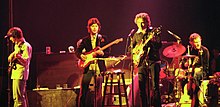
Bob Dylan and the Bandtouring in Chicago, 1974
Dylan began 1973 by signing with a new label, David Geffen's Asylum Records, when his contract with Columbia Records expired. On his next album, Planet Waves, he used the Band as backing group, while rehearsing for a tour. The album included two versions of "Forever Young", which became one of his most popular songs.[144] As one critic described it, the song projected "something hymnal and heartfelt that spoke of the father in Dylan",[145] and Dylan himself commented: "I wrote it thinking about one of my boys and not wanting to be too sentimental."[17]
Columbia Records simultaneously released Dylan, a collection of studio outtakes (almost exclusively covers), widely interpreted as a churlish response to Dylan's signing with a rival record label.[146] In January 1974, Dylan returned to touring after seven years; backed by the Band, he embarked on a North American tour of 40 concerts. A live double album,Before the Flood, was on Asylum Records. Soon, according to Clive Davis, Columbia Records sent word they "will spare nothing to bring Dylan back into the fold".[147] Dylan had second thoughts about Asylum, miffed that while there had been millions of unfulfilled ticket requests for the 1974 tour, Geffen had sold only 700,000 copies of Planet Waves.[147]Dylan returned to Columbia Records, which reissued his two Asylum albums.
|
|
Dylan said of the opening song from Blood on the Tracks: "I was trying to deal with the concept of time, and the way the characters change from the first person to the third person, and you're never sure if the first person is talking or the third person. But as you look at the whole thing it really doesn't matter." [17]
|
| Problems playing this file? See media help. |
After the tour, Dylan and his wife became estranged. He filled a small red notebook with songs about relationships and ruptures, and recorded an album entitled Blood on the Tracksin September 1974.[148] Dylan delayed the release and re-recorded half the songs at Sound 80 Studios in Minneapolis with production assistance from his brother, David Zimmerman.[149]
Released in early 1975, Blood on the Tracks received mixed reviews. In the NME, Nick Kent described "the accompaniments [as] often so trashy they sound like mere practice takes."[150] In Rolling Stone, Jon Landau wrote that "the record has been made with typical shoddiness."[150] Over the years critics came to see it as one of Dylan's greatest achievements. In Salon.com, Bill Wyman wrote: "Blood on the Tracks is his only flawless album and his best produced; the songs, each of them, are constructed in disciplined fashion. It is his kindest album and most dismayed, and seems in hindsight to have achieved a sublime balance between the logorrhea-plagued excesses of his mid-1960s output and the self-consciously simple compositions of his post-accident years."[151]Novelist Rick Moody called it "the truest, most honest account of a love affair from tip to stern ever put down on magnetic tape."[152]
In the middle of that year, Dylan wrote a ballad championing boxer Rubin "Hurricane" Carter, imprisoned for a triple murder in Paterson, New Jersey, in 1966. After visiting Carter in jail, Dylan wrote "Hurricane", presenting the case for Carter's innocence. Despite its length—over eight minutes—the song was released as a single, peaking at 33 on the U.S. Billboard chart, and performed at every 1975 date of Dylan's next tour, the Rolling Thunder Revue.[a 4][153] The tour featured about one hundred performers and supporters from the Greenwich Village folk scene, including T-Bone Burnett, Ramblin' Jack Elliott, Joni Mitchell,[154][155] David Mansfield, Roger McGuinn, Mick Ronson, Joan Baez, and Scarlet Rivera, whom Dylan discovered walking down the street, her violin case on her back.[156] Allen Ginsbergaccompanied the troupe, staging scenes for the film Dylan was shooting. Sam Shepardwas hired to write the screenplay, but ended up accompanying the tour as informal chronicler.[157]
Running through late 1975 and again through early 1976, the tour encompassed the release of the album Desire, with many of Dylan's new songs featuring a travelogue-like narrative style, showing the influence of his new collaborator, playwright Jacques Levy.[158][159] The 1976 half of the tour was documented by a TV concert special, Hard Rain, and the LP Hard Rain; no concert album from the better-received and better-known opening half of the tour was released until 2002's Live 1975.[160]
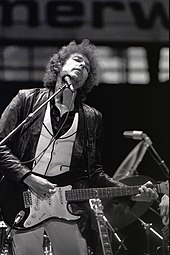
Dylan performing in the Feyenoord Football Club Stadium, Rotterdam, June 23, 1978
The 1975 tour with the Revue provided the backdrop to Dylan's nearly four-hour film Renaldo and Clara, a sprawling narrative mixed with concert footage and reminiscences. Released in 1978, the movie received poor, sometimes scathing, reviews.[161][162]Later in that year, a two-hour edit, dominated by the concert performances, was more widely released.[163]
In November 1976, Dylan appeared at the Band's "farewell" concert, with Eric Clapton, Joni Mitchell, Muddy Waters, Van Morrison and Neil Young. Martin Scorsese's cinematic chronicle,The Last Waltz, in 1978 included about half of Dylan's set.[164] In 1976, Dylan wrote and duetted on "Sign Language" for Eric Clapton's No Reason To Cry.[165]
In 1978, Dylan embarked on a year-long world tour, performing 114 shows in Japan, the Far East, Europe and the US, to a total audience of two million. Dylan assembled an eight piece band and three backing singers. Concerts in Tokyo in February and March were released as the live double album, Bob Dylan At Budokan.[166] Reviews were mixed. Robert Christgau awarded the album a C+ rating, giving the album a derisory review,[167] while Janet Maslin defended it in Rolling Stone, writing: "These latest live versions of his old songs have the effect of liberating Bob Dylan from the originals."[168] When Dylan brought the tour to the U.S. in September 1978, the press described the look and sound as a 'Las Vegas Tour'.[169] The 1978 tour grossed more than $20 million, and Dylan told the Los Angeles Times that he had debts because "I had a couple of bad years. I put a lot of money into the movie, built a big house ... and it costs a lot to get divorced in California."[166]
In April and May 1978, Dylan took the same band and vocalists into Rundown Studios inSanta Monica, California, to record an album of new material: Street-Legal.[170] It was described by Michael Gray as, "after Blood On The Tracks, arguably Dylan's best record of the 1970s: a crucial album documenting a crucial period in Dylan's own life".[171] However, it had poor sound and mixing (attributed to Dylan's studio practices), muddying the instrumental detail until a remastered CD release in 1999 restored some of the songs' strengths.[172]
Christian period
In the late 1970s, Dylan became a born again Christian[173][174][175] and released two albums ofcontemporary gospel music. Slow Train Coming(1979) featured the guitar accompaniment ofMark Knopfler (of Dire Straits) and was produced by veteran R&B producer Jerry Wexler. Wexler said that Dylan had tried to evangelize him during the recording. He replied: "Bob, you're dealing with a 62-year-old Jewish atheist. Let's just make an album."[176] Dylan won the Grammy Award for Best Male Rock Vocal Performance for the song "Gotta Serve Somebody". His second Christian-themed album, Saved (1980), received mixed reviews, described by Michael Gray as "the nearest thing to a follow-up album Dylan has ever made, Slow Train Coming II and inferior"[177] When touring in late 1979 and early 1980, Dylan would not play his older, secular works, and he delivered declarations of his faith from the stage, such as:
Years ago they ... said I was a prophet. I used to say, "No I'm not a prophet" they say "Yes you are, you're a prophet." I said, "No it's not me." They used to say "You sure are a prophet." They used to convince me I was a prophet. Now I come out and say Jesus Christ is the answer. They say, "Bob Dylan's no prophet." They just can't handle it.[178]
Dylan's Christianity was unpopular with some fans and musicians.[179] Shortly before his murder, John Lennon recorded "Serve Yourself" in response to Dylan's "Gotta Serve Somebody".[180] By 1981, Stephen Holden wrote in the New York Times that "neither age (he's now 40) nor his much-publicized conversion to born-again Christianity has altered his essentially iconoclastic temperament."[181]
1980s
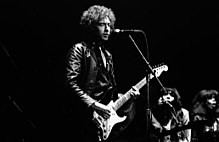
Dylan in Toronto April 18, 1980
In late 1980, Dylan briefly played concerts billed as "A Musical Retrospective", restoring popular 1960s songs to the repertoire. Shot of Love, recorded early the next year, featured his first secular compositions in more than two years, mixed with Christian songs. "Every Grain of Sand" reminded some of William Blake's verses.[182]
In the 1980s, reception of Dylan's recordings varied, from the well-regarded Infidels in 1983 to the panned Down in the Groove in 1988. Michael Gray condemned Dylan's 1980s albums for carelessness in the studio and for failing to release his best songs.[183] As an example of the latter, the Infidels recording sessions, which again employed Knopfler on lead guitar and also as the album's producer, resulted in several notable songs that Dylan left off the album. Best regarded of these were "Blind Willie McTell", a tribute to the dead blues musician and an evocation of African American history,[184] "Foot of Pride" and "Lord Protect My Child". These three songs were released on The Bootleg Series Volumes 1–3 (Rare & Unreleased) 1961–1991.[185]
Between July 1984 and March 1985, Dylan recorded Empire Burlesque.[186] Arthur Baker, who had remixed hits for Bruce Springsteen and Cyndi Lauper, was asked to engineer and mix the album. Baker said he felt he was hired to make Dylan's album sound "a little bit more contemporary".[186]
Dylan sang on USA for Africa's famine relief single "We Are the World". On July 13, 1985, he appeared at the climax at the Live Aid concert at JFK Stadium, Philadelphia. Backed byKeith Richards and Ronnie Wood, he performed a ragged version of "Hollis Brown", his ballad of rural poverty, and then said to the worldwide audience exceeding one billion people: "I hope that some of the money ... maybe they can just take a little bit of it, maybe ... one or two million, maybe ... and use it to pay the mortgages on some of the farms and, the farmers here, owe to the banks."[187] His remarks were widely criticized as inappropriate, but they did inspire Willie Nelson to organize a series of events, Farm Aid, to benefit debt-ridden American farmers.[188]
In April 1986, Dylan made a foray into rap music when he added vocals to the opening verse of "Street Rock", featured on Kurtis Blow's album Kingdom Blow.[189] Dylan's next studio album, Knocked Out Loaded, in July 1986 contained three covers (by Little Junior Parker, Kris Kristofferson and the gospel hymn "Precious Memories"), plus three collaborations with (Tom Petty, Sam Shepard and Carole Bayer Sager), and two solo compositions by Dylan. One reviewer commented that "the record follows too many detours to be consistently compelling, and some of those detours wind down roads that are indisputably dead ends. By 1986, such uneven records weren't entirely unexpected by Dylan, but that didn't make them any less frustrating."[190] It was the first Dylan album sinceFreewheelin' (1963) to fail to make the Top 50.[191] Since then, some critics have called the 11-minute epic that Dylan co-wrote with Sam Shepard, "Brownsville Girl", a work of genius.[192]
In 1986 and 1987, Dylan toured with Tom Petty and the Heartbreakers, sharing vocals with Petty on several songs each night. Dylan also toured with the Grateful Dead in 1987, resulting in a live album Dylan & The Dead. This received negative reviews: Allmusic said, "Quite possibly the worst album by either Bob Dylan or the Grateful Dead."[193] Dylan then initiated what came to be called the Never Ending Tour on June 7, 1988, performing with a back-up band featuring guitarist G. E. Smith. Dylan continued to tour with a small, evolving band for the next 20 years.[194]
In 1987, Dylan starred in Richard Marquand's movie Hearts of Fire, in which he played Billy Parker, a washed-up rock star turned chicken farmer whose teenage lover, (Fiona), leaves him for a jaded English synth-pop sensation played by Rupert Everett.[195] Dylan also contributed two original songs to the soundtrack—"Night After Night", and "I Had a Dream About You, Baby", as well as a cover of John Hiatt's "The Usual". The film was a critical and commercial flop.[196] Dylan was inducted into the Rock and Roll Hall of Fame in January 1988, with Bruce Springsteen's introduction declaring, "Bob freed your mind the way Elvis freed your body. He showed us that just because music was innately physical did not mean that it was anti-intellectual.[197]
The album Down in the Groove in May 1988 sold even more unsuccessfully than his previous studio album.[198] Michael Gray wrote: "The very title undercuts any idea that inspired work may lie within. Here was a further devaluing of the notion of a new Bob Dylan album as something significant."[199] The critical and commercial disappointment of that album was swiftly followed by the success of the Traveling Wilburys. Dylan co-founded the band with George Harrison, Jeff Lynne, Roy Orbison, and Tom Petty, and in late 1988 their multi-platinum Traveling Wilburys Vol. 1 reached three on the US album chart,[198]featuring songs that were described as Dylan's most accessible compositions in years.[200]Despite Orbison's death in December 1988, the remaining four recorded a second album in May 1990 with the title Traveling Wilburys Vol. 3.[201]
Dylan finished the decade on a critical high note with Oh Mercy produced by Daniel Lanois. Michael Gray wrote that the album was: "Attentively written, vocally distinctive, musically warm, and uncompromisingly professional, this cohesive whole is the nearest thing to a great Bob Dylan album in the 1980s."[199][202] The track "Most of the Time", a lost love composition, was later prominently featured in the film High Fidelity, while "What Was It You Wanted?" has been interpreted both as a catechism and a wry comment on the expectations of critics and fans.[203] The religious imagery of "Ring Them Bells" struck some critics as a re-affirmation of faith.[204] |





 Bob Dylan 終打破兩周沉默,在電話確認接受諾貝爾文學獎。(美聯社)