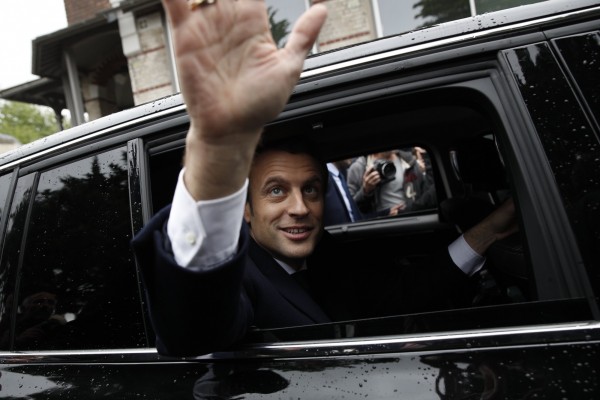
Emmanuel Jean-Michel Frédéric Macron(French: [emanɥɛl makʁɔ̃]; born 21 December 1977) is a French politician, senior civil servant, and former investment banker. Born in Amiens, he studied Philosophy at Paris Nanterre University, completed a Master's of Public Affairs at Sciences Po, and graduated from the École nationale d'administration(ENA) in 2004. He worked as an Inspector of Finances in the Inspectorate General of Finances (IGF) and then became an investment banker at Rothschild & Cie Banque.
A member of the Socialist Party (PS) from 2006 to 2009, Macron was appointed as deputy secretary-general under François Hollande's first government in 2012. He was appointed Minister of Economy, Industry and Digital Affairs in 2014 under the Second Valls Government, where he pushed through business-friendly reforms. He resigned in August 2016 to launch a bid in the 2017 presidential election. In November 2016, Macron declared that he would run in the election under the banner of En Marche!, acentrist[2] political movement he founded in April 2016. He qualified for the runoff after the first round of the election on 23 April 2017.
Early life and education
Born in Amiens, Emmanuel Jean-Michel Frédéric Macron is the son of Françoise (Noguès), a physician, and Jean-Michel Macron, Professor of neurology at the University of Picardy.[3]Raised in a non-religious family, he was baptized a Roman Catholic at his own request at age 12.[1]
He was educated mostly at the Jésuites de la Providence[4] lycée in Amiens[5] before his parents sent him to finish his last year of school[6] at the élite high school Lycée Henri-IV in Paris. He studied Philosophy at the University of Paris-Ouest Nanterre La Défense, obtaining a DEA degree.
He obtained a master's degree in public affairs at Sciences Po, before training for a senior civil service career at the École nationale d'administration (ENA), graduating in 2004.[7]
Professional career
Macron worked as an Inspector of Finances in the French Ministry of Economy between 2004 and 2008. In 2007, he served as deputy rapporteur for the Commission to improve French economic growth headed by Jacques Attali.[5] Macron paid €50,000 to buy himself out of his government contract in 2008,[8] and left to work as an investment banker at a highly-paid position at Rothschild & Cie Banque.[9]
Political career
Macron was a member of the Socialist Party (PS) from 2006 to 2009.[10]
From 2012 to 2014, he served as deputy secretary-general of the Élysée, a senior role in President Hollande's staff.[7] He was appointed as the Minister of Economy and Finance in the second Valls Cabineton 26 August 2014, replacing Arnaud Montebourg.[11]As Minister of the Economy, Macron was at the forefront of pushing through business-friendly reforms. On 17 February 2015, prime ministerManuel Valls pushed Macron's signature law package through a reluctant parliament using the special 49.3 procedure.[12]
In August 2015, Macron stated that he was no longer a member of the PS and was now an Independent.[13]
2017 French presidential bid
Macron founded En Marche! in Amiens on 6 April 2016.[14] A liberal,[15] progressive[16][17]political movement, En Marche!, an independent political party, for which he was reprimanded by President Hollande.[18] On 30 August 2016, Macron resigned from the government ahead of the 2017 presidential election.[19][20] On 16 November 2016, Macron formally declared his candidacy for the French presidency after months of speculation. In his announcement speech, Macron called for a "democratic revolution" and promised to "unblock France".[21]
Macron attracted criticism for the time taken to spell out a formal program during his campaign; despite declaring in November, he had still not released a complete set of proposals by February, attracting both attacks from critics and concern among allies and supporters.[22] He eventually laid out his 150-page formal program on 2 March, publishing it online and discussing it at a marathon press conference that day.[23]
Macron accumulated a wide array of supporters, securing endorsements from François Bayrou of the Democratic Movement (MoDem), MEP Daniel Cohn-Bendit, the ecologist candidate François de Rugy of the primary of the left, and Socialist MP Richard Ferrand, secretary-general of En Marche!, as well as numerous others – many of them from the Socialist Party, but also a significant number of centrist and centre-right politicians.[24]
Political positions
Macron has been described by some observers as a social liberal[25][26][27][28][29] and by others as a social democrat.[30][31][32] During his time in the French Socialist Party, he supported the party's right wing,[33] whose political stance has been associated with "third way" policies advanced by Bill Clinton, Tony Blair and Gerhard Schröder, and whose leading spokesman has been former prime minister Manuel Valls.[34][35][36][37] Overall Macron is largely seen as a centrist.[38][39][40][41][42][43][44]
Economy
Macron has notably advocated in favor of the free market and reducing the public-finances deficit.[45] He first publicly used the term "liberal" to describe himself in a 2015 interview with Le Monde. He added that he is "neither right nor left" and that he advocates "a collective solidarity".[46][47] During a visit to the Vendée in August 2016, he stated, "Honesty compels me to say that I am not a socialist." He explained that he was part of the "left government" because he wanted "to serve the public interest" as any minister would.[48] In his book Revolution, published in November 2016, Macron presents himself as both a "leftist" and a "liberal ... if by liberalism one means trust in man."[49] With his party En Marche!, Macron's stated aim is to transcend the left–right divide in a manner similar toFrançois Bayrou or Jacques Chaban-Delmas, asserting that "the real divide in our country ... is between progressives and conservatives". With the launch of his independent candidacy and his use of anti-establishment rhetoric, Macron has been labelled a "populist" by some observers, notably Manuel Valls, but Macron rejects this term.[50][51]
Macron is a supporter of the El Khomri law he become the most vocal proponent of The economic overhaul of the country.[52]
He has supported the Comprehensive Economic and Trade Agreement (CETA) between Canada and the European Union and criticized the Walloon government for trying to block it.[53] He believes that CETA should not require the endorsement of national parliaments because "it undermines the EU".[54] Regarding the Transatlantic Trade and Investment Partnership (TTIP), Macron stated in June 2016 that "the conditions [to sign the treaty] are not met", adding that "we mustn't close the door entirely" and "need a strong link with the US".[55]
In April 2017, Macron called for a "rebalancing" of Germany's trade surplus, saying that "Germany benefits from the imbalances within the euro zone and achieves very high trade surpluses".[56]
Foreign policy
Macron described France's colonization of Algeria as a "crime against humanity".[57] He also said: "It's truly barbarous and it's part of a past that we need to confront by apologising to those against whom we committed these acts."[58] Polls following his remarks reflected a decrease in his support.[57]
Macron was in 2012 a Young Leader with the French-American Foundation, a pro-American organisation founded in the 1970s by two US members of the Council on Foreign Relations.
In January 2017 he said France needed a more "balanced" policy toward Syria, including talks with Bashar Assad.[59] In April 2017, following the chemical attack in Khan Shaykhun, Macron proposed possible military intervention against Assad regime, preferably under United Nations auspices.[60]
He supports the continuation of President Hollande's policies on Israel, also opposes theBDS movement, and has refused to state a position on recognition of the State of Palestine.[61]
European Union
An article in the New York Times described Emmanuel Macron as "ardently pro-Europe" and stated that he "has proudly embraced an unpopular European Union."[62]
Macron was described by some as europhile[63][64] andfederalist[65][66] but he describes himself as "neither pro-european, eurosceptic nor a federalist in the classical sense",[67] and his party as "the only pro-european political force in France".[68]
In June 2015, Macron and his German counterpart Sigmar Gabriel published a platform advocating a continuation of European integration. They advocate the continuation "of structural reforms (like labor market), institutional reforms (including the area of economic governance)",[69] but also a reconciliation of 'tax and social systems (like better coordination or harmonization of the corporate taxes via, for example, minimum wages)".
He also advocates the creation of a post of the EU Commissioner that would be responsible for the Eurozone and Eurozone's Parliament and a common budget.[70]
In addition, Macron stated: "I'm in favor of strengthening anti-dumping measures which have to be faster and more powerful like those in the United States. We also need to establish a monitoring of foreign investments in strategic sectors at the EU level in order to protect a vital industry and to ensure our sovereignty and the European superiority."[46]
Greece
In July 2015, as Economy Minister, Emmanuel Macron insisted in an interview that any Greece bailout package must also ease their burden by including reductions in the country's overall debt.[71]
In July 2015, while challenging the "loaded question" of the 2015 Greek referendum, Macron called not to cause "automatic ejection" of Greece from the eurozone and "not doing the Versailles Treaty of eurozone" in which case "no" side won.
He believed that the Greek and European leaders co-produced the Greek government-debt crisis,[72] and that the agreement reached in summer 2015 between Greece and its creditors, notably driven by François Hollande, won't help Greece in dealing with the debt, while at the same time criticizing the International Monetary Fund.[73]
In June 2016, he criticized the austerity policies imposed on Greece, considering them to be unsustainable and calling for the joint establishment of "fiscal and financial solidarity mechanisms" and a mechanism for restructuring the debt of eurozone member states.[73]Yanis Varoufakis, Minister of Finance in the First Cabinet of Alexis Tsipras, praised Macron, calling him "the only French Minister in the Francois Hollande's administration that seemed to understand what was at stake in the eurozone" and who, according to him, "tried to play the intermediary between us [Greece] and the troika of our creditors [EC, IMF, ECB] even if they don't allow him to play the role".[74]
Immigration
Unlike many French Socialists, including former Prime Minister Manuel Valls, Macron supports the open-door policy toward immigrants and refugees pursued by Angela Merkelin Germany[75] and promotes tolerance towards immigrants and Muslims.[62] Macron has expressed confidence in France's ability to absorb more immigrants and welcomes their arrival into Europe, asserting that the influx will have a positive economic impact.[76]
However, he believes that Frontex (the European Border and Coast Guard Agency) is "not a sufficiently ambitious program" and has called for more investment in coast and border guards, "because anyone who enters [Europe] at Lampedusa or elsewhere is a concern for all European countries".[54] Regarding asylum policy, he believes "the ... period of review should be considerably shortened" and that "all those whose claims fail must be deported immediately."
Security and terrorism
Macron believes that the proposed reform bill on deprivation of citizenship for French-born and naturalized citizens convicted on terrorism charges was not a "concrete solution" and believes that "the endless prolongation of the state of emergency raises legitimate questions". He advocates an increase in state funding of intelligence agencies.[77]
Macron calls for a restoration of community policing and considers that "the management of some major risks must be delegated to the associations' or the private sector".[78]
He considers that his proposal to provide each young adult a "Culture Pass" of 500€ may encourage young people to discover the culture of France and deter terrorism.[79]
Macron has endorsed proposals to make it mandatory for internet companies to allow the government to access encrypted communications from customers.[80]
Environment
Ahead of the 2015 United Nations Climate Change Conference, Macron called for acceleration of theecological transition and advocated a "balance between ecological imperatives and economic requirements", an objective that the French government seeks to achieve by fighting on "five fronts": "innovation", "simplification", "strengthening of our energy efficiency and [...] reduction of fossil fuels usage", "energy competitiveness" and "action in Europe and worldwide".[81]
During the summer of 2016, he defended the use of diesel fuel for which he believes there shouldn't be a "hunt" since it "remains at the heart of the French industrial policy". Macron expressed this opinion in the aftermath of the Volkswagen emissions scandal. He was then part of a Socialist Party-backed government; prominent members from that party, including Paris mayor Anne Hidalgo, criticized that position.[82][83][84] In addition, Macron is in favor of using nuclear energy which he considers "a French choice and a choice for the future".[85]
In 2016, Macron proposed that France "secures its supplies in the most strategic materials using three levers: the circular economy and the recovery of materials contained in the end of life of the products [...]; The diversification of supplies to overcome geopolitical risks [...] and to bring more competitiveness; the creation of new reasonable sized mines in France, while following the best social and environmental standards".[86]
Although he is sceptical about the construction of the Aéroport du Grand Ouest, Macron believes that the construction should start since the people backed the project on the 2016 local referendum.[87]
Secularism
Macron supports the principle of secularism (laïcité). He also said that "we have a duty to let everybody practice their religion with dignity".[88] In July 2016, at the first meeting of En Marche!, Macron expressed opposition to the ban on Muslim headscarves in universities, stating, "Personally, I do not believe we should be inventing new texts, new laws, new standards, in order to hunt down veils at universities and go after people who wear religious symbols during field trips."[89]
In an interview with the French news magazine Marianne, Macron asserted that "secularism is not designed to promote a republican religion", and responded to comments by Manuel Valls and Jean-Pierre Chevènement regarding the practice of Islam in French society by condemning the notion that citizens should be "discreet" in their religious practice, stating that "historical precedents when we asked for discretion in matters of religion did not bring honor to the Republic."[90]
In the same interview, Macron said of French Muslims, "I ask one thing: absolutely respect the rules while in public. Religious relationships are about transcendence, and I am not asking people to be moderate - that's not what I'm arguing. My own deep conviction is that a practising Catholic may believe that the laws of his religion go far beyond the laws of the Republic. I simply believe that when one enters the public realm, the laws of the Republic must prevail over religious law." He also condemned "religious schools that teach hatred towards the Republic, with instruction mainly in Arabic or, in other instances, which teach the Torah more than basic fundamentals."[90] This statement triggered an intense negative reaction from the Fonds social juif unifié (FSJU), an organization that runs Jewish religious schools in France.[91]
Personal life
Macron is married to Brigitte Trogneux, 24 years his senior,[92] who was his teacher in La Providence High School in Amiens.[93][94] They first met when he was a 15-year-old student in her class, and she was 39, but were officially a couple only after he turned 17.[95][96] His parents initially attempted to separate the couple by sending him away to Paris to finish the final year of his schooling, as they felt his youth made this relationship inappropriate,[6][96]but the couple stayed together after he graduated, and were eventually married in 2007. They live with Trogneux's three children from her previous marriage.[7]
https://en.wikipedia.org/wiki/Emmanuel_Macron


.jpg)

.jpg)