Marion Anne Perrine "Marine" Le Pen(French: [maʁin ləpɛn]; born 5 August 1968) is a French lawyer and politician. She is the former president of the National Front (FN), a political party in France. She is the youngest daughter of long-time FN leader Jean-Marie Le Pen and the aunt of FN MP Marion Maréchal-Le Pen.
Le Pen joined the National Front in 1986 and was elected as a regional councillor (1998–present), a Member of European Parliament(2004–present), and a municipal councillor inHénin-Beaumont (2008–2011). She won the leadership of the FN in 2011 with 67.65% (11,546 votes) of the vote, defeating Bruno Gollnisch and succeeding her father, who had been president of the party since he founded it in 1972.[2][3][4][5][6][7][8] In 2012, she placed third in the presidential election with 17.90% of the vote, behind François Hollande andNicolas Sarkozy.[9][10][11][12] She launched a second bid for the 2017 presidential election, which took place in April 2017. She finished second in the first round of the upcoming election, with 21.30% of the vote, and will faceEmmanuel Macron of En Marche! in the second round on 7 May 2017.
Described as more democratic and republican than her nationalist father, Le Pen has led a movement of "de-demonization of the Front National" to detoxify and soften its image, based on renovated positions and renewed teams, also expelling controversial members accused of racism, antisemitism, or pétainism. She expelled her father from the party on 20 August 2015 after he made new controversial statements.[13][14]
She has also relaxed some political positions of the party, advocating for civil unions for same-sex couples instead of her party's previous opposition to legal recognition of same-sex partnerships, accepting unconditional abortion and withdrawing thedeath penalty from her platform.[15][16][17][18]
Le Pen was ranked among the most influential people in 2011 and 2015 by the Time100.[19][20] In 2016, she was ranked as second-most influential MEP in the European Parliament by Politico, just behind thePresident of the European Parliament Martin Schulz.[21]
Early life
Childhood
Marion Anne Perrine Le Pen was born on 5 August 1968[22] in Neuilly-sur-Seine. She is the youngest of the three daughters of Jean-Marie Le Pen, a Breton politician and a formerparatrooper, with his first wife Pierrette Lalanne. She was baptized 25 April 1969, at La Madeleine by Father Pohpot. Her godfather was Henri Botey, a relative of her father.
She has two sisters: Yann and Marie Caroline. In 1976, Marine survived a bomb attack on the family as they slept in their beds.[23] She was eight when a bomb meant for her father exploded in the stairwell outside the family's apartment. The blast ripped a hole into the outside wall of the building. Marine, her two older sisters and their parents were unharmed.[24]
She was a student at the lycée Florent Schmitt at Saint-Cloud. Her parents divorced in 1987.[25][26]
Legal studies and work
uestion_book-new.svg">  |
This section relies largely or entirely upon a singlesource. Relevant discussion may be found on the talk page. Please help improve this article by introducing citations to additional sources. (February 2017) |
Le Pen studied law at Panthéon-Assas University, graduating with a Master of Laws in 1991 and a Master of Advanced Studies (DEA) in criminal law in 1992.[27] Registered at the Paris bar association, she worked as a lawyer for six years (1992–1998).[27] In France - as in many other countries - when a defendant cannot afford a lawyer, one is chosen to represent them. She often fulfilled this role.
In 1992, she received the certificate as a lawyer (CAPA) and became a lawyer practising in Paris. She then argued regularly before the criminal chamber of the 23rd District Court of Paris which judges immediate appearances. She was a member of the Bar of Paris until 1998, when she joined the legal department of the National Front.
Private life
Le Pen was raised Roman Catholic.[28] She was married in 1995 to Franck Chauffroy, a business executive who worked for the National Front. By Chauffroy, she has three children (Jehanne, Louis, and Mathilde).[25] After her divorce from Chauffroy in 2000, she married Eric Lorio in 2002, the former national secretary of the National Front and a former adviser to the Regional election in Nord-Pas de Calais, whom she divorced in 2006.
Since 2009, she has been in a relationship with Louis Aliot, who is of ethnic French Pied-Noir and Algerian Jewish[29] heritage. He was the National Front General Secretary from 2005 to 2010, then the National Front vice president who was in charge of the Project.[30]She spends most of her time in Saint-Cloud, and has resided in La Celle-Saint-Cloud with her three children since September 2014. She has an apartment in Hénin-Beaumont. In 2010, she also bought a house with Aliot in Millas.[31]
Early political career
First steps and rise within National Front: 1986–2010
In 1986, at the age of 18, Marine Le Pen joined the FN. In 2000, she became president ofGenerations Le Pen, a loose association close to the party aimed at "de-demonizing the Front National".[25] In 1998, she joined the FN's juridical branch, which she led until 2003.
In 2000, she joined the FN Executive Committee (bureau politique). In 2003, she became vice-president of the FN.[25] In 2006, Jean-Marie Le Pen entrusted her with the management of his 2007 presidential campaign. In 2007, she became one of the two executive vice-presidents of the FN and was in charge of training, communication and publicity.[27]
In 1998, she acquired her first political mandate when she was elected regional councillor in the Nord-Pas-de-Calais. From 2002, she began to establish her parliamentary base in the former coal mining area of the Pas-de-Calais.[25]
Her aim is to expand the political influence of the FN and transform it into a "big popular party that addresses itself not only to the electorate on the right but to all the French people".[4] She has frequently stated that she rules out any political alliance with the Union for a Popular Movement.[32][33]
She has at numerous times distanced herself from some of Jean-Marie Le Pen's controversial statements,[34] notably those relating to war-crimes, which the media point to her attempts to improve the party's image. While her father has provoked a long-time controversy by saying that the gas chambers were "a detail of the history of World War II", she said it has been "the height of barbarism".[35][36]
Internal campaign for the FN leadership: 2010–11
Her candidacy was endorsed by an overwhelming majority of senior executives[37] and notably by Jean-Marie Le Pen, founder of the FN.[38][39]
She spent four months campaigning for the FN leadership, holding meetings with FN members in 51 departments to explain in detail her political views and projects for the party.[40] All the other departments were visited by one of her official supporters.[37]
On 3 September 2010, she launched her internal campaign at Cuers, Var.[41] During a meeting in Paris on 14 November 2010, she claimed: "My project is not to assemble our political family, or rather is not only to assemble our political family. It consists of shaping the Front National as the center of grouping of the whole French people". She also explained why the FN leadership and the candidature for the presidential election must not be dissociated: thus the next FN leader will run in the 2012 presidential election.[42] During her final meeting at Hénin-Beaumont on 19 December 2010, she claimed that the FN presents the real debates of the next presidential campaign.[43][44] Most of her campaign tours throughout France were reported in local newspapers and regional television programmes.
In December 2010 and early January 2011, FN members voted by post to elect their new president and the hundred members of the Central Committee. The party held its congress at Tours for two days (15–16 January 2011).[45] On 16 January 2011, Marine Le Pen was officially elected with 67.65% (11,546 votes) as the new president of the Front National[27][46] and Jean-Marie Le Pen became de facto its honorary chairman. Her challenger Bruno Gollnisch polled 32.35% (5,522 votes).
Controversy
Marine Le Pen stirred up controversy during the internal campaign. During a speech to the party faithful in Lyon on 10 December 2010, she said that the weekly illegal blocking of public streets and squares in multiple French cities (notably the rue Myrha in the 18th arrondissement of Paris) for Muslim prayers was comparable with an occupation of parts of French territory. Specifically, Le Pen said:
For those who want to talk a lot about World War II, if it's about occupation, then we could also talk about it (Muslim prayers in the streets), because that is occupation of territory ... It is an occupation of sections of the territory, of districts in which religious laws apply ... There are of course no tanks, there are no soldiers, but it is nevertheless an occupation and it weighs heavily on local residents.[47]
The mention of World War II brought claims from the media and politicians that she had drawn an irresponsible parallel with the Nazi occupation of France (May 1940 – December 1944).[48] Nearly the entire political and media class strongly criticised her statement, which was widely commented on by different political analysts.[49][50][51][52][53][54] Whereas theCRIF,[55] the French Council of Muslim Faith (CFCM)[56] and the LICRA[57] denounced her statement, other groups like the MRAP[58] and the LDH[59] declared their intention of lodging a formal complaint. The imam of the Great Mosque of Paris and former president of the CFCM, Dalil Boubakeur, claimed that though her parallel was questionable and condemnable, she had asked a valid question.[60]
A member of the FN's Executive Committee, Louis Aliot, denounced "the attempted manipulation of opinion by communitarian groups and those really responsible for the current situation in France".[61] On 13 December 2010, she confirmed her statement during a press conference held in the FN's headquarters in Nanterre.[62][63][64] After Jean-François Kahn's comments on BFM TV on 13 December 2010, she denounced "state manipulation" mounted from the Elysée with the intention of demonizing her in public opinion.[65][66]
On 15 December 2015, the Lyon court acquitted her of "inciting hatred", considering that her statement "did not target all of the Muslim community" and was protected "as a part of freedom of expression".[67]
Media rise (2002–2011)
National media
Marine Le Pen on 25 April 2005
Her various appearances on television and radio have played an important role in her political rise at national and local levels. Her political personality regularly attracts the attention of the French media[68][69][70][71][72] as well as the European,[26][73][74][75][76] the Middle Eastern[77][78] and the US press.[79][80][81]
On 5 May 2002, after the run-off in the 2002 presidential election, she took part in a televised debate on France 3. Political analysts compared her appearance to a "media baptism" and claim that her political emergence has its roots in this debate.
During the programme Mots croisés (Crossed Words) onFrance 2 on 5 October 2009,[82] Marine Le Pen quoted sections of Frédéric Mitterrand's autobiographical novel The Bad Life, accusing him of having sex with underage boys and engaging in "sex tourism", demanding his resignation as a Minister of Culture.[83][84][85][86] According to French political commentator Jérôme Fourquet, during the Mitterrand case she broke through and gained a media ascendancy over the party.[87]
Hosted on France 2 by journalist and commentator Arlette Chabot, À vous de juger (You Be The Judge) was one of France's foremost political programmes. For her first appearance as a guest debater on 14 January 2010, Marine Le Pen opposed Éric Besson, then Minister of Immigration, Integration, National Identity and Mutually Supportive Development.[88]
For her first appearance as a main guest on 9 December 2010, she was successively questioned on economic, societal and immigration matters by Arlette Chabot and political commentator Alain Duhamel, then debated with the socialist mayor of Évry Manuel Valls and finally was matched against Rachida Dati, former Minister of Justice.[89] Her appearance attracted 3,356,000 viewers (14.6% of the televised audience),[90] which represented the highest viewing figures for 2010 and the fourth best since the start of the series in September 2005.[91]
In December 2010, French journalist Guillaume Tabard described her as the "revelation of the year". He further described her as "first an electoral phenomenon" and "a media phenomenon after".[92]
Hosted on France 2 by journalist and anchorman David Pujadas, Des paroles et des actes(Words and Acts) replaced À vous de juger. For her first appearance as a main guest on 23 June 2011, Le Pen opposed Cécile Duflot, national secretary of the Greens.[93][94] Her appearance attracted 3,582,000 viewers which represented 15.1% of the televised audience.[95][96]
Hosted on TF1 by anchorwoman Laurence Ferrari and political commentator François Bachy, Parole directe (Direct Speech) is one of France's foremost political programmes. For her first appearance as a sole guest on 15 September 2011, Le Pen attracted an average of 6 million viewers (23.3% of the televised audience) with a peak of 7.3 million in the second half of the programme.[97][98]
International media
At an international level, she was invited by the Quebec web-radio Rockik in December 2008,[99] the Canadian Broadcasting Corporation (Radio Canada) in May 2010[100] and the Israeli radio 90FM in March 2011.[101] In March 2011, she appeared on the front cover page of The Weekly Standard magazine with the heading "The Future of the European Right?".[102] During a press conference organized on 13 January 2012 by the European American Press Club, she spoke in front of international journalists about various topical and thematic issues.[103]
On 4 April 2011, she appeared for the first time as a candidate in the 2011 Time 100Poll.[104] On 21 April, she was listed in the 2011 Time 100.[19] Vladimir Zhirinovsky, leader of the far-right Liberal Democratic Party of Russia and vice chairman of the State Duma, wrote a commentary about her political destiny.[105]
In October 2011, she presented her book in Verona, Italy and met Assunta Almirante, the widow of the far-right MSI leader Giorgio Almirante.[106] The logo of the Front National was inspired by MSI logo.
In February 2013, she spoke at the Cambridge Union Society, the University of Cambridge's debating society. Her appearance sparked controversy, with anti-fascist groupUnite Against Fascism opposing her invitation on a No Platform basis and organising a demonstration of about 200 people outside the venue.[107][108] The protests were supported by numerous Cambridge societies, including Cambridge University Students' Union and Cambridge Universities Labour Club, however others, notably the Cambridge Libertarians,[109] supported her right to freedom of expression.
President of the FN
De-demonization of the FN
From a general point of view, Marine Le Pen is often judged more moderate than her father. A part of the French electorate considers her positions more nuanced, polished and detoxified than Jean-Marie Le Pen's "provocations". Her smiling, calm image contrasts with much of the stereotypes generally attributed to her political family.[110] At the beginning of her media rise, she often talked about her particular treatment as the daughter of "Le Pen" and of the 1976 attack (then the biggest bomb explosion in France since World War II).[110][111] It has been seen as a way to humanize her party.[110][112]
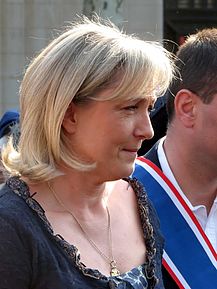
Marine Le Pen in the traditional
Jeanne d'Arc march, 3 May 2007
For example, Bernard-Henri Lévy, a strong opponent of the FN, talked about "a far-right with a human face".[113]Journalist Michèle Cotta claims that the fact she is a young woman condemning racism and refusing her father's "faults" (notably his enjoyment of shocking other people) contributed to her strategy of de-demonization of the National Front.[114] References to World War II or to theFrench colonial wars are absent from her speeches, which is often looked on as a generation gap.[115] She distanced herself from her father on the gas chambers he famously called "a detail in the history of World War II", saying that she "didn't share the same vision of these events".[116]L'Express wrote that the expulsion of Jean-Marie Le Pen in 2015 was the completion of her endeavour. The opponents of the FN denounce a more dangerous strategy because of its evident success.[117]
In a 2010 RTL interview, Le Pen stated that her strategy was not about changing the FN's program but about showing it as it really is, instead of the image given to it by the media in the previous decades. The media and her political adversaries are accused of spreading an "unfair, wrong and caricatural" image of the National Front. She refuses the qualification of far-right or extreme-right, considering it a "perjorative" term : "How am I party of the extreme right? ... I don't think that our propositions are extreme propositions, whatever the subject".[118] However, the radical far-right (e.g., Minute, Rivarol, Patrick Buisson, Henry de Lesquen) reproached her for abandoning or softening her stance on immigration, gay marriage and abortion. In her speech in Lyon on 10 December 2010, she mentioned the fate of gays living in difficult neighbourhoods, victims of religious laws replacing the republican law.[119][120][121]
In 2014, the American magazine Foreign Policy mentioned her, along with four other Frenchmen, in its list of the 100 global thinkers of the year, underlining the way she "renovated the image" of her party, which had became a model for other right-wing parties in Europe after her success in the European elections.[122] At a European level, she stopped the alliance built by her father with some right-wing extremist parties and refused to be part of a group with the radical Jobbik or the neo-nazi Golden dawn. Her transnational allies share the fact that they have officially condemned antisemitism, accepted a more liberal approach toward social matters and to be sometimes pro-Israel such as the DutchPVV. French historian Nicolas Lebourg concluded she is looked upon as a compass for them in order to copy while maintaining local particularities.[123][124]
For a long time, she has been reluctant to endorse Donald Trump, while other European populists have already embraced his candidacy, and only supported him by saying: "For France, anything is better than Hillary Clinton". However, on 8 November 2016 she posted a tweet congratulating Trump on his presidential victory.[125] Nevertheless, her strategy has difficulties as her image seems to remain controversial: Germany's Angela Merkel has said she will "I will contribute to make other political forces be stronger than the National Front" and Israel still holds a bad opinion of her party.[126][127] Nigel Farage has said : "I've never said a bad word about Marine Le Pen; I've never said a good word about her party".[128]
Her social program and her support of SYRIZA in the 2015 Greek general elections have led Nicolas Sarkozy to declare her a far-left politician sharing some of Jean-Luc Mélenchon's propositions. President François Hollande said she was talking "like a leaflet of the Communist Party". Eric Zemmour, journalist for the conservative newspaper Le Figaro, wrote during the 2012 presidential election that the FN had become a left-wing party under the influence of Florian Philippot. She has also relaxed some political positions of the party, advocating for civil unions for same-sex couples instead of her party's previous opposition to legal recognition of same-sex partnerships, accepting unconditional abortion and withdrawing the death penalty from her platform.[129][130][15][16][17][18]
First steps as a new leader: 2011
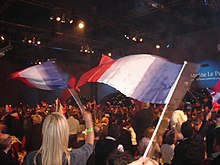
Supporters of Marine Le Pen in 2011
As a president of the Front National, Marine Le Pen currently sits as an ex officio member among the FN Executive Office (8 members),[131] the Executive Committee (42 members)[132] and the Central Committee (3ex officio members, 100 elected members, 20 co-opted members).[133]
During her opening speech in Tours on 16 January 2011, she advocated to "restore the political framework of the national community" and to implement the direct democracywhich enables the "civic responsibility and the collective tie" thanks to the participation of public-spirited citizens for the decisions. The predominant political theme was the uncompromising defence of a protective and efficient State, which favours secularism, prosperity and liberties. She also denounced the "Europe of Brussels" which "everywhere imposed the destructive principles of ultra-liberalism and free trade, at the expense of public utilities, employment, social equity and even our economic growth which became within twenty years the weakest of the world".[134]
After the traditional Joan of Arc and Labor Day march in Paris on 1 May 2011, she gave her first speech in front of 3000 supporters.[135][136] On 11 August 2011, she held an exceptional press conference about the current systemic crisis.[137]
On 10 and 11 September 2011, she made her political comeback with the title "the voice of people, the spirit of France" in the convention center of Acropolis in Nice.[138] During her closing speech on 11 September 2011, she tackled the audience about immigration, insecurity, the economic and social situation, reindustrialization and 'strong state'.[139]
During a demonstration held in front of the Senate on 8 December 2011, she expressed during a speech her "firm and absolute opposition" to the right of foreigners to vote.[140]
She regularly holds thematic press conferences[141] and interventions[142] on varied issues in French, European and international politics.
First presidential candidacy: 2011–12

Marine Le Pen sings "
La Marseillaise" at the conclusion of the presentation of her presidential project held in Paris on 19 November 2011.

Marine Le Pen present her presidential project on 19 November 2011 in
Paris.
Marine Le Pen stood in the 2012 French presidential election. On 16 May 2011, her presidential candidacy was unanimously validated by the FN Executive Committee.[143] On 10 and 11 September 2011, her political comeback in Nice prefigured the launching of her presidential campaign.[139] During a press conference on 6 October 2011, she officially unveiled the line-up of her presidential campaign team.[144]
On 19 November 2011, she presented in Paris the main thematic issues of her presidential project: sovereign people and democracy, Europe, reindustrialization and strong state, family and education, immigration and assimilation versus communitarianism, geopolitics and international politics.[145][146][147] During a press conference held on 12 January 2012,[148] she presented in detail the assessment of her presidential project[149] and a plan of debt paydown of France.[150] During a press conference held on 1 February 2012, she presented an outline of her presidential project for the overseas departments and territories of France.[151] Many observers have noticed her tendency to enhance economical and social subjects such as globalization and delocalisations, instead of immigration or law and order which have been the paramount platform of the FN in previous decades.
On 11 December 2011, she held her first presidential meeting in Metz.[152][153] From early January to mid April 2012, she held weekly meetings in the major French cities. On 17 April 2012, between 6,000 and 7,000 people took part in her final meeting organized at theZenith in Paris.[154][155]
On 13 March 2012, she publicly announced that she had the 500 necessary signatures to take part in the presidential election.[156][157] On 19 March 2012, the Constitutional Councilofficially validated her candidature and those of nine others competitors.[9]
On 22 April 2012, she polled 17.90% (6,421,426 votes) in the first round and finished in third position behind François Hollande and incumbent president Nicolas Sarkozy.[10][11][12]Her national result was higher in percentage and votes than those of Jean-Marie Le Pen in the 2002 presidential election (16.86%, 4,804,772 votes in the first round; 17.79%, 5,525,034 votes in the run-off).[158]
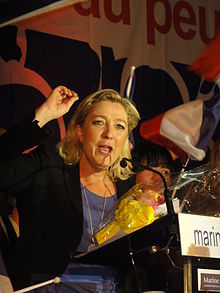
Marine Le Pen in her presidential campaign, on 15 April 2012.
r%C3%A9sidentielle_fran%C3%A7aise_2012_premier_tour.png">

r%C3%A9sidentielle_fran%C3%A7aise_2012_premier_tour.png">
First round results : candidates with the most votes by departments (mainland France, overseas and French citizens living abroad). Marine Le Pen came first in Gard.
She was ahead in Gard(25.51%, 106,646 votes) whereas Sarkozy and Hollande respectively polled 24.86% (103,927 votes) and 24.11% (100,778 votes).[11][159]She came first in her municipal stronghold of Hénin-Beaumont (35.48%, 4,924 votes) whereas Hollande and Sarkozy respectively polled 26,82% (3,723 votes) and 15,76% (2,187 votes).[160] She globally achieved her highest results east of a line from Le Havre in the north to Perpignan in the south.[161] In contrast, she globally polled less in western France, especially big cities such as Paris, overseas and among the French citizens living abroad (5.95%, 23,995 votes).[162] However, she got significative results in two rural departments in western France such as Orne (20.00%, 34,757 votes)[163] and Sarthe (19.17%, 62,516 votes).[164]
She achieved her highest regional result in Picardy (25.03%, 266,041 votes),[165] her highest departmental result in Vaucluse (27.03%, 84,585 votes),[166] her highest overseas result in Saint Pierre and Miquelon (15.81%, 416 votes).[167]
In addition to Picardy, she also polled over 20% in ten other regions: Corsica (24.39%, 39,209 votes),[168] Champagne-Ardenne (23.91%, 172,632 votes),[169] Provence-Alpes-Côte d'Azur (23.87%, 650,336 votes),[170] Lorraine (23.66%, 308,392 votes),[171]Languedoc-Roussillon (23.45%, 363,880 votes),[172] Nord-Pas-de-Calais (23.29%, 517,115 votes),[173] Alsace (22.12%, 219,252 votes),[174] Franche-Comté (21.29%, 141,972 votes),[175] Burgundy (20.36%, 191,148 votes),[176] Upper Normandy (20.15%, 207,520 votes).[177] In addition to Vaucluse, she also polled over 25% in nine other departments :Aisne (26.33%, 78,452 votes),[178] Meuse (25.82%, 29,038 votes),[179] Corse-du-Sud(25.71%, 19,081 votes),[180] Pas-de-Calais (25.53%, 216,753 votes),[181] Gard (25.51%, 106,646 votes),[159] Haute-Marne (25.26%, 27,624 votes),[182] Aube (25.12%, 40,740 votes),[183] Haute-Saône (25.12%, 36,807 votes),[184] Oise (25.08%, 109,339 votes).[185] In addition to Saint Pierre and Miquelon, she also polled over 10% in the Collectivity of Saint Martin (12.51%, 665 votes),[186] in New Caledonia (11.66%, 10,409 votes),[187] in Saint Barthélemy (11.41%, 310 votes),[188] in French Guiana (10.48%, 3,920 votes)[189] and inRéunion (10.31%, 37,549 votes).[190]
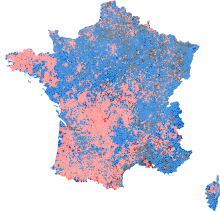
First round results : candidates with the most votes by municipalities in metropolitan France (dark gray : Marine Le Pen)
She achieved her lowest regional result in Île-de-France (12.28%, 655,926 votes),[191] her lowest departmental result in Paris (6.20%, 61,503 votes),[192] her lowest overseas result in Wallis and Futuna (2.37%, 152 votes).[193]
In addition to Île-de-France, she polled less than 15% inBrittany (13.24%, 262,095 votes)[194] and in Pays de la Loire (14.39%, 308,806 votes).[195] In addition to Paris, she polled less than 10% in Hauts-de-Seine (8.51%, 62,447 votes).[196] In addition to Wallis and Futuna, she polled less than 5% in Mayotte (2.77%, 996 votes)[197] and inMartinique (4.76%, 6,960 votes).[198]
A French sociologist, Sylvain Crépon, who analysed the social and occupational groups of the FN voters in 2012, explained: "The FN vote is made up of the victims of globalisation. It is the small shopkeepers who are going under because of the economic crisis and competition from the out-of-town hypermarkets; it is low-paid workers from the private sector; the unemployed. The FN scores well among people living in poverty, who have a real fear about how to make ends meet."[161] Crépon also analysed the increase of the FN vote in "rural" areas and the recent sociological changes in these areas made up of small provincial towns and new housing-estate commuter belts built on the distant outskirts of the cities: "The rural underclass is no longer agricultural. It is people who have fled the big cities and the inner suburbs because they can no longer afford to live there. Many of these people will have had recent experience of living in the banlieues (high immigration suburbs) – and have had contact with the problems of insecurity."[161]Commentators also pointed that there are more young people and women voting for the party in 2012.[161]
During a speech delivered in Paris on 1 May 2012 after the traditional Joan of Arc and Labor Day march, she has refused to back either incumbent president Sarkozy or socialist Hollande in the run-off on 6 May. Addressing the party's annual rally at Place de l'Opéra, she vowed to cast a blank ballot and told her supporters to vote with their conscience, saying: "Hollande and Sarkozy – neither of them will save you. On Sunday I will cast a blank protest vote. I have made my choice. Each of you will make yours." Accusing both candidates of surrendering to Europe and financial markets, she asked: "Who between Francois Hollande and Nicolas Sarkozy will impose the austerity plan in the most servile way? Who will submit the best to the instructions of the IMF, the ECB or the European Commission?"[199]
Electoral progression: 2012–16
In the wake of her success, she announced the foundation of the "Blue Marine Gathering", an electoral coalition dedicated to the June parliamentary elections. Herself a candidate in the Pas-de-Calais' 11th constituency, she collected 42,36% of the vote, far before the Socialist representative Philippe Kemel (23.50%) and her far-left rival Jean-Luc Mélenchon(21.48%). She was beaten in the second round with 49.86%. She filed an appeal rejected by the constitutional Council which however recognized some proven deceptions. Nationally, her party has only elected two lawmakers: her niece Marion Maréchal-Le Penand Gilbert Collard.
In 2014, she led her party to other success in the municipal and senatorial elections: eleven mayors and two senators were elected. It was the first time the National Front entered in France's upper chamber.
ille_-_Meeting_de_Marine_Le_Pen_pour_les_%C3%A9lections_r%C3%A9gionales,_le_30_novembre_2015_%C3%A0_Lille_Grand_Palais_(39).JPG">
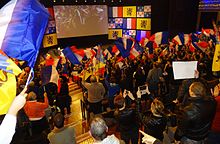
ille_-_Meeting_de_Marine_Le_Pen_pour_les_%C3%A9lections_r%C3%A9gionales,_le_30_novembre_2015_%C3%A0_Lille_Grand_Palais_(39).JPG">
France's regional elections in 2015
On 24 May 2014, the National Front won the European election in France with 24.90% of the vote. Marine Le Pen came in first place in her North-West constituency with a score of 33.60%. 25 FN members were sent to theEuropean Parliament of Strasbourg. They voted against the Juncker Commission in July. One year later, she was able to announce the formation of a group composed of the French National Front, the Freedom Party of Austria, the Italian Lega Nord, the Dutch Party for Freedom, the PolishCongress of the New Right, the Flemish Vlaams Belang and former UKIP member Janice Atkinson. Her first attempt to constitute this group in 2014 failed because of the UKIP refusal and of controversial statements of her father Jean-Marie Le Pen in June. Le Pen sat in the commission for international trade. In 2016, Politico ranked her as the second most influential MEP after Martin Schulz.
In April 2015, her father provoked a political crisis in the National Front because of two interviews he gave. Some controversial statements included his opinion on World War IIand on minorities in France. Marine Le Pen organized a postal vote to ask the FN members to change the statuts of the party in order to expel her father. Le Pen père pursued his movement and the justice canceled the vote. On 25 August, the FN executive Office voted to expel him from the party he had founded forty years earlier. Many observers noticed her dependence on her closest advisor, Florian Philippot, a former left-wing technocrat. A national purge expelled the members refusing the evolution of the FN under Marine Le Pen's leadership.
She tardily announced her candidacy for the presidency of the regional council of Nord-Pas-de-Calais-Picardie for the 2015 regional elections. She regretted the proximity with the next presidential election. On 6 December, she came in first with 40.6% of the vote. But the Socialist candidate (third with 18.12%) withdrew and called to vote for her right-wing opponent Xavier Bertrand who won by 57.80% of the vote. Her niece Marion also lost but got a better result than her.
Second presidential candidacy: 2016–17

Marine Le Pen’s 2017 campaign logo
Excepting the candidates for the center-right primary, Marine Le Pen was the first to announce her candidacy for the 2017 French presidential election on 8 April 2016. She consistently maintained high popularity in polling figures. She has appointed David Rachline, a young FN member of the Senate, as her campaign manager. The FN had difficulties finding funding because of the opposition of every French bank to her political platform. This led to the National Front borrowing €9 million from the First Czech-Russian bank in Moscow in 2014, even as the E.U. placed sanctions on Russia for annexing Crimea. In February 2016, the FN asked Russia for another loan, this time in the amount of €27 million. The loan has not materialized.[200]
ille_-_Meeting_de_Marine_Le_Pen_pour_l%27%C3%A9lection_pr%C3%A9sidentielle,_le_26_mars_2017_%C3%A0_Lille_Grand_Palais_(132).JPG">

ille_-_Meeting_de_Marine_Le_Pen_pour_l%27%C3%A9lection_pr%C3%A9sidentielle,_le_26_mars_2017_%C3%A0_Lille_Grand_Palais_(132).JPG">
Marine Le Pen in her presidential campaign, on 26 March 2017.
Most political analysts notice her strong position because of the absence of a primary in her party (consolidating her leadership), of the news such as the migrants crisis or the terrorist attacks in France (reinforcing her political positions) and of the very right-wing campaign of Nicolas Sarkozy in the Republican primary (enlarging her themes). In a 2016 interview with the BBC, Le Pen stated thatDonald Trump's presidential victory will in fact help her in the 2016–2017 presidential race. In her opinion, Mr Trump has "made possible what had previously been presented as impossible".[201] However, she stated she would not officially launch her campaign before February 2017, waiting for the results of the Republican and Socialist primaries, and preferred to remain silent in the media and usher thematic think tanks dedicated to the elaboration of her program. In consequence, her rare media appearances attract consistent audiences (2.3 million viewers for Vie politique on TF1 on 11 September 2016 and 4 million for Une ambition intime on M6 on 16 October).
The communication of her party also attracts media attention: a new Mitterrand-inspired poster showing her in a rural landscape with the slogan "Appeased France" is an attempt to respond to surveys indicating she remains somewhat controversial for an important part of the French electorate. But the mockeries sparked by this poster led to a change of slogan: "In the name of the people". Others have noticed the disappearance of the FN logo and of the name Le Pen on the campaign's posters.
She officially launched her candidacy on 4 and 5 February 2017 in Lyon. Le Pen promised a referendum in which the nation would decide whether to withdraw from the European Union if she could not achieve France's territorial, monetary, economical and legislative goals in a six-month renegotiation with the EU. Her first appearance on TV four days later generated the highest viewing figures of France 2 since the previous presidential election (16.70% with 3.7 million telespectators).[202]
On 2 March 2017, the European Parliament voted to revoke Le Pen's immunity from prosecution for tweeting violent imagery. Le Pen had tweeted an image of beheaded journalist James Foley in December 2015. She took down the tweet following a request from Foley's family. In an unrelated case, Le Pen faces prosecution for allegedly spending European Union Parliament funds on her own political party; the lifting of her immunity from prosecution does not apply to the ongoing investigation into the misuse of parliamentary funds by the FN.[203]
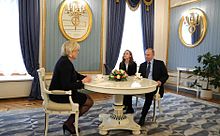
Marine Le Pen and Vladimir Putin in Moscow on 24 March 2017
Le Pen has met with several incumbent heads of state including Lebanon's Michel Aoun,[204] Chad's Idriss Déby,[205] and Russia's Vladimir Putin.[206]
The ground floor of the building which housed Le Pen's campaign headquarters was targeted by an arson attempt during the early morning of 13 April, 2017.[207][208]
In 2017, Le Pen argued that France as a nation bore no responsibility for the Vel' d'Hiv Roundup, a part of the Holocaust in which Paris policemen arrested Jewish citizens for deportation to Auschwitz. She repeated a gaullist thesis according to which France was not represented by the Vichy regime but by General de Gaulle's Free France.
On 20 April 2017, in the wake of a shooting targeting police officers that was treated as a suspected terrorist attack, Le Pen canceled a planned campaign event. The next day, she called for the closure of all mosques, a remark that received criticism from the French Prime Minister, Bernard Cazeneuve, who accused her of attempting to "capitalize" on the incident. She also called for the expulsion of hate preachers and people on the French security services' watch list, and the revocation of their citizenship. The Guardian noted that the attack may serve as "ammunition" for right-wing candidates in the election, such as Le Pen.[210][211]
On April 21, 2017, United States President Donald Trump wrote on Twitter that the shooting would have "a big effect on presidential election."[212] Later on the same day, Trump stated that Le Pen was the "strongest on borders, and she’s the strongest on what’s been going on in France."[213] On the other hand, former U.S. President Barack Obamaexpressed his support for Macron in a phone call to him.[214]
Le Pen won 23.3% of the vote in the first round of the election on 23 April 2017, placing her second behind Macron, who got 24.0%.[215] She will face Macron in the run-off on 7 May.
On 24 April 2017, a day after the first round, Le Pen announced that she would temporarily step down as the leader of the National Front in an attempt to unite voters.[1] "The President of the Republic is the president of all the French people, they must bring them all together," she said.[216]
Political positions
Economy
Marine Le Pen contends that the FN's immigration programme is better known among the voters; she thus concentrates on the party's economic and social programme.[217][218]

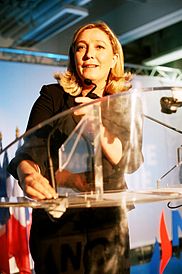
On 17 October 2011, in front of the French
Dexia headquarters in
La Défense, Marine Le Pen holds a press conference about the systemic banking crisis
Opposed to free trade and autarky, she advocatesprotectionism as a median way. She has used a raging river as a metaphor for the economy; she has used this metaphor to say that free trade is like allowing the torrent to rush along unchecked and autarky equates to the erection of a dam whereas protectionism is to install a sluice gate. "Protectionism is not autarky! ... Our position is not extreme – as our opponents would have it believed – but one which favours the middle way".[42]
In 2010, she vigorously criticized the pension plan drawn up by Nicolas Sarkozy and his liberal-conservative government.[219][220]
She paid tribute to the economist Maurice Allais, who died on 9 October 2010.[221] A French laureate of the Nobel Prize in Economics (1988), Allais had expressed concerns about the 1992 Maastricht Treaty, the single European currency, free trade andglobalization and the 2004 European Constitution.[222][223]
She favours the repeal of the oi sur la Banque de France" href="https://fr.wikipedia.org/wiki/Loi_sur_la_Banque_de_France">1973 Pompidou-Giscard Law, which makes it illegal for France to borrow at zero or a low rate of interest from the Banque de France and forces the country to borrow at higher rate on the international financial markets. In her view, the national debt has grown steeply because of this law. She claimed that in 2010 France had already refunded 1.355 trillion euros of accrued interest on loans at a time when the national debt represented around 1.650 trillion euros.[218][224]
She has expressed support for the French public utilities, the civil servants, and the general public interest.[225][226] She thus opposes the programmed privatization of the French Post Office (La Poste) : in her view, "the privatization, with the aim of only making profitable, will result in the removal of post offices in the rural areas where the relinquishment of the state is already high". In October 2009, she claimed that three post offices had already disappeared each day in France since 1 January 2009.[227][228] She said that theliberalization of the French public utilities had been ratified by the former Prime MinisterLionel Jospin during the Barcelona summit on 15 and 16 March 2002.[229][230] She had also warned that the UMP government planned a "progressive privatization of the French Social Security system from 2011" – a condition imposed by the financial markets.[231]
During a press conference in June 2011, she advocated to reintroduce the Havana Charterand implement an "International Trade Organization" (in place of World Trade Organization), in order to reorganize the world trade exchanges.[232] Signed by 53 countries and rejected by the US in 1951, this Charter was a trade agreement that would have established an international currency known as the bancor.[233] She claimed that the "Havana Charters's proposals perfectly fit into her economic philosophy"[232] and that "its first article conciliates international trade and employment".[234]
During her speech at the National Press Club in Washington, D.C. in November 2011, she proposed "three essential solutions to stop the current world systemic crisis and turn the world towards a greater justice and greater prosperity": reintroduction of a "polymetallic standard" in the International monetary systems as a world standard of reference and exchanges in order to establish a "free monetary system" and struggle against speculation; the ratification of the modernized Havana Charter by the 1948 signatory nations and incoming emerging countries, in order to favour a "reasonable protectionism that encourages cooperation in trade among nations through the end of 'unbridled free trade'"; application of the 1933 Glass–Steagall Act, which legally separated investment banking and commercial banking, to "the banking system of each country".[233][234] In her view, these solutions will be able to bring a global support for employment thanks to the integration of "full employment" appearing as one of the main targets of the Havana Charter and for industry thanks to the authorization of state aids appearing in the Charter's article 13.[234]
In October 2011, she advocated to implement a drastic regulation of the banking sector separating by law the deposit banks from the merchant banks. She claimed that "the deposit banks should be rescued by a temporary and partial nationalization". In her view, "the balance sheet of the banks should be the object of a transparency operation".[235]
In October 2011, she suggested 7 measures to save €30 billion per year in order to preserve France's AAA credit rating.[236] The largest part of the measures are made up of avoiding fraud on welfare payments and avoidance of tax loopholes (together €18.5 bn), stopping non-useful local spending (€4bn) as well as stopping payments of France to the EU (€7bn).
A president of the Mouvement des Entreprises de France (MEDEF), Laurence Parisotregularly levels strong criticism at the FN's economic and social programme.[237] She replied that "the FN is not the friend of the CAC 40 and is fighting the social regression brought about by the MEDEF and inflicted on the French people by the allies of the UMP and the PS".[238] After Parisot's new criticism, she claims that "the philosophy of the FN's economic project comes down to some words: construction of a strong, protective and strategist state, reasoned protections at the boundaries, support to the small and medium enterprises, and get back the monetary sovereignty, only able to assure France's recovery".[239] She also replied that "Laurence Parisot, this is the exact opposite of her democratic and republican project, a project of hope which puts back man and nation in the center of politics".[240] After the publication of Parisot's critical book relating to the FN economic project, she suggested a "direct and public debate" with the president of the MEDEF.[241]
Agriculture and environment
In her view, "the Common Agricultural Policy (CAP) after 2013 will be unable to protect our farmers from speculators and savage global competition, or to compensate for the excesses of the multinationals of the food processing industry and large-scale distributors. The CAP after 2013 will remain wedged between the ultraliberal and internationalist market logic of the European Commission and a future ‘green’ CAP, in reality serving the neo-capitalists of ecological business".[242]
During her first visit at the Paris International Agricultural Show on 25 February 2011,[243]Marine Le Pen denounced the CAP as an "unbearable bureaucracy" and advocated to replace it with a "French agricultural policy". She also claimed that "leaving the EU, we could allocate 15 billions of euros to our agriculture".[244][245][246]
She claims that 'internationalist organisations' such as the EU, FAO, United Nations and G-20 are directly responsible for the food crises throughout the world. She advocates France's food independence with regard to multinationals[247] and "a realignment of the farm aid politics to the third countries in order to favour their food sovereignty in particular by the reintroduction of localized food crops".[248]
She advocates the implementation of the "autarky of big spaces" and an "economy in concentric circles". In her view, it is an "ecological heresy to consume products grown at 20,000 km away and recycle waste thousands km further". She claims that we should "produce to the closest", "distribute on the spot", "consume as a priority products of its region" and then "in the nearby region" if not produced on the spot. She seeks to implement "contracts of cooperation" if necessary goods like coffee are not produced in Europe.[249]
Energy and transport

On 19 October 2011, Marine Le Pen in Milipol
Marine Le Pen regularly denounces sharp rises in energy prices[250][251] (gas,[252] gasoline,[253][254][255]electricity[256]) which has "harmful consequences on the purchasing power of the working and middle-class families".[253][254][255] In her view, this rise mainly stems from the European liberalization of the energy sector, jointly implemented by right wing and socialist governments since 1996.[250][252][256]
She advocates an immediate reduction of 20% of the domestic tax on oil products (TIPP), a surcharge of fantastic profits of the largest gas and oil companies and a struggle against international speculation on basic products such as food and energy.[250][251][253][254][255]She considers that "a strong state has authority to be the guarantor of public utilities, being the exclusive owner of the strategic companies of public utility and the regulator of tariffs".[252]
After a fatal event occurred on 12 September 2011 in the Centraco nuclear installation located on the Marcoule Nuclear Site, she claimed that "this accident illustrated the dangerousness of this energy and the necessity to consider a progressive and well-thought-out exit from nuclear power". In her view, "the State must secure the 58 French nuclear power plants and invest in researches to process nuclear waste". She advocates to "start the energy diversification of France, in particular with an ambitious programme of research into hydrogen".[257]
She favours accompanied combined transport (ferroutage) and public transport.[249]
Taxation
Marine Le Pen denounces the current corporate tax as "a crying injustice". She claims that the main groups of CAC 40 only pay 8% of corporate tax whereas the small offices/home offices, the small and medium enterprises, the craftsmen and the shopkeepers fully pay 33.33%. She advocates to implement a flexible corporate tax according to the use of profits: heavier when the profits benefit the shareholders and lighter when the profits turn towardsprofit sharing, salaries, employment and productive investment, enabling a relocation of activities.[258]
European Union and globalization
As MEP, she holds globalization, intergovernmental organizations, 'euro-mondialism', free trade and ultra-liberalism responsible for the decline of agriculture[259] and the fishing industry,[260]deindustrialization, offshoring and structural unemployment.[261][262][263] Advocating a 'Europe of the nations' like a loose confederation of sovereignnation states, she opposes supranationalism,[264] the euro and the eurozone,[265] the technocracy of Brussels,[266] and the EU's federalism.[267]
She opposes the establishment of a direct European tax, which is favoured by the leaders of the European Parliament and European Commission. She claims that an indirect European tax already exists, since France is a net annual contributor to the EU budget by up to 7 billion euros annually.[268]
She claims that the Treaty of Lisbon is the 'gravedigger of the independence and identity of the European nations' and the 'executioner of public utilities in the name of a cult of profitability and free competition – both mortal enemies of public interest'.[226][228] In her view, the Treaty of Lisbon is an 'exact copy' of the European Constitution which was twice rejected by referendum: first in France by 54.67% of the voters on 29 May 2005[269][270]and then in Netherlands by 61.54% of the voters on 1 June 2005.[271] She thus regretted that the Treaty of Lisbon had been imposed on the French people by parliament in order to avoid another referendum.[272][273] She also criticized its approval by the Socialist Party.[228]She denounces the Treaty's amending implemented by the EU leaders, notably Germany.[274] In her view, the revision is aimed at "solving the euro" and "forever eliminating the budgetary sovereignty of the states to institute a kind of supranational European monetary fund".[275]
Opposed to the accession of Turkey to the European Union, she prefers the option of a "privileged partnership".[276] Marine Le Pen opposes accession of Ukraine to the European Union, while supporting its association status.[277] She is currently campaigning for a referendum on France leaving the EU.[278]
Euro and eurozone
She is a strong opponent of the Euro and advocates leaving the common currency.
She claims that the implementation of the Euro entailed a rise in prices and its abandonment would lead to an increase in purchasing power.[279] Quoting economic data from Eurostat (annual average growth, unemployment, GDP gap), she notes that "the European countries which did not enter the euro display higher performances than countries in the eurozone for ten years".[279] Interviewed in October 2011 by Adam Boultonon Sky News, she cited the UK's relative stability as an example of how France's economy need not suffer from pulling out of the euro. She noticed that "United Kingdom is not in the eurozone and does not have the least desire to be in it. UK does not tolerate this kind of taking away of its freedom".[75]
In order to recover monetary sovereignty, she advocates that France should gradually leave the euro with a new conversion rate fixed to 1 euro = 1 franc. In her view, France should jointly negotiate a "grouped departure" from the euro and eurozone. This departure should take effect on the same day and include the other European countries (such as Ireland, Greece, Italy, Spain, Portugal, Belgium) which are suffering because of the single currency.[280] Since the present government and the whole political class had strongly criticized her economic plan, she submitted a new document detailing how a successful departure of United Kingdom, Spain and Italy from the European Monetary System (EMS) had been achieved from September 1992.[281]
She explains the tenet and the mechanism of a competitive devaluation (J curve),[281]which "will quickly have a positive effect on employment and purchasing power, stimulating industry, international trade and enabling to fight offshorings".[279] Quoting extracts from a book by the French economist Alain Cotta, she claims that a devaluation of the franc will not bring about inflation.[279]
She anticipates a "total economic federalization of the eurozone". In her view, "this option which is favoured by the European technostructure, presents all the features of a totalitarian utopia". She claims that a "monstrous superstructure, already named 'European ministry of Finance', would decide in the opaqueness our policies of education, health and security". In her view, "the federal headlong rush also supposes a massive financial transfer of our countries towards Southern and Eastern Europe, at the detriment of the most vulnerable French people".[282]
About successive bailout plans, she laments that "the contributing countries, France in particular, throw in the hole of the European debt billions which dig their deficits and come them closer to the eye of the cyclone".[282] In her view, "the hundred of billions paid do not product any result, will not settle any problem, will not rescue a eurozone already in bankruptcy and push France into the chasm of excessive debt, whereas the French debt has already exploded under the mandate of Nicolas Sarkozy". Fearing that "France falls into the excessive debt", she refuses "any new assistance plan in order to bail out one after the other the countries suffering because of the single currency".[283]
She asserts that despite the expansion of the abilities of the European Financial Stability Facility, reassuring announcements and new austerity plans, Greece is sinking, social devastation is intensifying and the anger of the people bursts out.[282] In July 2011, she claimed that "after the seventeen billions of the first Greek bailout plan, the fifteen billions of the new assistance plan to Greece will make heavy our own already huge debt".[284][285]During her press conference organized on 6 September 2011 at the Pont de la Concorde in front of the National Assembly, she vigorously denounced the favourable voting by Socialist and UMP-NC MPs of second Greek bailout plan.[286][287][288]
Geopolitics and intergovernmental organizations
She pledged to pull France out of NATO, saying that the National Front has from day one been opposed to NATO membership.[289] Interviewed in October 2011 by Kommersant, she claimed that "she believed in a multipolar world".[76][290]
In her view, France has also to revise its geostrategic relations with the USA.[289] She regularly denounces France's bandwagoning towards the USA. She advocates that France takes its independence towards US and regains the geopolitical independence beloved byCharles de Gaulle.[291]
In May 2011, she claimed that the "old institutions" such as World Trade Organization,World Bank and International Monetary Fund were "expired".
In 2011, she advocated the "replacement of WTO by an 'International Trade Organization', founded on the sane principles of protection, interest of people and support to small and medium enterprises, the 'humbles' faced with the 'powerful' and cartels".[232][234]
In her view, IMF which "has become an infernal machine at the service of the ultraliberal ideology, is in its current form an extremely harmful institution". She claims that "the structural adjustment plans that IMF imposes on countries where it operates, systematically result in privatization of public utilities, dismantling of the state, drop in salaries and pensions, and removal of protections at boundaries". In her view, "citizens are always the first victims of IMF like in Argentina in 2001 and today in Greece". She claims that "the in-depth results of IMF are disastrous : rise in debts and sharp increase in rhythm of financial crises for two decades". She consequently advocates the abolition of IMF.[292] On 28 July 2011, she reacted after the publication of the IMF yearly report on France. In a letter addressed to the managing director of IMF Christine Lagarde, she explained in detail the "four pillars to get out France of the debt and straighten out our public accounts".[293]
Immigration
Illegal immigration
Marine Le Pen advocates to "vote for the abolition of the law enabling the regularization of the illegal immigrants". In her view, "this measure corresponds with the interest of France, the respect of its authority and the most elementary justice".[139]
In July 2011, she wrote an open letter to policemen, gendarmes and customs officers concerning the policy of the fight against illegal immigration.[294] She criticized the "passivity and inactivity of the UMP government faced with the collapse of expulsions of illegal immigrants" as well as its "blind submissiveness to very questionable European injunctions". Denouncing a "sharp fall in deportations since the beginning of 2011 after a decrease of near 5% in 2010", she claimed that "most of the detention centres are almost empty in 2011". Advocating the "return of any foreigner illegally entered to France towards his/her country of origin", she claims that she "refuses to give up the fight against illegal immigration".[294]
She favours a "radical change of politics in order to drastically reduce upstream the influx of illegal immigrants towards France". In her view, this policy requires to "cut the 'suction pumps' of illegal immigration while France is in this field one of the most incentive countries in the world".[294] Implemented in 2000 by Lionel Jospin's government, the aide médicale d'Ėtat (AME) grants free medical care to illegal immigrants. Denouncing a "state scandal" and an "increasing financial black hole for the French social security system", she "pledges to repeal the AME as soon as she will come to power".[231][294] She claims that, in the wake of selected immigration and then endured immigration, Nicolas Sarkozy is imposing health-care immigration on the French people.[231]
In February 2011, she claimed that in the wake of the Arab Spring, Europe and particularly France would be confronted with a surge in illegal immigration. She denounced "the EU's tragic helplessness to respond to this new migratory challenge" and "the EU's inability to face these emergency situations and to control effectively the migratory flows".[295]
Accompanied by the vice-president of the FN Louis Aliot and Mario Borghezio MEP (Lega Nord), she travelled to Lampedusa on 14 March 2011.[296] She met the island's mayor Bernardino De Rubeis (Movement for the Autonomies) and visited a housing center for illegal immigrants. She said that "Europe can't welcome everyone... We would be pleased to take them all in our boat, but it's not big enough. We'll all go to the bottom. We would be adding one misery to another" and "I also want to offer my support to the inhabitants of Lampedusa who have had the feeling of being completely abandoned". Around 9,000 migrants had already reached Lampedusa by boat since mid-January 2011 when protests in Tunisia unleashed a revolution across the Arab world.[297][298][299][300] During an international press conference held in Rome on 15 March 2011, she explained the situation of illegal immigration in Lampedusa, emphasized "the helplessness of EU" and how "each nation is more efficient to deal with the issue", and proposed solutions to settle this issue.[301]
In order to curb the illegal immigration influx from Tunisia and Libya, she has enjoined Nicolas Sarkozy to announce France's immediate and definitive withdrawal from Schengen Area and to reinstate urgently customs controls in all the borders of the country. She claimed that the UMP government's deceptive announcements about Schengen issue aimed at concealing its political inactivity and attempting to cheat public opinion.[302][303] In her view, the announcement of a technical adjustment of Schengen Agreement proposed by Nicolas Sarkozy and Silvio Berlusconi during 26 April 2011 French-Italian summit "will not settle strictly anything". Reminding that the United Kingdom and Ireland have refused the Agreement, she claims that only the withdrawal from Schengen Area will enable France to re-establish necessary customs controls and stop immigration.[304] She claims that "traffickers and networks of smugglers thrive when a country does not control its borders".[294]
Le Pen blamed the 2017 social unrest in French Guiana on the rise of illegal immigration.[305]
Legal immigration
Marine Le Pen seeks to establish a moratorium on legal immigration.[306][307] During a press conference on 21 February 2011, she unveiled "the 2010 real figures of immigration" based on data transmitted by high-ranking officials of the Minister of the Interior, detailed the welfare benefits to which the legal and illegal immigrants are entitled, and proposed concrete solutions based on working models in the UK and the Netherlands.[308] In July 2011, she claims that "with 203,000 residence permits allocated in 2010 versus 114,000 in 2000 under Lionel Jospin, the UMP power promotes a laxer than ever policy of legal immigration".[294]
On 28 November 2010, 52.9% of the Swiss voters and 15 5/2 cantons approved thepopular initiative "for the deportation of criminal foreigners" while the governmental counterproposal was rejected by 54.2% of voters and all the 20 6/2 cantons. She praised "the great victory of the Swiss people against the ruling elite".[309] Afterwards, she took part in debates on Radio Suisse Romande (RSR) with the SVP national councillor Oskar Freysinger[310] and then on Radio Cité Genève.[311]
Interviewed by The Daily Telegraph, she praised David Cameron's pledge to cut net annual immigration to UK from around 200,000 to "tens of thousands".[312] In February 2011, David Cameron expressed a rejection of multiculturalism during a speech at Munich Security Conference.[313] Afterwards, she congratulated him, for what she claimed was an endorsement of the FN's views on the failure of multiculturalism and immigration.[314]
Citizenship and nationality
In Le Pen's view, citizenship is indivisible from nationality and rests on the equality of all people before the law; the latter should preclude preferential treatment based on the membership of a social, ethnic or religious category.[315] As a result, she favours the repeal of affirmative action[315][316] and the restoration of the "republican meritocracy".[316][317]
She has said that filiation should be the normal route to French nationality, withnaturalization the exception:[315] "nationality is inherited or merited".[306] In her view, naturalization can only be obtained after a check on the ability of assimilation to republican principles.[315] In order to settle the immigration issue, she advocates a reform of the nationality regulations so as to remove dual citizenship and the automatic acquisition of French nationality.[307] On 30 May 2011, she wrote a letter to the Members of Parliament about dual citizenship, saying that "in the dual citizenship lie one of the main ferments of breach of the republican cohesion that France needs more than ever and a potent brake on the assimilation of French people from immigration".[318][319]
She favours an enforcement of the law regarding loss of nationality.[306] In her opinion, a foreigner who does not respect the law in France should be deprived of French nationality; equally any foreigner committing serious crimes and offences in France should be returned to his or her country of origin.[306]
She favours a 'French first' policy with regard to employment, welfare and accommodation.[306][307]
Communitarianism and secularism
Advocating that the FN remains a non-denominational party, Marine Le Pen regularly states her attachment to secularism (laïcité) in French society.[320] She vigorously defends the1905 French law on the Separation of the Churches and the State, stipulating that the French republic does not recognise, grant a salary to, or subsidise any form of religious worship.[315][320][321]
She favours a ban on any communitarian or religious demands in schools, and seeks an amendment to the Constitution stating that the French republic does not recognize any community (denominations and ethnic groups).[306][321] Opposed to the financing of mosques from public funds, she further seeks to deny their financing from foreign assets.[306][320][321] In her view, the construction, maintenance and financing of places of worship should be a matter for groups of worshippers operating within a regulated framework.[306][315] She advocates to implement "the separation of the mosque and the state" and opposes the training of Imams by the French republic.[321]
On 29 November 2009, 57.5% of Swiss voters and 19 ½ cantons approved the popular initiative "for a ban on the construction of new minarets" (without retroactive effect on the four minarets already built in Switzerland). She congratulated the Swiss people on the overwhelming approval of the ban and denounced the ruling elite for its contempt of direct democracy.[322][323][324][325]
In February 2010, the fast food chain Quick announced that eight of its franchises would offer exclusively halal meals. This decision immediately triggered a controversy among the French political class from the Socialist Party, the UMP (Lionnel Luca MP) and the FN.[326]The controversy was particularly sharp in Roubaix (Nord): the socialist mayor René Vandierendonck even threatened a lawsuit and she wrote two official statements about the matter.[326][327] Denouncing an "accelerated policy of Islamisation" and a "breach of the constitutional principle of secularism", she claimed that Quick had been owned by the French state since October 2006 and that the UMP state is the owner of Quick through theCaisse des dépôts et consignations (Qualium Investissement subsidiary), which holds 99.63% of its capital.[326][327]
Interviewed by Radio 1 in June 2011, she said that unlike the leader of the PVV Geert Wilders, she is "not waging war against Islam" and "is fighting the Islamisation of French society". Emphasizing her divergence with the Dutch MP, she claimed: "That's the difference between Geert Wilders and me. He reads the Qur’an literally: you can’t interpret the Qur’an – or indeed the Bible – literally. I resist fundamentalists who want to impose their will and law on France. Sharia Law is not compatible with our principles, our values or democracy."[328]
Social issues
Marine Le Pen supports keeping abortion legal, and opposes efforts to abolish public subsidies for abortion. However, she believes that abortion is a serious moral issue that is too often regarded as trivial by French culture.
Le Pen opposes the repeal of the 1975 Veil Law (Loi Veil) which framed abortion in a restrictive legislative provision. She claims that an unfavorable socio-economic background is a determining factor for the majority of women who have undergone an abortion. Consequently, she advocates a strongly pro-family policy more conducive to the nurturing and raising of children. Favourable to a policy aimed at increasing the birth rate, she explains her views on abortion in her autobiography À contre flots.[329]
She is strictly opposed to any softening of the law against euthanasia.[330]
She supported a referendum on whether to reinstate capital punishment in France, which was abolished in 1981.[331] The electorate would have the choice between restoring the death penalty and introducing a life imprisonment without parole. Currently, convicted persons in France serving life sentences are eligible for parole after serving 18 to 22 years, except in a small number of cases.[332] She rescinded the party's traditional support for the death penalty with her 2017 campaign launch, instead announcing support for imprisonment "in perpetuity" for the "worst crimes" in February 2017.[333]
National politics and overseas
On the 70th anniversary of the Appeal of 18 June, Marine Le Pen held a press conference at the FN's headquarters. Drawing a parallel with the fall of France in June 1940, she denounced the weakening of the nation state, German domination within the EU and subservience to Atlanticism. Her goal was to "become the personification of national ambition and to return to France a spirit of greatness and an awareness of its place in history".[334]
She remains committed to France's territorial sovereignty, including the Overseas departments and territories. During a debate on Radio Cité Genève with Éric Bertinat, an SVP member of the Grand Council of Geneva, she vigorously opposed his proposal that the French departments of Ain and Haute-Savoie be incorporated into Switzerland.[335]
During her opening speech, she reminded that France is present in three oceans and possesses the second-largest Exclusive Economic Zone in the world, covering 11 million km2[134][336] During her opening speech, she also emphasized the importance of the French language and Francophonie. She stated, "our national language is spreading through the five continents, privilege that it shares only with English" and that "the Francophonie has to vibrate in the lands of Asia, Americas, Europe and Africa again".[134]
In April 2011, she wrote a letter to all the prefects of France.[337] She denounced "the weakening of the state", "the discouragement of its personnels" and "the ineffectiveness of its governance". She claimed that the history of France shows us that as soon as there is a gap of the state, the local baronies reconstruct. She proposed a politic of re-establishment of the state which will lean on the high-ranking and devoted civil servants.[338]
Mayotte
In a referendum on becoming an overseas department held on 29 March 2009, 95.22% of the Mahoran voters approved the change of status. An overseas collectivity from 2003,Mayotte became France's 101st department on 31 March 2011. A third of the population of Mayotte are illegal migrants, mostly from the nearby islands of the archipelago which make up the independent Comoran state.[339] In her view, the accession of Mayotte to an overseas department will create a new in-draught for illegal immigration, which constitutes a threat for the stability of the island. She claims that the departmental status of the island requires the relinquishment of the jus soli wished in 2005 by François Baroin, then Minister of Overseas and the implementation of the 'French first' policy in the granting of welfare aids.[340]
New Caledonia
Reasserting her unshakeable attachment to French Caledonia, she stated that "New Caledonia is in France and must stay there". In her view, "the creation of a citizenship and an acknowledgment of a 'Kanak identity' organize a true dismemberment of the sovereignty and a breach of the unity of the French republic". In June 2010, she claimed that "the official acknowledgment of the flag of the separatists of FNLKS as emblem of New Caledonia would constitute an affront to France and would show the true will of the UMP government to get rid of this French territory".[341] She stated that "the only flag of New Caledonia, a French territory, is the French flag in accordance with the article 2 of the French constitution". In February 2011, she again claimed that "the controversial solution of the two flags, contrary to the Nouméa Accord, which was supported by the Prime MinisterFrançois Fillon, is an additional proof of the will of the government and Nicolas Sarkozy to want to get rid of a part of France".[342]
International politics
Europe
She had described the Front National as a "patriotic" party with more in common with theUnited Kingdom Independence Party (UKIP) and its "opposition to the totalitarian character of the EU and its desire to remove people's sovereignty" than with the British National Party(BNP).[312]
On 8 June 2011, Marine Le Pen and the leader of the Freedom Party of Austria Heinz-Christian Strache held in the European Parliament a joint press conference about "globalization, migration and economic threats in the EU".[343] Both are aiming at strengthening the ties between their two respective movements and also with other eurosceptic parties.[344]
In a statement written on 20 July 2011, she wrote that "If Belgium is going to split, ifFlanders pronounces its independence, which seems more and more credible a possibility, the French republic would do well to welcome Wallonia to its heart." She said that "on this eve of the Belgian National Day, it is nevertheless the responsibility of France and the French to extend a hand to the Walloons", and that "the historic and fraternal links that unite our two people are too strong for France to abandon the Walloons". She suggested any such plan to become part of France should be agreed by a referendum in both countries.[345][346][347]
In a statement about the 2011 Norway attacks, she reiterated her condolences to the Norwegian people and recalled her determination to fight mercilessly against all forms of violence and barbarity. In reply to a MRAP's statement, she claimed that "the Norwegian slaughter was the work of a lone lunatic who must be ruthlessly punished".[348]
In October 2011, after her resignation from the Alliance of European National Movements(AENM), she joined the European Alliance for Freedom (EAF), a Pan-Europeansovereigntist platform created in late 2010.[349]
Russia and Ukraine
She advocates forging a privileged partnership with Russia. She has said that a French-Russian partnership is necessitated by "obvious civilization and geostrategic factors" as well as France's "energy security interests". In her view, "France's interests are in Europe, but in Great Europe, especially including its partnership with Russia".[289] Interviewed byKommersant, she said "the process of demonization of Russia is taking place at the level of the EU leadership and at the wishes of the US, which is trying to create a unipolar world." Interviewed about democracy in Russia and Vladimir Putin, she replied: "We also do not have an ideal democracy in France and, therefore, do not have the right to give Russia lessons in democracy. But I openly admit that, to some extent, I admire Vladimir Putin. He makes mistakes, but who doesn’t? The situation in Russia is complicated, and one cannot expect all the problems stemming from the collapse of the Soviet Union to be quickly resolved – they require time. I think that Vladimir Putin has principles and a vision of the future that is necessary to ensure Russia's prosperity, which it deserves.[76][290]
The National Front considers that Ukraine has been subjugated by the United States, through the Ukrainian Crisis. The National Front denounces anti-Russian sentiment in Eastern Europe and the submission of Western Europe to NATO's interests in the region.[350] Marine Le Pen is very critical against the threats of sanctions directed by the international community against Russia: "European countries should seek a solution through diplomacy rather than making threats that could lead to an escalation." She argues that the United States are leading a new Cold War against Russia. She sees no other solution for peace in Ukraine than to organize a kind of federation that would allow each region to have a large degree of autonomy.[351] She thinks Ukraine should be sovereign and free as any other nations.[277] According to Russian media, Le Pen has promised to recognize the 2014 Russian annexation of Crimea (from Ukraine) in case she is elected President of France.[352] On 3 January 2017 she told BFM TV "I do not believe that there was an illegal annexation: there was a referendum, the citizens of Crimea wanted to join Russia."[353]
North Africa, Middle East and Asia
In October 2011, she denounced a "violence wave" in Tunisia and "numerous deadly attacks" perpetrated against the Copt minority in Egypt. She claimed that "the revolutions in Maghreb, which have been led in the name of freedom and human rights, turned into a democratic fiasco and the eruption of violent Islamist movements". In her view, "these violent attacks illustrate the extreme fragility of the democratic processes in countries faced with the growing influence of radical Islamist movements and the threats that hang over individual freedom". She also "expressed deepest concern faced with the possibility of seeing to surge Islamist dictatorships on Europe's doorstep".[354]
About the situation in Libya, she claimed that the confrontations pertained to a civil war in which France's interest was not to interfere. She regretted the haste of the French diplomacy which had "prematurely recognized the National Transitional Council which spoke in the name of the Libyan rebels". She claimed that the transfer of the US command towards NATO increased the submissiveness of the French Armed Forces. Denouncing "the US supremacy" in the military intervention, she "refused the idea that France slavishly followed the USA in this new stalemate".[355] One month after the launching of hostilities, she claimed that "France mired into the 'vote-catching war' of Sarkozy". She noticed that "the United Nations' mandate had largely been overstepped", that "the war dragged on" and that "the deaths of civilians increased". Denouncing the planned dispatch of British, French and Italian military advisers, she lamented the decision of French authorities to compromise further France in "a new Afghanistan".[356][357]
Interviewed by the Israeli daily newspaper Haaretz about the fact that some of her European senior colleagues had formed alliances with, and visited, some Israeli settlers and groups, Marine Le Pen said : "The shared concern about radical Islam explains the relationship ... but it is possible that behind it is also the need of the visitors from Europe to change their image in their countries ... As far as their partners in Israel are concerned, I myself don't understand the idea of continuing to develop the settlements. I consider it a political mistake and would like to make it clear in this context that we must have the right to criticize the policy of the State of Israel – just as we are allowed to criticize any sovereign country – without it being considered anti-Semitism. After all, the National Front has always been Zionistic and always defended Israel's right to exist". She has opposed the immigration of French Jews to Israel in response to radical Islam, explaining: "The Jews of France are Frenchmen, they're at home here, and they must stay here and not emigrate. The country is obligated to provide solutions to the development of radical Islam in the problematic regions".[77]
In a statement about the death of Osama bin Laden, she welcomed his "salutary elimination" and said that his execution was "a right and appropriate answer to the death of the victims in the 2011 Marrakech bombing".[358]
She regularly states that France should promptly withdraw its troops from Afghanistan.[291]
Africa
Marine Le Pen claims that "whereas Africa struggles to find the ways of growth and thus future prosperity, whereas starvation or disease decimate millions of innocent souls, whereas skillfully maintained conflicts discourage the most dynamic and talented African elites, French-African relations are marred by an unforgivable misdemeanour: corruption". She advocates to "have a dialogue with Africa in line with our common history and our mutual interests" and "implement a real partnership which enables a harmonious development of the African continent". In her view, "the only reasonable way lies in a close relationship between the European and African continents, because the development of the African continent will break the migratory stranglehold which threats us and enable the two continents to live their own identities in peace, security and prosperity".[359]
She stated that only diplomacy, negotiation and consultation were able to settle the tangle of the 2010–2011 Ivorian crisis, which had begun in the aftermath of the run-off of the 2010 presidential election, when both Laurent Gbagbo and Alassane Ouattara have claimed victory and taken the presidential oath of office.[360][361][362]
Interviewed in January 2011 by the monthly panafrican magazine Première Ligne, she denounced the interference of France and the international community in internal politics ofCôte d'Ivoire and criticized Nicolas Sarkozy's support for Alassane Ouattara as a "political mistake". Denouncing a "double standards diplomacy", she said that the Economic Community of West African States (ECOWAS) is not legitimate to decide a military intervention in Côte d'Ivoire since it had not intervened in Niger after the coup d'état led bySalou Djibo on 18 February 2010.[360][361]
In parliamentary questions addressed to the European Commission,[363] she denounced the violation of the article 5 of the fourth complementary agreement to Ouagadougou Political Agreement, which had planned the completion of disarmament and reunification of Côte d'Ivoire before the organization of elections.[362]
On 12 September 2011, she strongly criticised that Rwandan president Paul Kagame be received by Nicolas Sarkozy. She said "welcoming Kagame whose regime is accused in a United Nations report of 'crimes against humanity' against civilian populations in Democratic Republic of the Congo, Sarkozy once more demonstrated his contempt for law and justice". She also claimed, that "accepting to receive Kagame in Paris, he sullied the reputation of the French army outrageously accused by Kigali of having taken part in the Rwandan Genocide.[364]
https://en.wikipedia.org/wiki/Marine_Le_Pen


.JPG)
.svg)

_02.jpg)


