返回列表 發帖

[轉貼] 視覺藝術運動普普藝術的開創者安迪·沃荷Andy Worhol命盤

安迪·沃荷
藝術家

說明

安迪·沃荷,美國藝術家、印刷家、電影攝影師,是視覺藝術運動普普藝術的開創者之一。安迪·沃荷在美國賓夕法尼亞州的匹茲堡出生,在他的家鄉匹茲堡,有安迪·沃荷博物館紀念他的作品及一生。在他成為商業插畫家獲得巨大成功之後,沃荷曾經從事畫家、前衛電影製作人、檔案家、作家等工作。他亦發明了廣為流傳的「成名十五分鐘」理論。 維基百科
出生: 1928 年 8 月 6 日,美國賓夕凡尼亞匹茲堡
逝世: 1987 年 2 月 22 日,美國紐約州紐約紐約醫院
請從論壇首頁右上角進入「個人中心」,就可以編輯您個人的頭像、簽名檔及自我介紹。請用高級模式回覆,點HTML框,可有更多變化豐富版面。
不怕辛苦,就怕不公平;不怕卑微,就怕不公義。
可以哭泣,不要洩氣;可以悲傷,不要放棄!

安迪·沃荷[編輯]

維基百科,自由的百科全書
跳至導覽跳至搜尋
安迪·沃荷
Andy Warhol 1975.jpg
安迪·沃荷攝於1975年
出生Andrew Warhola, Jr.
1928年8月6日
 美國賓夕法尼亞州匹茲堡
逝世1987年2月22日(58歲)
 美國紐約市
國籍 美國
教育程度卡內基技術學院 (卡內基梅隆大學)
知名於版畫,繪畫,電影,攝影
知名作品Chelsea Girls(1966年電影)
Exploding Plastic Inevitable(1966年活動)
金寶湯罐頭》(1962年繪畫)
運動波普藝術
安迪·沃荷在斯洛伐克布拉迪斯拉發的雕像

安迪·沃荷英語:Andy Warhol,1928年8月6日-1987年2月22日),美國藝術家、印刷家、電影攝影師,是視覺藝術運動普普藝術的開創者之一。安迪·沃荷在美國賓夕法尼亞州匹茲堡出生,在他的家鄉匹茲堡,有安迪·沃荷博物館紀念他的作品及一生。在他成為商業插畫家獲得巨大成功之後,沃荷曾經從事畫家、前衛電影製作人、檔案家、作家等工作。他亦發明了廣為流傳的「成名十五分鐘」理論。

安迪·沃荷認為藝術與金錢掛勾,因此應該要努力把藝術商業化。他的著名作品中,有一幅不斷複製家傳戶曉的金寶湯圖案,就表現了資本主義生產方式的新一階段。他經常使用絲網版畫技法來重現圖像。他的作品中最常出現的是名人以及人們熟悉的事物,比如瑪麗蓮·夢露埃爾維斯·普雷斯利。重複亦是其作品的一大特色。

安迪·沃荷亦曾投放精力到電影和樂隊地下絲絨英語:The Velvet Underground)中。但其電影作品多被視為地下電影,《Chelsea Girl》、《Eat》、《Blue Movie》等片以創意的色情、缺乏情節和過度地冗長(《Four Stars》一片更是長達25小時)著稱。

1968年,安迪·沃荷遭瓦萊麗·索拉納斯槍擊,重傷但撿回一命。1987年2月22日,安迪·沃荷因膽囊切割手術之後藥物過敏在紐約的醫院去世[1],享年58歲。他的身價估計高達七億美元

生平[編輯]

童年時代[編輯]

位於匹茲堡的沃荷童年的家

安迪·沃荷於1928年8月6日出生於匹茲堡的一棟兩居室排屋[2],父母安德烈·沃霍拉與茱莉亞·沃霍拉是來自斯洛伐克北部盧森尼亞(Carpatho-Rusyn)的移民者[3][4][5],育有三個兒子,安迪是他們最小的孩子[6][7]

安迪的家庭是虔誠的拜占庭天主教徒,他們頻繁且有規律地沿襲他們東歐祖先的傳統進行禮拜。沃荷的父親是一個工人,於1934年將家庭遷移到道爾森街的磚房[8]。沃荷便就讀於附近的福爾摩斯學校並且在卡內基學院(現在的卡內基美術館(The Carnegie Museum of Art))免費學習藝術。在繪畫之外,好萊塢電影也強烈吸引著他,他經常出入當地的影院。沃荷在九歲的時候得到了第一台相機,他喜歡拍照,並且在地下室自己沖洗照片。

沃荷在三年級的時候罹患西德納姆舞蹈病,這是一種神經系統疾病,四肢會不自主地運動[9]。之後他罹患憂鬱症,並且懼怕醫院醫生。由於常常臥床不起,他便在床上畫畫、聽收音機、收集電影明星照片貼在病床周邊。沃荷認為這是對他人格發展、技能奠定及個人愛好形成很重要的一段時期[10]

安迪14歲時(1942年),父親安德烈·沃霍拉去世[11],同年,安迪進入了Schenley高中。安德烈在意識到兒子在藝術上的天分後,一直攢錢來支付大學學費。沃荷於1945至1949年進入卡內基理工學院學習(現在的卡內基梅隆大學(Carnegie Mellon University)),獲得海報設計的藝術學士學位,想要成為一個商業插畫家。在這幾年中,他在Home's百貨商場做展陳設計工作。

1950年代:成功的商業插畫家與波普的萌芽[編輯]

沃荷在畢業之後,到了紐約試圖成為商業藝術家,他的第一個作品便在1949年9月號的《Glamour》雜誌中萌芽。隨後,沃荷成為了1950年代最成功的插畫家之一,並且獲得了大量獎項。1954年,26歲的沃荷首次獲得美國平面設計學會傑出成就獎;1956年和1957年他連續獲得藝術指導人俱樂部獨特成就獎和最高成就獎。他的插畫獨特而異想天開,暗藏對照片與圖像的摹寫。沃荷時不時使用他母親的可愛而古怪的手寫字體,茱莉亞·沃霍拉在1952年離開了匹茲堡,與兒子共同生活了20年直至1972年。

這些插畫中,他古怪的鞋廣告畫為他獲得了最多的名聲,這些畫作漫不經心還有墨跡污點,還有一些他早期作品的圖案[12]。伴隨著唱片業的擴張、黑膠唱片、高保真、立體聲唱片的出現、RCA唱片公司僱傭了沃荷作為唱片封面及宣傳材料的設計師[13][14][15]

1956年6月至8月沃荷用一場環球旅行獎勵自己的工作成就,與他同行的是他的朋友Charles Lisanby。他們去了夏威夷亞洲歐洲國家,這是沃荷德第一次出國旅行,也是他人生中的一件大事。

沃荷經常在Serendipity 3展覽他的作品,這是一間位於曼哈頓東邊的時髦餐廳兼冰淇淋店。他常常在那裡舉行聚會,朋友們可以邊狼吞虎咽「凍熱巧克力」邊幫助沃荷新出版的書籍絲網印刷。

1960年代:波普的興起與實驗電影[編輯]

1950年代後期,沃荷開始將更多精力投入繪畫當中。他在1961年創作了基於漫畫與廣告的第一幅普普藝術作品,隨後的幾年,沃荷開始了他的名人生涯。他最著名的「金寶湯罐頭」系列繪畫作品轟動了整個藝術界。安迪·沃荷在紐約的第一次個人普普藝術展覽於1962年11月6日至24日在埃莉諾沃德固定美術展覽廳展出,展覽作品以美國產品為標誌,包括《馬里琳雙連畫》、《一百個湯罐》、《一百個可樂瓶》、《一百張美元鈔票》等等。

紐約現代藝術博物館在1962年12月舉辦一場關於普普藝術的研討會,與沃荷一樣的藝術家們被指責為對消費主義的「諂媚」。但無論評論家們如何炮轟沃荷們對商業主義的擁抱,整個1960年代,世界越來越清晰地見證著藝術文化領域的商業轉變,而沃荷正是這場轉變的核心[16][17]

1964年一場名為《美國市場》的展覽是一個重要事件,一個典型的美國小超市環境在展覽中展出,但農產品、罐頭商品、以及牆上的海報都是六位美國普普藝術家創造的,其中包括引起爭議的比利蘋果,瑪麗英曼以及羅伯特瓦特。沃荷的作品《金寶湯罐頭》賣到1500美元,而他的簽名則是6美元一張。這場展覽是是大眾直接接觸普普藝術的第一個重大事件,也引發了關於什麼是藝術的再一次討論熱潮。

隨即他開始了一大系列的電影明星的肖像創作,包括瑪麗蓮·夢露貓王伊莉莎白·泰勒等。同一時期,沃荷也開始了他「死亡與災難」系列繪畫。

沃荷的第一次雕塑展覽於1964年舉辦,包括幾百個舉著超市貨物箱的複製品,也包括《布里洛盒子》及《海因茨盒子》。借著這個時機,他成立新工作室,將它塗成銀色並且以「工廠」命名。工作室中聚集了大量藝術家、作家、音樂家、地下名人。它很快成為了「紐約根據地」,在那裡開辦的聚會常常出現在全國的八卦欄目新聞中。他開始以絲網印刷的方式製造印刷品,它們很流行但同樣引來了大量爭議。在1963到1968年,沃荷和他的超級明星們創造了幾百部電影,這些電影有劇本亦有即興發揮的部分。它們內容廣泛,有概念性的實驗也有簡單的敘事片,有短的肖像片也有色情泛濫主題片。他的著名電影作品包括《帝國大廈》、《切爾西女孩》、《熒幕實驗》等等。

沃荷(左)和田納西·威廉斯(右)交談,攝於1967年

沃荷在堪薩斯的一所Max’s夜店執掌門戶,而那裡是當時藝術家與明星們經常出入的場所。在60年代中期,沃荷便已經成為了雜誌與媒體的常客。沃荷通過一部移動傳媒影片探索了表演藝術領域,叫做《不可避免的塑料爆炸》,搖滾樂隊地下絲絨樂隊(The Velvet Underground)是影片的主角。1966年,沃荷在卡斯利特美術館(the Leo Castelli Gallery)展覽了壁紙《牛》以及《銀色的雲》。

雖然沃荷早在50年代便出版了一系列藝術作品書籍,但第一本大量製作的書籍是《安迪沃荷索引》,出版於1967。兩年後他創立了《訪問》,這是一本關於電影、時尚、流行文化的雜誌。他隨後的出版物包括《安迪沃荷的哲學》(1975)以及《暴露》(1979)《普普藝術》(1980),和《美國》(1985)。書籍中大部分內容都來自他的訪談記錄。

沃荷在1968年6月3日遭到了瓦萊麗·蘇連娜槍擊[18]。瓦萊娜曾經是「工廠」的場景中一個邊緣人物,也是一位激進的女權主義者,出演1968年沃荷的電影《我,一個男人》[19]。她在當天早些時候向沃荷索要自己的劇本《抬起你的屁股》,而沃荷聲稱他已經把它丟棄了。瓦萊娜隨後被逮捕並解釋自己的行為是由於沃荷「過分控制了我的生活」[20]。沃荷在襲擊中受到重傷,進行了開胸手術、心臟刺激術才僥倖存活。這次槍擊事件極大影響了沃荷的人生及藝術創作[21][22]。在這之後,「工廠」攝影棚收到了更密切的監控,屬於它的六十年代也逐漸走向終結[22]

1970年代:社交[編輯]

吉米·卡特會見安迪·沃荷(右邊

在1974年,沃荷開始了他的時光膠囊系列作品:一些硬紙板做的盒子中填滿了他日常生活中的常見物品,包括書信、照片、藝術品、衣服、收藏品等等。安迪創作了六百多個這樣的盒子,現在那些盒子都成為了他的生活以及他所處的時代的寶貴檔案。

在整個70年代,沃荷頻繁地與名人們社交,包括卡特總統和杜魯門卡波特,兩個人都曾經是他早期作品的重要主題。他開始受到成百份的來自社會名流、音樂家、電影明星的肖像繪製要求[23]。明星肖像成為了他事業重要的一部分,也是他收入的主要來源。他是紐約著名的迪廳54號工作室的社交常客[24],並且常與時尚設計師霍斯頓、表演家萊莎明奈利和比安卡賈格爾出入。

1980年代:最後的輝煌[編輯]

沃荷的墓碑

沃荷在1984年與年輕藝術家巴斯奎特、弗朗西斯科和凱斯哈寧開始了合作,他重新拿回了畫筆、放棄了他從1962年起開始使用的絲網印刷。他統治了紐約80年代藝術市場的「牛市」,除了那些年輕的塗鴉藝術家,他還與一些新表現主義與歐洲超前衛主義運動中的藝術家們合作。這段時間中,沃荷創造了麥可·傑克森的肖像畫,並為他的專輯《戰慄》大賣做出了巨大貢獻。

80年代中期,他的兩檔電視節目「安迪沃荷的電視」及「安迪沃荷的十五分鐘」在紐約有線電視和全國音樂電視中播放。他創造了「周六現場秀」、並在「愛之船」中出演,也創作了一系列音樂錄影帶。沃荷也與一些模特公司簽約,在一些時尚秀場和大量的平面及電視廣告中出現。

沃荷是一位多產的藝術家,他創作了大量的藝術作品,在70年代和80年代,他的繪畫、印刷品、攝影作品包括:《毛》、《女士們先生們》、《頭骨》、《錘子與鐮刀》、《影子》、《槍》、《刀》、《十字架》、《美元標誌》、《時代精神》、《偽裝》等等。他最後兩場展覽分別是米蘭展出的《最後的晚餐》系列畫作以及紐約的《繡畫》。這兩個展覽都在1987年1月開始,次月,他便在膽囊炎手術後於匹茲堡去世[25][26]

私人生活[編輯]

許多人認為安迪是名無性戀,單單只是一個窺陰癖者(窺視他人性行為或脫衣而獲快感者),但這個傳言已經被其傳記作家Victor Bockris、Bob Colacello(安迪·沃荷的雜誌編輯)及藝術歷史學家Richard Meyer所推翻。問題不在於安迪的性取向為何,而是在於他的性向如何影響他的工作及對藝術世界的定位,這是一門探討藝術家的主要學問;而安迪也在接受專訪與朋友的言談中及其所發行的雜誌(Popism: The Warhol Sixties)做說明。

繪畫作品[編輯]

1960年初,沃荷成為了一名成功的商業插畫家,而他為i.miller鞋子所作的細膩、高雅的繪畫更是尤為受歡迎。他的這些作品主要採用「墨跡畫法」(版畫)繪製,這是他早期藝術作品中最為常用的一種技術。儘管同時期的甚多藝術家都致力於商業藝術,但他們絕大多數都十分小心謹慎,似乎是要掩飾這一點。而對於沃荷來說,他作為一名插圖師所取得的榮光,似乎已經掩蓋了他的本意——成為一名被大眾肯定的純粹藝術家。

沃荷的早期繪畫作品大都從卡通或者廣告中取材,明顯的手繪風格,帶有水滴的痕跡。這些水滴痕跡模仿自成功的抽象表現主義藝術家(例如威廉·德庫寧)。沃荷的第一幅波普繪畫作品於1961年4月展出,為紐約布朗威·泰勒商店的櫥窗展示作背景。在這個舞台上,沃荷的作品與賈斯珀·瓊斯、詹姆斯·羅森奎斯特與羅伯特·勞什伯格的作品一同大放光彩[27]。最終,沃荷將他的圖像語言減弱為圖標本身——名牌商標、名人、美元標誌等——並且消除了自己繪畫作品中的一切手繪痕跡。

對於沃荷而言,定義他的職業在一定程度上就是定義他的作品主題形式。卡通形式已經被李奇登斯坦利用於他的作品中,活版印刷術被賈斯珀應用等等,而沃荷想要尋找一種與眾不同的主體形式。這時,他的一位好友建議他畫一些他最愛的東西。就是這位開畫廊的穆里爾·拉圖,幫助沃荷想出了湯罐頭和美元標誌的點子。2009年出版的沃荷傳記《波普,沃荷的天賦》中記載,1961年11年23日,沃荷給拉圖寫了一張50美元的支票,作為她為他想出湯罐頭點子的報酬[28]。沃荷為他的首個主要展覽繪製了他著名的坎貝爾湯罐頭,他號稱他幾乎一生都在午餐時喝這種湯。在蘇富比公司在1971年11月17日於紐約舉辦的拍賣會上,這幅畫賣出了1萬美元的價錢。對於一位作品銷售總價已經超過600萬美元的藝術家而言,這已經是一筆小小的零頭了[29]

沃荷很喜歡名人,於是他也把他們畫進了作品中。通過這些起步,他逐漸發展出了他後期的繪畫風格與主題。起初,他一直在研究自己標誌化的主題事物,而後來,他把越來越多的精力投於研究屬於自己的標誌化風格,並且漸漸消除了自己藝術作品中的手繪痕跡。沃荷頻繁使用絲網版畫技術,他的後期繪畫作品則可以從幻燈片中找到影子。作為著名的畫家,沃荷擁有幾個助手,在他的指導下,助手們幫助他製作絲網版畫的不同版本作品[30]

沃荷塗裝的M1跑車

1979年,沃荷作為第四屆受邀藝術家參與BMW藝術項目,被委託塗畫超級跑車BMW M1。與之前三位藝術家不同的是,沃荷拒絕在汽車模型上繪製,而是選擇立刻直接在一輛原大小的跑車實物上進行繪畫。據稱沃荷只花了23分鐘就畫完了整輛汽車[31]

沃荷的作品既包括卡通漫畫也包括嚴肅作品,他的繪畫主題既可以是一個湯罐頭,又可以是一把電椅。無論是畫名人,日常用品,還是自殺的畫面,車禍或是災難,沃荷都使用同一種繪製手法——絲網版畫,成系列地重複生產,並且通常使用明快的色彩。例如他在1962~1963年間創作的《死亡與災難》系列作品,這個系列包括《紅色車禍》《紫色跳樓者》和《橙色災難》。

沃荷作品中統一的元素就是他那巴斯特·基頓式的冷麵風格——不論在藝術上還是就他自己而言都是冷漠無情的。這是由沃荷自身的行事風格決定的——他在媒體面前總是裝聾作啞,拒絕解釋自己的作品。你需要知道的關於他和他的作品的一切已經擺在那裡了。這位藝術家因為說過這樣一句話而出名:「你只需要看著我的繪畫、我的電影和我的樣子,這就是我。在這些表面之下什麼也沒藏著。」[32]

在多年從事絲網版畫、氧化繪畫、攝影等藝術後,沃荷再一次拿起了畫筆,在1984~1985年間與Jean-Michel Basquiat合作了超過50幅大型作品[33][34]儘管它們在首次展出後就遭到了批評,但仍被沃荷稱為傑作,並對他之後的創作產生了影響。[35]

這些影響可以在他《最後的晚餐》系列作品中看出來。這是他最後一個同時也許是他最龐大的一個系列作品。有些人認為這個系列「也許是沃荷最偉大的作品」[36],但也有人認為它「空洞,對宗教狂熱崇拜」並且「毫無生氣」[37]。這也是由美國藝術家所創作的規模最為龐大的宗教題材系列作品[36]

沃荷去世時正在為梅賽德斯-奔馳公司繪製「汽車」系列作品[38]


2013年11月13日安迪沃荷(Andy Warhol)另一幅畫作《銀色車禍(雙重災難》(Silver Car Crash (Double Disaster))周三在紐約舉行的蘇富比拍賣會上,以1億500萬美元(8億1900萬港元)賣出,創下安迪沃荷作品最高拍賣價紀錄。

電影藝術[編輯]

代表作品[編輯]

安迪·沃荷(右)和導演Ulli Lommel在1979年

安迪·沃荷的藝術形式多種多樣,如油畫、繪畫、攝影、雕塑等,除此之外,他還是一個高產的電影製片人。在1963年至1968年間,他拍攝了60多部電影[39],以下便是其中比較著名的電影:

  • 口交》(Blow Job,1963):拍攝正在接受Hilary口交的MR.,片長35分鐘。 
  • 《沉睡》(Sleep,1963):拍攝詩人John Giorno的睡眠狀態,片長超過六小時。
  • 《吻》(Kiss,1963-1964):本部影片是一系列拍攝於1963年8月到1964年底的短片的合集,在每部短片中,演員的表演皆為接吻三分鐘。這部電影的拍攝顛覆美國海斯法案,表達了安迪對這項法令的嘲諷態度。(這條法令禁止演員接吻超過三秒鐘。)
  • 帝國大廈》(Empire,1964):本部影片拍攝紐約帝國大廈從早到晚長達8小時時間內的變化。
  • 《吃》(eat):本部影片拍攝一個男人吃一個蘑菇的過程,片長45分鐘。
  • 《蝙蝠俠德庫拉》(Batman Dracula,1964):這部電影是對蝙蝠俠系列的「尊敬」,被認為是公然裝模作樣的蝙蝠俠的首度亮相,沃荷也是蝙蝠俠迷。
  • 《切爾西女郎》(The Chelsea Girls,1966):這部影片是安迪·沃荷在長時間前衛藝術片之後第一個商業上的成功。本部影片的名字參考了影片拍攝地點。這部影片拍攝於紐約「雀兒喜酒店」,內容遵循那裡很多年輕女孩的生活軌跡。影片呈現於一個分割的屏幕上(split screen),伴隨著交替出現的連接到每個屏幕的聲軌,以及交替出現的黑白、彩色畫面。這樣的分割畫面形式在當時相當前衛。
  • 《我,一個男人》(I, a Man ,1967):本部影片是安迪·沃荷第一對於異性戀題材的接觸。影片由8個小故事組成,每個小故事都講述了同一個男人與不同女人的性冒險。
  • 《寂寞牛仔》(Lonesome Cowboys,1968):本部影片由安迪·沃荷與保羅·莫利賽聯合導演,影片是關於一群同性戀牛仔居住在只有一個女人的西部小鎮的故事,從主人公的名字(Julian and Ramona)可以看出,本部影片的劇情大致改編於《羅密歐與朱麗葉》,整部影片也流露出對於傳統好萊塢西部片的諷刺。1968年11月,該電影贏得美國舊金山影展的頭獎。
  • 《藍色電影》(Blue Movie,1968):本部影片是安迪·沃荷執導的最後一部影片。沃荷是這樣描述這部電影的:「在1968年10月,我拍攝了一部Viva(安迪御用女演員)與路易斯·瓦登發生性關係的電影,我就叫它『幹』。」儘管這部影片確實包括性交內容,但影片的主體是由關於越戰及各種生活瑣事的對話組成的。雖然這部影片一開始在安迪的「工廠」上映,但直到1969年7月31日它才在一個劇場與廣大影迷見面。不幸的是,劇場的工作人員由於播放這部影片被捕,膠片被沒收,經理被罰250美元。

電影藝術的影響[編輯]

很多看過安迪·沃荷電影的影迷和影評者認為他根本不能算得上是個真正意義上的導演,不過也難怪,舉著攝像機對著某個物體長達幾個小時,比如拍攝一個熟睡的人或者帝國大廈,可不是一個導演該做的工作。但是他對於攝影、電影以及導演的理念實際上已經遠遠超越了那個年代,甚至領先於當代。他對於靜態景物長時間的拍攝其實就是對於平面作品在時間上的延伸,其創作理念其實和瑪麗蓮夢露頭像的是相似的。這樣的理念讓他將自己的電影作品二次回收,把許多電影的畫面抽取出來再製作成網版版畫。

直到安迪·沃荷開始與楚克·溫和保羅·莫利賽的合作之後,他才開始用心地處理聲音,他的電影也不再像是前衛的「造型藝術」。從此,他的電影多了一些敘事元素,多了一些幽默感,因而拉近了與觀眾的距離,雖然題材依舊前衛大膽。

其他藝術創作[編輯]

儘管沃荷最盛稱於世的是他作於紙上和畫布上的作品,但他作為電影製片人、攝影家、日記作者、偶爾還作為雕塑家(至少是物體製造者)、甚至商品設計員,都展現了他不菲的藝術才華。

電視節目[編輯]

安迪·沃荷夢想有一個叫做《沒什麼特別的》的節目,這個節目的特別之處在於他的最愛的主題:什麼都沒有。他在80年代初期推出有線節目《安迪·沃荷在線》,但並未獲得很大的成功和利潤。他之後又為MTV推出一檔節目《安迪·沃荷的十五分鐘》,其效果也是一般。

書籍和印刷品[編輯]

對於視覺藝術家來說,安迪·沃荷創作(或至少出版)許多作品。他寫了一本關於自己的哲學的書、1960年代的回憶錄、蹩腳的小說及一本從兩萬頁中提煉出約800頁的日記

  • 《安迪·沃荷的日記》:沃荷在世界各地講述他的日記給帕特·哈克特。從一個費用帳戶日記,它演變成一個在70年代到80年代間安迪·沃荷的每日紀事。他口述每個活動,包括最小的開支,然後僱傭實習生和助手去轉述這些總數超過3400條錄音帶的內容。日記可能是最為真實的。日記里記錄了很多流水帳,如沃荷去了哪些社交聚會,他花了多少錢打車,還包括對他遇見的人的一些尖酸的評價,但是裡面也不乏一些發自內心且縝密思考的評論。
  • 《波普主義:沃荷的60年代》:安迪·沃荷在20世紀60年代的故事和圍繞著他的工作室的瘋狂,給讀者一個從內部看待這一年代文化革命的視角。
  • 《安迪·沃荷的哲學:從A到B,循環往復》:關於沃荷對於美、愛、成功和其它的一切的觀察,這本書提供進入安迪·沃荷世界非常好的窗口。
  • 《野莓》:是安迪·沃荷和蘇西·法蘭克福寫的一本有趣的食譜。
  • 《安迪·沃荷系列》:由為視覺藝術而設的安迪·沃荷基金的檔案彙編而成。

無可否認的是,對於這些作品的「作者」是誰還有爭論的餘地。《波普主義》署名的是沃荷和帕特·哈克特,但是鮑勃·科拉塞羅卻聲稱自己是這個作品的捉刀代筆者,而版權所有者則是安迪·沃荷。《曝光》的扉頁上寫著此書的作者是沃荷和「鮑勃·科拉塞羅」,而版權所有者是「沃荷」。據維克多·博克里斯說,《從A到B,循環往復》是從沃荷和布麗吉德·波克以及帕特·哈克特電話交談錄音里挑選出來的,由帕特轉寫並由鮑勃·科拉塞羅修訂成最終版本的。這本書的版權也完全歸安迪·沃荷所有。

1969年他創辦《閒言風語》(inter/VIEW,後更名為Interview)雜誌。《閒言風語》的特色在於其沒有中介的、不加任何編輯並以錄音形式記錄的訪談。《閒言風語》現在依然運轉,肯定算得上是在藝術家所創辦的雜誌中最長壽的一個。儘管雜誌中包含許多沃荷創作的材料,但是很難將《閒言風語》視作一部藝術作品。據說當時他之所以創辦這個雜誌只是為了獲得電影首映的入場券。

由沃荷自行出版的書籍包括:

  • 《25個名為山姆的貓和一個藍色的
  • 《愛是一個粉紅蛋糕
  • 《尋找丟失的鞋子》
  • 《一本金書》
  • 《聖貓》
  • 《美國》

攝影[編輯]

沃荷最初從廣告和新聞攝影借來的照片,用於他的電影明星肖像和絲網印刷繪畫。後來,很少有人看到沒有帶相機的他,他開始捕捉富人和名人的面孔。他的照片集和數不清的寶利來,對於他的絲網印刷繪畫是特殊的最愛。他的1979年出版的攝影書《曝光》,用睜大的但遠非純潔的雙眼觀察了這個世界。

唱片封面[編輯]

他曾設計過兩張前所未有的最震撼人心的唱片封面。

首先,《地下絲絨&尼科》(1967)顯現了一個素白色背景下巨大的黑黃色香蕉。在原版中香蕉的皮被剝開露出了內部的果肉。在封面的右下角署上了一個巨大的安迪·沃荷的簽名,讓人覺得這可能是錄製該唱片的藝術家的名字。是的,這個香蕉是一個赤裸裸的、明顯的陰莖的象徵,但是誰又會把這樣一個單調的、卡通的圖像當做什麼東西的象徵呢?音樂家貝克·漢森談到:「它如此的平淡,說明了一切又一切都沒有說明。」

滾石的《濕手指》(1971)所包含的意味很多。封面上是一個穿著牛仔褲的男子鼓起襠部的特寫鏡頭,褲子的拉鏈是開著的。它顯得滑稽、性感甚至讓人感到有些震驚,並且有點低級趣味:這正是人們所認為的搖滾樂。

雕塑[編輯]

沃荷創造了各種稱為雕像物品的作品。其中最著名的雕刻莫過於是他的布里諾盒子,這個是由絲網狀的墨水印到像護具一樣的木頭盒子上的。在這個雕刻的另一部分上還有亨氏番茄醬和凱洛格玉米片[40]

其他一些著作包括充滿了氦氣的銀雲,銀色的膠帶,和枕頭形狀的氣球。銀雲在由威洛比·夏普負責的空氣藝術上被展覽了出來。這些雲狀物還被一些革新者和舞蹈者梅斯·坎寧安的舞劇《雨林》給改編了[41]

表演藝術[編輯]

他通過他的混合藝術表演團參與過20世紀60年代的「偶生藝術」。創造了混合藝術表演形式,取名為Exploding Plastic Inevitable,形式中包括現場音樂、舞蹈和電影放映。

沃荷和他的朋友們在派對和公眾場合籌劃了一些很戲劇化的多媒體事件,混合了音樂電影、投影圖,甚至傑德拉·馬蘭加在S&M的組織中爆裂了攪拌器,1966年不可避免的爆炸性的塑料製品成為了他著作中的高潮[42]

海報[編輯]

他在1972年喬治·麥戈文的總統競選上為其設計的海報也取得了成功。很難將沃荷視作熱衷政治得人,但是這張海報卻是一個宣傳鼓動的成功製作。它僅僅以沃荷風格製作了競爭對手理察·尼克森的肖像,但這張海報上的尼克森看上去乖戾、粗暴、雙下巴,還有一張綠臉,絕對不是你想從他那買輛二手車得人,更不用選其作總統了。圖像下方是簡單的標題:「投給麥戈文」(VOTE McGOVERN[43]

表演[編輯]

沃荷出演過其他人的電影,有些是古怪的獨立製作的作品,如《古柯鹼牛仔》或《空白的一代》,但也有一些是主流電影,如《妓女》。

牆紙[編輯]

在卡斯特利畫廊的展覽上,他在牆上貼滿自己設計的母牛的牆紙。

總結[編輯]

沃荷在繪畫和電影以外的媒介中也工作過。作為一些雕塑品、唱片封面以及政治海報的設計圖,他的作品是較嚴肅的。沃荷比人們所設想的更善言辭。他的日記是一部經典。他完善了訪談錄音的使用。

思想及對世界的影響[編輯]

關於性取向[編輯]

沃荷本人是同性戀[44][45],對同性戀的態度坦誠而自由。在他的藝術生涯中,他創作了大量色情攝影作品以及男性裸體的畫作。他的許多著名電影作品也關注了男性同性戀地下文化或者公開探索了性與欲望的複雜性,很多電影的首映是在男性同性戀色情劇院。在Popism一書中,De Antonio將沃荷很難被男同性戀藝術家Jasper Johns and Robert Rauschenberg接受的事件解釋為「他太過張揚了而使他們不悅」。對此沃荷的回應是:「我不能說什麼,這一切太真實了。所以我決定我不要去想那麼多,因為那些都是我無論如何不想去改變的地方,那些我從未想過會願意做出改變的地方……其他人可能可以改變他們的態度但那個人不是我。」

沃荷在《沃荷的哲學》中說「對於那些花上一輩子時間試圖成為女孩的男孩,我感到深深著迷,因為他們得付出那麼多努力(雙倍的時間),才能除去那些泄漏機密的男性特徵,並吸取所有的女性特徵。我的意思不是說這樣做正確,我不是說這是個好主意,我不是說這麼做不算是自我挫敗並自我摧殘,而且我也不是說這不算是一名男性對於自身所能做到最最荒謬的一件事。我所要說的是,這是件極為辛苦的差事。這一點你不能否認。」

關於性[編輯]

沃荷將性行為定義為一種填補心靈空白的行為。在《沃荷的哲學》一書中沃荷說:「最好的愛情是那種「不去想它」的愛情。有些人能夠跟人發生性行為而且真的讓自己的心靈一片空白,然後用性加以填滿;有些人永遠無法讓自己的心靈一片空白然後用性加以填滿,因此當他們在性交當下,他們想著:「這真的是我嗎?我真的在做這件事嗎?這實在很詭異。五分鐘前我不是在做這件事。再過一會,我也不會做這件事。我媽會怎麼說?別人怎麼會想到要做這件事呢?」因此第一種人——可以讓自己的心靈一片空白用性填滿然後不去想它的那種人——比較快活。另一種人必須找其他的事來放鬆,然後沉迷於其間。對我來說,那件其他的事就是幽默。」以及「愛與性可以搭在一起,性與不愛可以搭在一起,而愛與不性也可以搭在一起。但是自愛與自性則不好。」 他同時認為「綺想式性愛遠勝於真實的性愛。永遠不去做是非常刺激的。最撩人的吸引力來自從未相遇的兩極。」

沃荷對性解放的關注也是具有前瞻性和透徹性的。性的解放使婚姻變得不再神秘,在電影1968年10月的電影《Fuck》中,沃荷表達了他對性解放的看法。拍攝於紐約格林威治村一間公寓,雖然在片中演員Viva和路易斯·瓦登(Louis Waldon)發生真正的性關係,但影片中一大部分的時間,他們都花在討論越戰、做菜和淋浴上。 正如他本人所說:「我一直希望拍一部純粹關於性交的電影,沒有任何其他的東西。就像《吃》就只是吃,《睡》就只是睡一樣。所以1968年10月我就拍了一部Viva和路易斯·瓦登性交的電影,我稱它為《幹》。」這部電影回歸到電影本身的記錄性本質,通過冷靜的微觀行為觀察,詮釋性解放中虛無與疏淡的意味。

名聲[編輯]

沃荷酷愛名聲也很喜歡創造名聲,他認為名聲是一個只要有一絲機會人們都會樂於享用的好東西。他早年就開始向電影明星寫信索要簽名照片,並且無論在什麼情況下都帶著照相機和錄音機,他的作品來自於時代的名人,來自它們在媒體下的形象如瑪麗蓮夢露、毛澤東、貓王、馬龍白蘭度等等,使用名人肖像使他的作品更容易出名。這也是了他對於名聲的平均化、傳遞性的具體實踐。他認為名聲的分配越平均,世界會越美好。

安迪沃荷同樣樂於創造名聲,他花大量的時間與自己工作室中的演員們進行交流,演員們也花大量的心思取悅沃荷,因為他可以決定誰能成為他電影中的下一個明星。於此同時,他為名人畫的肖像捕捉了他們的某些特質,大量的複製使人們容易捕捉這些特質,這些畫中人更加出名,人們也更容易將明星的形象概念化。某種程度上看,沃荷是將影視明星符號化、概念化以及商品化的推動者。

平等[編輯]

安迪沃荷的民主與平等思想是徹底的,他與社會最上層的人社交,也與社會最底層的人來往。正如他所描繪的:「這個國家的偉大之處在於,在美國開始了一個傳統,在那裡最有錢的人與最窮的人享受著基本相同的東西。你可以看電視喝可口可樂,你知道總統也喝可口可樂,麗斯·泰勒喝可樂,你想你也可以喝可樂。可樂就是可樂,沒有更好更貴的可樂,你喝的與街角的叫花子喝的一樣,所有的可口可樂都一樣好。」

他的藝術作品也呈現出同樣的「可口可樂」姿態:無論是富人還是窮人都能從那鮮明的色彩和明確的構圖中獲得快樂。藝術品是讓人想看且需要看的物品,而他採用絲網印刷技術保證了這些藝術品的大量可重複性、以及價格的低廉性。換句話說,他認為可複製的商品品是在工業時代對自由與平等的最好饋贈。 將高雅藝術與通俗藝術無界化是沃荷藝術中對後世影響最深遠的部分。他試圖將平常物品搬上最高藝術殿堂,如他的湯罐系列,同時他又努力從中尋找變化和樂趣。他將最反映時代精神的物品以直接的方式呈現給大家,所有人都能看懂,而不同的人又會它們產生不同的理解。

重複性[編輯]

安迪沃荷的藝術中強調重複性,這也許源於他在天主教會中所做的不斷的祈禱。他的畫作中顏色與構圖不斷變換,造型卻從未改變的明星獲得了重點的重複,如夢露的紅唇、貓王的臀部及毛澤東的臉部輪廓。沃荷認為重複可以讓人發現新的樂趣,當無趣的主題被不斷重複,美感應運而生。我們可以從The velvet underground地下絲絨樂隊的音樂中看出這一點。沃荷在1966-1967年成為這一樂隊的經紀人,他們音樂中不斷重複的簡單和弦、歌詞無疑受到了沃荷商業藝術思想的薰陶。

重複性是工業生產的特質,也是工業美的體現。在沃荷的作品中,我們看到了重複所能產生的韻律美。不僅如此,他作品中的色彩與構圖使得它們得以在重複中富於變化,這對於之後的工業產品藝術化有深遠的影響。

商業性[編輯]

沃荷以商業廣告藝術家出名,然而在商業上的成功起初並不被藝術評論家們看好,他們批判沃荷僅僅是一個「商業藝術家」,指責他的肖像作品中展現的明星流於表象、缺乏深度。他在《沃荷的哲學》中也說「賺錢是一種藝術、工作也是一種藝術、最賺錢的買賣是最佳的藝術。」而一些有遠見的藝術評論家則認為沃荷的膚淺和商業性是「時代最偉大的鏡子」,認為沃荷抓住了70年代美國文化中不可抗拒的時代精神。在今天我們越來越多地看到藝術作品中的商業痕跡,如繪畫作品的,也看到商業中的藝術痕跡,如電影般的廣告。

商業、消費主義直至今天都仍是美國社會的主流觀點,甚至有愈演愈烈的趨勢。沃荷將商業與藝術相結合的方式是簡單而直接的:絲網印刷帶來的粗糙質感、重複的畫面、沒有內容只有形式的電影畫面都表現出一種旁觀的、冷淡的嘲諷態度,令我們得以冷靜地思考時代的冷漠、空虛與個性的失去。

媒體[編輯]

安迪·沃荷幾乎嘗試運用所有可能的媒體進行創作表達他的思想:繪畫、絲網印刷、照片、音樂、電影、電視、電台廣播、書籍、報紙。多種媒體的使用表現了他對媒體在20世紀中後期對藝術創作的影響的預見性。媒體成就了他的名聲,他也給媒體們提供更多可以報導的素材。

在另一方面,沃荷本人對於媒體持有鮮明的嘲諷態度,他認為媒體正在決定著我們對事件的判斷,採訪中記者只是為了獲得已經預先想好的說辭。在沃荷的哲學中他說:「我發現幾乎所有的訪問都是預設好的。他們和你連話都沒說過,就知道他們要寫什麼,也知道他們對你的看法,因此他們不過是到處找些字眼與細節來印證他們早就決定要說的話。」

https://zh.wikipedia.org/wiki/%E5%AE%89%E8%BF%AA%C2%B7%E6%B2%83%E8%8D%B7

請從論壇首頁右上角進入「個人中心」,就可以編輯您個人的頭像、簽名檔及自我介紹。請用高級模式回覆,點HTML框,可有更多變化豐富版面。
不怕辛苦,就怕不公平;不怕卑微,就怕不公義。
可以哭泣,不要洩氣;可以悲傷,不要放棄!

TOP

Andy Warhol

From Wikipedia, the free encyclopedia
Jump to navigationJump to search
Andy Warhol
Andy Warhol 1975.jpg
Warhol in 1975
Born
Andrew Warhola

August 6, 1928
DiedFebruary 22, 1987 (aged 58)
EducationCarnegie Institute of Technology (Carnegie Mellon University)
Known forPrintmaking, painting, cinema, photography
Notable work
Chelsea Girls (1966 film)
Exploding Plastic Inevitable(1966 event)
Campbell's Soup Cans (1962 painting)
Marilyn Diptych (1962 painting)
MovementPop art

Andy Warhol (/ˈwɔːrhɒl/;[1] born Andrew Warhola; August 6, 1928 – February 22, 1987) was an American artist, director and producer who was a leading figure in the visual art movementknown as pop art. His works explore the relationship between artistic expression, advertising, and celebrity culture that flourished by the 1960s, and span a variety of media, including painting, silkscreening, photography, film, and sculpture. Some of his best known works include the silkscreen paintings Campbell's Soup Cans (1962) and Marilyn Diptych (1962), the experimental film Chelsea Girls (1966), and the multimedia events known as the Exploding Plastic Inevitable (1966–67).

Born and raised in Pittsburgh, Warhol initially pursued a successful career as a commercial illustrator. After exhibiting his work in several galleries in the late 1950s, he began to receive recognition as an influential and controversial artist. His New Yorkstudio, The Factory, became a well-known gathering place that brought together distinguished intellectualsdrag queens, playwrights, Bohemian street people, Hollywood celebrities, and wealthy patrons.[2][3][4] He promoted a collection of personalities known as Warhol superstars, and is credited with coining the widely used expression "15 minutes of fame." In the late 1960s, he managed and produced the experimental rock band The Velvet Underground and founded Interview magazine. He authored numerous books, including The Philosophy of Andy Warhol and Popism: The Warhol Sixties. He lived openly as agay man before the gay liberation movement. After gallbladdersurgery, Warhol died of cardiac arrhythmia in February 1987 at the age of 58.

Warhol has been the subject of numerous retrospective exhibitions, books, and feature and documentary films.The Andy Warhol Museum in his native city of Pittsburgh, which holds an extensive permanent collection of art and archives, is the largest museum in the United States dedicated to a single artist. Many of his creations are very collectible and highly valuable. The highest price ever paid for a Warhol painting is US$105 million for a 1963 canvas titled Silver Car Crash (Double Disaster); his works include some of the most expensive paintings ever sold.[5] A 2009 article in The Economist described Warhol as the "bellwether of the art market".[6]


Biography

Early life and beginnings (1928–49)

Warhol's childhood home. 3252 Dawson Street, South Oakland neighborhood ofPittsburgh, Pennsylvania

Warhol was born on August 6, 1928, in Pittsburgh, Pennsylvania.[7] He was the fourth child of Ondrej Warhola (Americanized as Andrew Warhola, Sr., 1889–1942)[8][9] and Julia (née Zavacká, 1892–1972),[10] whose first child was born in their homeland and died before their move to the U.S.

His parents were working-class Lemko[11][12] emigrants from MikóAustria-Hungary (now called Miková, located in today's northeastern Slovakia). Warhol's father emigrated to the United States in 1914, and his mother joined him in 1921, after the death of Warhol's grandparents. Warhol's father worked in a coal mine. The family lived at 55 Beelen Street and later at 3252 Dawson Street in the Oakland neighborhood of Pittsburgh.[13] The family wasRuthenian Catholic and attended St. John Chrysostom Byzantine Catholic Church. Andy Warhol had two older brothers—Pavol (Paul), the oldest, was born before the family emigrated; Ján was born in Pittsburgh. Pavol's son,James Warhola, became a successful children's book illustrator.

In third grade, Warhol had Sydenham's chorea (also known as St. Vitus' Dance), the nervous system disease that causes involuntary movements of the extremities, which is believed to be a complication of scarlet feverwhich causes skin pigmentation blotchiness.[14] At times when he was confined to bed, he drew, listened to the radio and collected pictures of movie stars around his bed. Warhol later described this period as very important in the development of his personality, skill-set and preferences. When Warhol was 13, his father died in an accident.[15]

As a teenager, Warhol graduated from Schenley High School in 1945. Also as a teen, Warhol won a Scholastic Art and Writing Award.[16] After graduating from high school, his intentions were to study art education at theUniversity of Pittsburgh in the hope of becoming an art teacher, but his plans changed and he enrolled in the Carnegie Institute of Technology, now Carnegie Mellon University in Pittsburgh, where he studied commercial art. During his time there, Warhol joined the campus Modern Dance Club and Beaux Arts Society.[17] He also served as art director of the student art magazine, Cano, illustrating a cover in 1948[18] and a full-page interior illustration in 1949.[19] These are believed to be his first two published artworks.[19] Warhol earned a Bachelor of Fine Arts in pictorial design in 1949.[20] Later that year, he moved to New York City and began a career in magazine illustration and advertising.

1950s

Warhol's early career was dedicated to commercial and advertising art, where his first commission had been to draw shoes for Glamour magazine in the late 1940s.[21] In the 1950s, Warhol worked as a designer for shoe manufacturer Israel Miller.[21][22] American photographer John Coplans recalled that

nobody drew shoes the way Andy did. He somehow gave each shoe a temperament of its own, a sort of sly, Toulouse-Lautrec kind of sophistication, but the shape and the style came through accurately and the buckle was always in the right place. The kids in the apartment [which Andy shared in New York – note by Coplans] noticed that the vamps on Andy's shoe drawings kept getting longer and longer but [Israel] Miller didn't mind. Miller loved them.

Warhol's "whimsical" ink drawings of shoe advertisements figured in some of his earliest showings at the Bodley Gallery in New York.

Warhol was an early adopter of the silk screen printmaking process as a technique for making paintings. A young Warhol was taught silk screen printmaking techniques by Max Arthur Cohn at his graphic arts business in Manhattan.[23] While working in the shoe industry, Warhol developed his "blotted line" technique, applying ink to paper and then blotting the ink while still wet, which was akin to a printmaking process on the most rudimentary scale. His use of tracing paper and ink allowed him to repeat the basic image and also to create endless variations on the theme, a method that prefigures his 1960s silk-screen canvas.[21] In his book Popism: The Warhol Sixties, Warhol writes: "When you do something exactly wrong, you always turn up something."[24]

Warhol habitually used the expedient of tracing photographs projected with an epidiascope.[25] Using prints byEdward Wallowitch, his 'first boyfriend'[26] the photographs would undergo a subtle transformation during Warhol's often cursory tracing of contours and hatching of shadows. Warhol used Wallowitch's photographYoung Man Smoking a Cigarette (c.1956),[27] for a 1958 design for a book cover he submitted to Simon and Schuster for the Walter Ross pulp novel The Immortal, and later used others for his dollar bill series,[28][29] and for Big Campbell's Soup Can with Can Opener (Vegetable), of 1962 which initiated Warhol's most sustained motif, the soup can.

With the rapid expansion of the record industryRCA Records hired Warhol, along with another freelance artist, Sid Maurer, to design album covers and promotional materials.[30]

1960s

Warhol (left) and Tennessee Williams (right) talking on the SSFrance, 1967.

He began exhibiting his work during the 1950s. He held exhibitions at theHugo Gallery[31] and the Bodley Gallery[32] in New York City; in California, his first West Coast gallery exhibition[33][34] was on July 9, 1962, in theFerus Gallery of Los Angeles with Campbell's Soup Cans. The exhibition marked his West Coast debut of pop art.[35] Andy Warhol's first New York solo pop art exhibition was hosted at Eleanor Ward's Stable GalleryNovember 6–24, 1962. The exhibit included the works Marilyn Diptych100 Soup Cans100 Coke Bottles, and 100 Dollar Bills. At the Stable Galleryexhibit, the artist met for the first time poet John Giorno who would star in Warhol's first film, Sleep, in 1963.[36]

It was during the 1960s that Warhol began to make paintings of iconic American objects such as dollar bills, mushroom cloudselectric chairsCampbell's Soup CansCoca-Colabottles, celebrities such as Marilyn MonroeElvis PresleyMarlon BrandoTroy DonahueMuhammad Ali, andElizabeth Taylor, as well as newspaper headlines or photographs of police dogs attacking African-American protesters during the Birmingham campaign in the civil rights movement. During these years, he founded his studio, "The Factory" and gathered about him a wide range of artists, writers, musicians, and underground celebrities. His work became popular and controversial. Warhol had this to say about Coca-Cola:

What's great about this country is that America started the tradition where the richest consumers buy essentially the same things as the poorest. You can be watching TV and see Coca-Cola, and you know that the President drinks Coca-Cola, Liz Taylor drinks Coca-Cola, and just think, you can drink Coca-Cola, too. A Coke is a Coke and no amount of money can get you a better Coke than the one the bum on the corner is drinking. All the Cokes are the same and all the Cokes are good. Liz Taylor knows it, the President knows it, the bum knows it, and you know it.[37]

New York City's Museum of Modern Art hosted a Symposium on pop art in December 1962 during which artists such as Warhol were attacked for "capitulating" to consumerism. Critics were scandalized by Warhol's open embrace of market culture. This symposium set the tone for Warhol's reception.

Campbell's Soup I (1968)

A pivotal event was the 1964 exhibit The American Supermarket, a show held in Paul Bianchini's Upper East Side gallery. The show was presented as a typical U.S. small supermarket environment, except that everything in it—from the produce, canned goods, meat, posters on the wall, etc.—was created by six prominent pop artists of the time, among them the controversial (and like-minded) Billy Apple, Mary Inman, and Robert Watts. Warhol's painting of a can of Campbell's soup cost $1,500 while each autographed can sold for $6. The exhibit was one of the first mass events that directly confronted the general public with both pop art and the perennial question of what art is.[citation needed]

Andy Warhol, between 1966 and 1977

As an advertisement illustrator in the 1950s, Warhol used assistants to increase his productivity. Collaboration would remain a defining (and controversial) aspect of his working methods throughout his career; this was particularly true in the 1960s. One of the most important collaborators during this period was Gerard Malanga. Malanga assisted the artist with the production of silkscreens, films, sculpture, and other works at "The Factory", Warhol's aluminum foil-and-silver-paint-lined studio on 47th Street (later moved to Broadway). Other members of Warhol's Factory crowd included Freddie HerkoOndine,Ronald TavelMary WoronovBilly Name, and Brigid Berlin (from whom he apparently got the idea to tape-record his phone conversations).[38]

During the 1960s, Warhol also groomed a retinue of bohemian and counterculture eccentrics upon whom he bestowed the designation "Superstars", including NicoJoe DallesandroEdie SedgwickVivaUltra Violet,Holly WoodlawnJackie Curtis, and Candy Darling. These people all participated in the Factory films, and some—like Berlin—remained friends with Warhol until his death. Important figures in the New York underground art/cinema world, such as writer John Giorno and film-maker Jack Smith, also appear in Warhol films (many premiering at the New Andy Warhol Garrick Theatre and 55th Street Playhouse) of the 1960s, revealing Warhol's connections to a diverse range of artistic scenes during this time. Less well known was his support and collaboration with several teenagers during this era, who would achieve prominence later in life including writerDavid Dalton,[39] photographer Stephen Shore[40] and artist Bibbe Hansen (mother of pop musician Beck).[41]

Attempted murder (1968)

On June 3, 1968, radical feminist writer Valerie Solanas shot Warhol and Mario Amaya, art critic and curator, at Warhol's studio.[42] Before the shooting, Solanas had been a marginal figure in the Factory scene. She authored in 1967 the S.C.U.M. Manifesto,[43] a separatist feminist tract that advocated the elimination of men; and appeared in the 1968 Warhol film I, a Man. Earlier on the day of the attack, Solanas had been turned away from the Factory after asking for the return of a script she had given to Warhol. The script had apparently been misplaced.[44]

Amaya received only minor injuries and was released from the hospital later the same day. Warhol was seriously wounded by the attack and barely survived: surgeons opened his chest and massaged his heart to help stimulate its movement again. He suffered physical effects for the rest of his life, including being required to wear a surgical corset.[14] The shooting had a profound effect on Warhol's life and art.[45][46]

Solanas was arrested the day after the assault, after turning herself in to police. By way of explanation, she said that Warhol "had too much control over my life." She was subsequently diagnosed with paranoid schizophreniaand eventually sentenced to three years under the control of the Department of Corrections. After the shooting, the Factory scene heavily increased security, and for many the "Factory 60s" ended.[46]

Warhol had this to say about the attack: "Before I was shot, I always thought that I was more half-there than all-there—I always suspected that I was watching TV instead of living life. People sometimes say that the way things happen in movies is unreal, but actually it's the way things happen in life that's unreal. The movies make emotions look so strong and real, whereas when things really do happen to you, it's like watching television—you don't feel anything. Right when I was being shot and ever since, I knew that I was watching television. The channels switch, but it's all television."[47]

1970s

President Jimmy Carter and Warhol in 1977

Compared to the success and scandal of Warhol's work in the 1960s, the 1970s were a much quieter decade, as he became more entrepreneurial. According to Bob Colacello, Warhol devoted much of his time to rounding up new, rich patrons for portrait commissions—including Shah of IranMohammad Reza Pahlavi, his wife Empress Farah Pahlavi, his sisterPrincess Ashraf PahlaviMick JaggerLiza MinnelliJohn LennonDiana Ross, and Brigitte Bardot.[48][49] Warhol's famous portrait of Chinese Communist leader Mao Zedong was created in 1973. He also founded, withGerard MalangaInterview magazine, and published The Philosophy of Andy Warhol (1975). An idea expressed in the book: "Making money is art, and working is art and good business is the best art."[50]

Warhol socialized at various nightspots in New York City, including Max's Kansas City; and, later in the 1970s,Studio 54.[51] He was generally regarded as quiet, shy, and a meticulous observer. Art critic Robert Hughescalled him "the white mole of Union Square."[52]

In 1979, along with his longtime friend Stuart Pivar, Warhol founded the New York Academy of Art.[53][54]

1980s

Warhol had a re-emergence of critical and financial success in the 1980s, partially due to his affiliation and friendships with a number of prolific younger artists, who were dominating the "bull market" of 1980s New York art: Jean-Michel BasquiatJulian SchnabelDavid Salle and other so-called Neo-Expressionists, as well as members of the Transavantgarde movement in Europe, including Francesco Clemente and Enzo Cucchi. Before the 1984 Sarajevo Winter Olympics, he teamed with 15 other artists, including David Hockney and Cy Twombly, and contributed a Speed Skater print to the Art and Sport collection. The Speed Skater was used for the officialSarajevo Winter Olympics poster.[55]

By this time, graffiti artist Fab Five Freddy paid homage to Warhol when he painted an entire train with Campbell soup cans. This was instrumental in Freddy becoming involved in the underground NYC art scene and becoming an affiliate of Basquiat.[56]

By this period, Warhol was being criticized for becoming merely a "business artist".[57] In 1979, reviewers disliked his exhibits of portraits of 1970s personalities and celebrities, calling them superficial, facile and commercial, with no depth or indication of the significance of the subjects. They also criticized his 1980 exhibit of 10 portraits at the Jewish Museum in Manhattan, entitled Jewish Geniuses, which Warhol—who was uninterested in Judaism and Jews—had described in his diary as "They're going to sell."[57] In hindsight, however, some critics have come to view Warhol's superficiality and commerciality as "the most brilliant mirror of our times," contending that "Warhol had captured something irresistible about the zeitgeist of American culture in the 1970s."[57]

Warhol also had an appreciation for intense Hollywood glamour. He once said: "I love Los Angeles. I love Hollywood. They're so beautiful. Everything's plastic, but I love plastic. I want to be plastic."[58]

In 1984 Vanity Fair commissioned Warhol to produce a portrait of Prince, in order to accompany an article that celebrated the success of Purple Rain and its accompanying movie.[59] Referencing the many celebrity portraits produced by Warhol across his career, Orange Prince (1984) was created using a similar composition to theMarilyn "Flavors" series from 1962, among some of Warhol's very first celebrity portraits.[60] rince is depicted in a pop color palette commonly used by Warhol, in bright orange with highlights of bright green and blue. The facial features and hair are screen-printed in black over the orange background.[61][62][63]

In the Andy Warhol Diaries, Warhol recorded how excited he was to see Prince and Billy Idol together at a party in the mid 1980s, and he compared them to the Hollywood movie stars of the 1950s and 1960s who also inspired his portraits: "... seeing these two glamour boys, its like boys are the new Hollywood glamour girls, likeJean Harlow and Marilyn Monroe".[64]

Works

Paintings

By the beginning of the 1960s, pop art was an experimental form that several artists were independently adopting; some of these pioneers, such as Roy Lichtenstein, would later become synonymous with the movement. Warhol, who would become famous as the "Pope of Pop", turned to this new style, where popular subjects could be part of the artist's palette. His early paintings show images taken from cartoons and advertisements, hand-painted with paint drips. Marilyn Monroe was a pop art painting that Warhol had done and it was very popular. Those drips emulated the style of successful abstract expressionists (such as Willem de Kooning). Warhol's first pop art paintings were displayed in April 1961, serving as the backdrop for New York Department Store Bonwit Teller's window display. This was the same stage his Pop Art contemporaries Jasper JohnsJames Rosenquist and Robert Rauschenberg had also once graced.[65]

It was the gallerist Muriel Latow who came up with the ideas for both the soup cans and Warhol's dollar paintings. On November 23, 1961, Warhol wrote Latow a check for $50 which, according to the 2009 Warhol biography,Pop, The Genius of Warhol, was payment for coming up with the idea of the soup cans as subject matter.[66] For his first major exhibition, Warhol painted his famous cans of Campbell's soup, which he claimed to have had for lunch for most of his life. A 1964 Large Campbell's Soup Can was sold in a 2007Sotheby's auction to a South American collector for £5.1 million ($7.4 million).[67]

He loved celebrities, so he painted them as well. From these beginnings he developed his later style and subjects. Instead of working on a signature subject matter, as he started out to do, he worked more and more on a signature style, slowly eliminating the handmade from the artistic process. Warhol frequently used silk-screening; his later drawings were traced from slide projections. At the height of his fame as a painter, Warhol had several assistants who produced his silk-screen multiples, following his directions to make different versions and variations.[68]

In 1979, Warhol was commissioned by BMW to paint a Group-4 race version of the then "elite supercar" BMW M1 for the fourth installment in the BMW Art Car Project. It was reported at the time that, unlike the three artists before him, Warhol opted to paint directly onto the automobile himself instead of letting technicians transfer his scale-model design to the car.[69] It was indicated that Warhol spent only a total of 23 minutes to paint the entire car.[70]

Warhol produced both comic and serious works; his subject could be a soup can or an electric chair. Warhol used the same techniques—silkscreens, reproduced serially, and often painted with bright colors—whether he painted celebrities, everyday objects, or images of suicide, car crashes, and disasters, as in the 1962–63 Death and Disaster series. The Death and Disaster paintings included Red Car CrashPurple Jumping Man, andOrange Disaster. One of these paintings, the diptych Silver Car Crash, became the highest priced work of his when it sold at Sotheby's Contemporary Art Auction on Wednesday, November 13, 2013, for $105.4 million.[71]

Some of Warhol's work, as well as his own personality, has been described as being Keatonesque. Warhol has been described as playing dumb to the media. He sometimes refused to explain his work. He has suggested that all one needs to know about his work is "already there 'on the surface'."[72]

His Rorschach inkblots are intended as pop comments on art and what art could be. His cow wallpaper (literally, wallpaper with a cow motif) and his oxidation paintings (canvases prepared with copper paint that was then oxidized with urine) are also noteworthy in this context. Equally noteworthy is the way these works—and theirmeans of production—mirrored the atmosphere at Andy's New York "Factory". Biographer Bob Colacello provides some details on Andy's "piss paintings":

Victor ... was Andy's ghost pisser on the Oxidations. He would come to the Factory to urinate on canvases that had already been primed with copper-based paint by Andy or Ronnie Cutrone, a second ghost pisser much appreciated by Andy, who said that the vitamin B that Ronnie took made a prettier color when the acid in the urine turned the copper green. Did Andy ever use his own urine? My diary shows that when he first began the series, in December 1977, he did, and there were many others: boys who'd come to lunch and drink too much wine, and find it funny or even flattering to be asked to help Andy 'paint'. Andy always had a little extra bounce in his walk as he led them to his studio.[73]

Warhol's first portrait of Basquiat (1982) is a black photo-silkscreen over an oxidized copper "piss painting".

After many years of silkscreen, oxidation, photography, etc., Warhol returned to painting with a brush in hand in a series of more than 50 large collaborative works done with Jean-Michel Basquiat between 1984 and 1986.[74][75] Despite negative criticism when these were first shown, Warhol called some of them "masterpieces," and they were influential for his later work.[76]

Andy Warhol was commissioned in 1984 by collector and gallerist Alexander Iolas to produce work based onLeonardo da Vinci's The Last Supper for an exhibition at the old refectory of the Palazzo delle Stelline in Milan, opposite from the Santa Maria delle Grazie where Leonardo da Vinci's mural can be seen.[77] Warhol exceeded the demands of the commission and produced nearly 100 variations on the theme, mostly silkscreens and paintings, and among them a collaborative sculpture with Basquiat, the Ten Punching Bags (Last Supper).[78]The Milan exhibition that opened in January 1987 with a set of 22 silk-screens, was the last exhibition for both the artist and the gallerist.[79] The series of The Last Supper was seen by some as "arguably his greatest,"[80]but by others as "wishy-washy, religiose" and "spiritless."[81] It is the largest series of religious-themed works by any U.S. artist.[80]

Artist Maurizio Cattelan describes that it is difficult to separate daily encounters from the art of Andy Warhol: "That's probably the greatest thing about Warhol: the way he penetrated and summarized our world, to the point that distinguishing between him and our everyday life is basically impossible, and in any case useless." Warhol was an inspiration towards Cattelan's magazine and photography compilations, such as Permanent Food, Charley, and Toilet Paper.[82]

In the period just before his death, Warhol was working on Cars, a series of paintings for Mercedes-Benz.[83]

A self-portrait by Andy Warhol (1963–64), which sold in New York at the May Post-War and Contemporary evening sale in Christie's, fetched $38.4 million.[84]

On May 9, 2012, his classic painting Double Elvis (Ferus Type) sold at auction at Sotheby's in New York for US$33 million. With commission, the sale price totaled US$37,042,500, short of the $50 million that Sotheby's had predicted the painting might bring. The piece (silkscreen ink and spray paint on canvas) shows Elvis Presleyin a gunslinger pose. It was first exhibited in 1963 at the Ferus Gallery in Los Angeles. Warhol made 22 versions of the Double Elvis, nine of which are held in museums.[85]

In November 2013, his Silver Car Crash (Double Disaster) diptych sold at Sotheby's Contemporary Art Auction for $105.4 million, a new record for the pop artist (pre-auction estimates were at $80 million).[71] Created in 1963, this work had rarely been seen in public in the previous years.[86] In November 2014, Triple Elvis sold for $81.9m (£51.9m) at an auction in New York.[87]

https://en.wikipedia.org/wiki/Andy_Warhol


請從論壇首頁右上角進入「個人中心」,就可以編輯您個人的頭像、簽名檔及自我介紹。請用高級模式回覆,點HTML框,可有更多變化豐富版面。
不怕辛苦,就怕不公平;不怕卑微,就怕不公義。
可以哭泣,不要洩氣;可以悲傷,不要放棄!

TOP

Warhol worked across a wide range of media—painting, photography, drawing, and sculpture. In addition, he was a highly prolific filmmaker. Between 1963 and 1968, he made more than 60 films,[88] plus some 500 short black-and-white "screen test" portraits of Factory visitors.[89] One of his most famous films, Sleep, monitors poet John Giorno sleeping for six hours. The 35-minute film Blow Job is one continuous shot of the face ofDeVeren Bookwalter supposedly receiving oral sex from filmmaker Willard Maas, although the camera never tilts down to see this. Another, Empire(1964), consists of eight hours of footage of the Empire State Building in New York City at dusk. The film Eat consists of a man eating a mushroom for 45 minutes. Warhol attended the 1962 premiere of the static composition by LaMonte Young called Trio for Strings and subsequently created his famous series of static films including KissEat, and Sleep (for which Young initially was commissioned to provide music). Uwe Husslein cites filmmaker Jonas Mekas, who accompanied Warhol to the Trio premiere, and who claims Warhol's static films were directly inspired by the performance.[90]

Batman Dracula is a 1964 film that was produced and directed by Warhol, without the permission of DC Comics. It was screened only at his art exhibits. A fan of the Batman series, Warhol's movie was an "homage" to the series, and is considered the first appearance of a blatantly campy Batman. The film was until recently thought to have been lost, until scenes from the picture were shown at some length in the 2006 documentaryJack Smith and the Destruction of Atlantis.

Warhol's 1965 film Vinyl is an adaptation of Anthony Burgess' popular dystopian novel A Clockwork Orange. Others record improvised encounters between Factory regulars such as Brigid BerlinVivaEdie Sedgwick,Candy DarlingHolly WoodlawnOndineNico, and Jackie Curtis. Legendary underground artist Jack Smithappears in the film Camp.

His most popular and critically successful film was Chelsea Girls (1966). The film was highly innovative in that it consisted of two 16 mm-films being projected simultaneously, with two different stories being shown in tandem. From the projection booth, the sound would be raised for one film to elucidate that "story" while it was lowered for the other. The multiplication of images evoked Warhol's seminal silk-screen works of the early 1960s.

Warhol was a fan of filmmaker Radley Metzger's film work[91] and commented that Metzger's film, The Lickerish Quartet, was "an outrageously kinky masterpiece".[92][93][94] Blue Movie—a film in which Warhol superstar Viva makes love in bed with Louis Waldon, another Warhol superstar—was Warhol's last film as director.[95][96] The film, a seminal film in the Golden Age of Porn, was, at the time, controversial for its frank approach to a sexual encounter.[97][98] Blue Movie was publicly screened in New York City in 2005, for the first time in more than 30 years.[99]

After his 3 June 1968 shooting, a reclusive Warhol relinquished his personal involvement in filmmaking. His acolyte and assistant director, Paul Morrissey, took over the film-making chores for the Factory collective, steering Warhol-branded cinema towards more mainstream, narrative-based, B-movie exploitation fare withFleshTrash, and Heat. All of these films, including the later Andy Warhol's Dracula and Andy Warhol's Frankenstein, were far more mainstream than anything Warhol as a director had attempted. These latter "Warhol" films starred Joe Dallesandro—more of a Morrissey star than a true Warhol superstar.

In the early 1970s, most of the films directed by Warhol were pulled out of circulation by Warhol and the people around him who ran his business. After Warhol's death, the films were slowly restored by the Whitney Museum and are occasionally projected at museums and film festivals. Few of the Warhol-directed films are available on video or DVD.

Factory in New York

  • Factory: 1342 Lexington Avenue (the first Factory)
  • The Factory: 231 East 47th Street, 1963–67 (the building no longer exists)
  • Factory: 33 Union Square, 1967–73 (Decker Building)
  • Factory: 860 Broadway (near 33 Union Square), 1973–84 (the building has now been completely remodeled and was for a time (2000–2001) the headquarters of the dot-com consultancy Scient)
  • Factory: 22 East 33rd Street, 1984–87 (the building no longer exists)
  • Home: 1342 Lexington Avenue
  • Home: 57 East 66th Street (Warhol's last home)
  • Last personal studio: 158 Madison Avenue

Music

In the mid-1960s, Warhol adopted the band the Velvet Underground, making them a crucial element of theExploding Plastic Inevitable multimedia performance art show. Warhol, with Paul Morrissey, acted as the band's manager, introducing them to Nico (who would perform with the band at Warhol's request). While managing The Velvet Underground, Andy would have them dressed in all black to perform in front of movies that he was also presenting.[100] In 1966 he "produced" their first album The Velvet Underground & Nico, as well as providing its album art. His actual participation in the album's production amounted to simply paying for the studio time. After the band's first album, Warhol and band leader Lou Reed started to disagree more about the direction the band should take, and their artistic friendship ended.[citation needed] In 1989, after Warhol's death, Reed and John Calere-united for the first time since 1972 to write, perform, record and release the concept album Songs for Drella, a tribute to Warhol.

Warhol designed many album covers for various artists starting with the photographic cover of John Wallowitch's debut album, This Is John Wallowitch!!! (1964). He designed the cover art for The Rolling Stones' albums Sticky Fingers (1971) and Love You Live (1977), and the John Cale albums The Academy in Peril(1972) and Honi Soit in 1981. One of Warhol's last works was a portrait of Aretha Franklin for the cover of her 1986 gold album Aretha, which was done in the style of the Reigning Queens series he had completed the year before.[101]

Warhol strongly influenced the new wave/punk rock band Devo, as well as David Bowie. Bowie recorded a song called "Andy Warhol" for his 1971 album Hunky Dory. Lou Reed wrote the song "Andy's Chest", about Valerie Solanas, the woman who shot Warhol, in 1968. He recorded it with the Velvet Underground, and this version was released on the VU album in 1985. Bowie would later play Warhol in the 1996 movie, Basquiat. Bowie recalled how meeting Warhol in real life helped him in the role, and recounted his early meetings with him:

I met him a couple of times, but we seldom shared more than platitudes. The first time we saw each other an awkward silence fell till he remarked my bright yellow shoes and started talking enthusiastically. He wanted to be very superficial. And seemingly emotionless, indifferent, just like a dead fish. Lou Reed described him most profoundly when he once told me they should bring a doll of Andy on the market: a doll that you wind up and doesn't do anything. But I managed to observe him well, and that was a helping hand for the film [Basquiat...] We borrowed his clothes from the museum in Pittsburgh, and they were intact, unwashed. Even the pockets weren't emptied: they contained pancake, white, deadly pale fond de teint which Andy always smeared on his face, a check torn in pieces, someone's address, lots of homeopathic pills and a wig. Andy always wore those silver wigs, but he never admitted it were wigs. One of his hairdressers has told me lately that he had his wigs regularly cut, like it were real hair. When the wig was trimmed, he put on another next month as if his hair had grown.[102]

Books and print

Warhol drawing and signature

Beginning in the early 1950s, Warhol produced several unbound portfolios of his work.

The first of several bound self-published books by Warhol was 25 Cats Name Sam and One Blue Pussy, printed in 1954 by Seymour Berlin on Arches brand watermarked paper using his blotted line technique for the lithographs. The original edition was limited to 190 numbered, hand colored copies, using Dr. Martin's ink washes. Most of these were given by Warhol as gifts to clients and friends. Copy No. 4, inscribed "Jerry" on the front cover and given toGeraldine Stutz, was used for a facsimile printing in 1987,[103] and the original was auctioned in May 2006 for US$35,000 by Doyle New York.[104]

Other self-published books by Warhol include:

  • A Gold Book
  • Wild Raspberries
  • Holy Cats

Warhol's book A La Recherche du Shoe Perdu (1955) marked his "transition from commercial to gallery artist".[105] (The title is a play on words by Warhol on the title of French author Marcel Proust's À la recherche du temps perdu.)[105]

After gaining fame, Warhol "wrote" several books that were commercially published:

  • a, A Novel (1968, ISBN 0-8021-3553-6) is a literal transcription—containing spelling errors and phonetically written background noise and mumbling—of audio recordings of Ondine and several of Andy Warhol's friends hanging out at the Factory, talking, going out.[citation needed]
  • The Philosophy of Andy Warhol (From A to B & Back Again) (1975, ISBN 0-15-671720-4)—according to Pat Hackett's introduction to The Andy Warhol Diaries, Pat Hackett did the transcriptions and text for the book based on daily phone conversations, sometimes (when Warhol was traveling) using audio cassettes that Andy Warhol gave her. Said cassettes contained conversations with Brigid Berlin (also known as Brigid Polk) and former Interview magazine editor Bob Colacello.[citation needed]
  • Popism: The Warhol Sixties (1980, ISBN 0-15-672960-1), authored by Warhol and Pat Hackett, is a retrospective view of the 1960s and the role of pop art.
  • The Andy Warhol Diaries (1989, ISBN 0-446-39138-7), edited by Pat Hackett, is a diary dictated by Warhol to Hackett in daily phone conversations. Warhol started the diary to keep track of his expenses after being audited, although it soon evolved to include his personal and cultural observations.[106]

Warhol created the fashion magazine Interview that is still published today. The loopy title script on the cover is thought to be either his own handwriting or that of his mother, Julia Warhola, who would often do text work for his early commercial pieces.[107]

Other media

Although Andy Warhol is most known for his paintings and films, he authored works in many different media.

Producer and product

He founded the gossip magazine Interview, a stage for celebrities he "endorsed" and a business staffed by his friends. He collaborated with others on all of his books (some of which were written with Pat Hackett.) He adopted the young painter Jean-Michel Basquiat, and the band The Velvet Underground, presenting them to the public as his latest interest, and collaborating with them. One might even say that he produced people (as in the Warholian "Superstar" and the Warholian portrait). He endorsed products, appeared in commercials, and made frequent celebrity guest appearances on television shows and in films (he appeared in everything from Love Boat[119] to Saturday Night Live[120] and the Richard Pryor movie Dynamite Chicken[121]).

In this respect Warhol was a fan of "Art Business" and "Business Art"—he, in fact, wrote about his interest in thinking about art as business in The Philosophy of Andy Warhol from A to B and Back Again.[122]

Personal life

Sexuality

Warhol was homosexual.[123][124] Interviewed in 1980, he indicated that he was still a virgin. Biographer Bob Colacello, who was present at the interview, felt it was probably true and that what little sex he had was probably "a mixture of voyeurism and masturbation—to use [Andy's] word abstract".[125] Warhol's assertion of virginity would seem to be contradicted by his hospital treatment in 1960 for condylomata, a sexually transmitted disease.[126] It has also been contradicted by his lovers, including Warhol muse BillyBoy, who has said they had sex to orgasm: "When he wasn't being Andy Warhol and when you were just alone with him he was an incredibly generous and very kind person. What seduced me was the Andy Warhol who I saw alone. In fact when I was with him in public he kind of got on my nerves....I'd say: 'You're just obnoxious, I can't bear you."[127] Billy Namealso denied that Warhol was only a voyeur, saying: "He was the essence of sexuality. It permeated everything. Andy exuded it, along with his great artistic creativity....It brought a joy to the whole art world in New York."[128]"But his personality was so vulnerable that it became a defense to put up the blank front."[129] Warhol's lovers included John Giorno,[130] Billy Name,[131] Charles Lisanby,[132] and Jon Gould. His boyfriend of 12 years wasJed Johnson, whom he met in 1968, and who later achieved fame as an interior designer.[133]

The fact that Warhol's homosexuality influenced his work and shaped his relationship to the art world is a major subject of scholarship on the artist and is an issue that Warhol himself addressed in interviews, in conversation with his contemporaries, and in his publications (e.g.Popism: The Warhol 1960s). Throughout his career, Warhol produced erotic photography and drawings of male nudes. Many of his most famous works (portraits ofLiza MinnelliJudy Garland, and Elizabeth Taylor, and films such as Blow JobMy Hustler and Lonesome Cowboys) draw from gay underground culture or openly explore the complexity of sexuality and desire. As has been addressed by a range of scholars, many of his films premiered in gay porn theaters, including the New Andy Warhol Garrick Theatre and 55th Street Playhouse, in the late 1960s.[134]

The first works that Warhol submitted to a fine art gallery, homoerotic drawings of male nudes, were rejected for being too openly gay.[26] In Popism, furthermore, the artist recalls a conversation with the film maker Emile de Antonio about the difficulty Warhol had being accepted socially by the then-more-famous (but closeted) gay artists Jasper Johns and Robert Rauschenberg. De Antonio explained that Warhol was "too swish and that upsets them." In response to this, Warhol writes, "There was nothing I could say to that. It was all too true. So I decided I just wasn't going to care, because those were all the things that I didn't want to change anyway, that I didn't think I 'should' want to change ... Other people could change their attitudes but not me".[26][135] In exploring Warhol's biography, many turn to this period—the late 1950s and early 1960s—as a key moment in the development of his persona. Some have suggested that his frequent refusal to comment on his work, to speak about himself (confining himself in interviews to responses like "Um, no" and "Um, yes", and often allowing others to speak for him)—and even the evolution of his pop style—can be traced to the years when Warhol was first dismissed by the inner circles of the New York art world.[136]

Religious beliefs
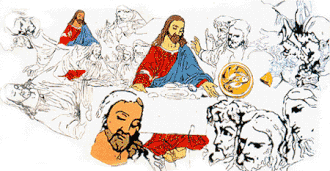
Images of Jesus from The Last Supper cycle (1986). Warhol made almost 100 variations on the theme, which the Guggenheim felt "indicates an almost obsessive investment in the subject matter."[137]

Warhol was a practicing Ruthenian Catholic. He regularly volunteered at homeless shelters in New York City, particularly during the busier times of the year, and described himself as a religious person.[138] Many of Warhol's later works depicted religious subjects, including two series, Details of Renaissance Paintings (1984) and The Last Supper (1986). In addition, a body of religious-themed works was found posthumously in his estate.[138]

During his life, Warhol regularly attended Liturgy, and the priest at Warhol's church, Saint Vincent Ferrer, said that the artist went there almost daily,[138] although he was not observed takingCommunion or going to Confession and sat or knelt in the pews at the back.[125] The priest thought he was afraid of being recognized; Warhol said he was self-conscious about being seen in a Roman Rite churchcrossing himself "in the Orthodox way" (right to left instead of the reverse).[125]

His art is noticeably influenced by the Eastern Christian tradition which was so evident in his places of worship.[138]

Warhol's brother has described the artist as "really religious, but he didn't want people to know about that because [it was] private". Despite the private nature of his faith, in Warhol's eulogy John Richardson depicted it as devout: "To my certain knowledge, he was responsible for at least one conversion. He took considerable pride in financing his nephew's studies for the priesthood".[138]

Collections

Warhol was an avid collector. His friends referred to his numerous collections, which filled not only his four-storytownhouse, but also a nearby storage unit, as "Andy's Stuff." The true extent of his collections was not discovered until after his death, when the Andy Warhol Museum in Pittsburgh took in 641 boxes of his "Stuff."

Warhol's collections included a Coca-cola memorabilia sign, and 19th century paintings[139] along with airplane menus, unpaid invoices, pizza dough, pornographic pulp novels, newspapers, stamps, supermarket flyers, and cookie jars, among other eccentricities. It also included significant works of art, such as George Bellows's Miss Bentham.[140] One of his main collections was his wigs. Warhol owned more than 40 and felt very protective of his hairpieces, which were sewn by a New York wig-maker from hair imported from Italy. In 1985 a girl snatched Warhol's wig off his head. It was later discovered in Warhol's diary entry for that day that he wrote: "I don't know what held me back from pushing her over the balcony."

Another item found in Warhol's boxes at the museum in Pittsburgh was a mummified human foot from Ancient Egypt. The curator of anthropology at Carnegie Museum of Natural History felt that Warhol most likely found it at a flea market.[141]

Death

Statue of Andy Warhol in Bratislava, Slovakia

Warhol died in Manhattan at 6:32 a.m. on February 22, 1987 at age 58. According to news reports, he had been making a good recovery from gallbladdersurgery at New York Hospital before dying in his sleep from a sudden post-operative irregular heartbeat.[142] rior to his diagnosis and operation, Warhol delayed having his recurring gallbladder problems checked, as he was afraid to enter hospitals and see doctors.[53] His family sued the hospital for inadequate care, saying that the arrhythmia was caused by improper care and water intoxication.[143] The malpractice case was quickly settled out of court; Warhol's family received an undisclosed sum of money.[144]

Shortly before Warhol's death, doctors expected Warhol to survive the surgery, though a revaluation of the case about thirty years after his death showed many indications that Warhol's surgery was in fact riskier than originally thought.[145] It was widely reported at the time that Warhol died of a "routine" surgery, though when considering factors such as his age, a family history of gallbladder problems, his previous gunshot wound, and his medical state in the weeks leading up to the procedure, the potential risk of death following the surgery appeared to have been significant.[145]

Warhol's brothers took his body back to Pittsburgh, where an open-coffin wake was held at the Thomas P. Kunsak Funeral Home. The solid bronze casket had gold-plated rails and white upholstery. Warhol was dressed in a black cashmere suit, a paisley tie, a platinum wig, and sunglasses. He was laid out holding a small prayer book and a red rose. The funeral liturgy was held at the Holy Ghost Byzantine Catholic Church on Pittsburgh'sNorth Side. The eulogy was given by Monsignor Peter Tay. Yoko Ono and John Richardson were speakers. The coffin was covered with white roses and asparagus ferns. After the liturgy, the coffin was driven to St. John the Baptist Byzantine Catholic Cemetery in Bethel Park, a south suburb of Pittsburgh.[146]

At the grave, the priest said a brief prayer and sprinkled holy water on the casket. Before the coffin was lowered, Paige Powell dropped a copy of Interview magazine, an Interview T-shirt, and a bottle of the Estee Lauderperfume "Beautiful" into the grave. Warhol was buried next to his mother and father. A memorial service was held in Manhattan for Warhol on April 1, 1987, at St. Patrick's Cathedral, New York.

Works

Foundation

Warhol's will dictated that his entire estate—with the exception of a few modest legacies to family members—would go to create a foundation dedicated to the "advancement of the visual arts". Warhol had so many possessions that it took Sotheby's nine days to auction his estate after his death; the auction grossed more than US$20 million.

In 1987, in accordance with Warhol's will, the Andy Warhol Foundation for the Visual Arts began. The foundation serves as the estate of Andy Warhol, but also has a mission "to foster innovative artistic expression and the creative process" and is "focused primarily on supporting work of a challenging and often experimental nature."[147]

The Artists Rights Society is the U.S. copyright representative for the Andy Warhol Foundation for the Visual Arts for all Warhol works with the exception of Warhol film stills.[148] The U.S. copyright representative for Warhol film stills is the Warhol Museum in Pittsburgh.[149] Additionally, the Andy Warhol Foundation for the Visual Arts has agreements in place for its image archive. All digital images of Warhol are exclusively managed by Corbis, while all transparency images of Warhol are managed by Art Resource.[150]

The Andy Warhol Foundation released its 20th Anniversary Annual Report as a three-volume set in 2007: Vol. I, 1987–2007; Vol. II, Grants & Exhibitions; and Vol. III, Legacy Program.[151] The Foundation remains one of the largest grant-giving organizations for the visual arts in the U.S.[152]

Many of Warhol's works and possessions are on display at The Andy Warhol Museum in Pittsburgh. The foundation donated more than 3,000 works of art to the museum.[153]

Media about Warhol

Warhol (right) with directorUlli Lommel on the set of 1979's Cocaine Cowboys, in which Warhol appeared as himself

Films

Warhol appeared as himself in the film Cocaine Cowboys (1979)[154] and in the film Tootsie (1982).

After his death, Warhol was portrayed by Crispin Glover in Oliver Stone's filmThe Doors (1991), by David Bowie in Julian Schnabel's film Basquiat (1996), and by Jared Harris in Mary Harron's film I Shot Andy Warhol (1996).

Warhol appears as a character in Michael Daugherty's opera Jackie O (1997). Actor Mark Bringleson makes a brief cameo as Warhol in Austin Powers: International Man of Mystery (1997).

Many films by avant-garde cineast Jonas Mekas have caught the moments of Warhol's life. Sean Gregory Sullivan depicted Warhol in the film 54 (1998). Guy Pearce portrayed Warhol in the film Factory Girl (2007) about Edie Sedgwick's life.[155] Actor Greg Travis portrays Warhol in a brief scene from the film Watchmen(2009).

In the movie Highway to Hell a group of Andy Warhols are part of the Good Intentions Paving Company where good-intentioned souls are ground into pavement.[156]

In the film Men in Black 3 (2012) Andy Warhol turns out to really be undercover MIB Agent W (played by Bill Hader). Warhol is throwing a party at The Factory in 1969, where he is looked up by MIB Agents K and J (J from the future). Agent W is desperate to end his undercover job ("I'm so out of ideas I'm painting soup cans and bananas, for Christ sakes!", "You gotta fake my death, okay? I can't listen to sitar music anymore." and "I can't tell the girls from the boys.").

Andy Warhol (portrayed by Tom Meeten) is one of main characters of the 2012 British television show Noel Fielding's Luxury Comedy. The character is portrayed as having robot-like mannerisms.

In the 2017 feature The Billionaire Boys Club Cary Elwes portrays Warhol in a film based on the true story about Ron Levin (portrayed by Kevin Spacey) a friend of Warhol's who was murdered in 1986.[157]

In September 2016, it was announced that Jared Leto would portray the title character in Warhol, an upcoming American biographical drama film produced by Michael De Luca and written by Terence Winter, based on the book Warhol: The Biography by Victor Bockris.[158]

Documentaries

  • The documentary Absolut Warhola (2001) was produced by Polish director Stanislaw Mucha, featuring Warhol's parents' family and hometown in Slovakia.[159]
  • Andy Warhol: A Documentary Film (2006) is a reverential, four-hour movie by Ric Burns[160] that won aPeabody Award in 2006.[161]
  • Andy Warhol: Double Denied (2006) is a 52-minute movie by Ian Yentob about the difficulties authenticating Warhol's work.[162]
  • Andy Warhol's People Factory (2008), a three-part television documentary directed by Catherine Shorr, features interviews with several of Warhol's associates.[163][164]

Television

Honors

In 2002, the U.S. Postal Service issued an 18-cent stamp commemorating Warhol. Designed by Richard Sheaff of Scottsdale, Arizona, the stamp was unveiled at a ceremony at The Andy Warhol Museum and features Warhol's painting "Self-Portrait, 1964".[166][167] In March 2011, a chrome statue of Andy Warhol and his Polaroid camera was revealed at Union Square in New York City.[168]


https://en.wikipedia.org/wiki/Andy_Warhol

請從論壇首頁右上角進入「個人中心」,就可以編輯您個人的頭像、簽名檔及自我介紹。請用高級模式回覆,點HTML框,可有更多變化豐富版面。
不怕辛苦,就怕不公平;不怕卑微,就怕不公義。
可以哭泣,不要洩氣;可以悲傷,不要放棄!

TOP

羅博士補充:

andy warhol 父親死亡時間中英文維基有差一年 中文寫14歲 英文寫13歲 

然後他三年級生病 在美國學制是 8 9歲左右

請從論壇首頁右上角進入「個人中心」,就可以編輯您個人的頭像、簽名檔及自我介紹。請用高級模式回覆,點HTML框,可有更多變化豐富版面。
不怕辛苦,就怕不公平;不怕卑微,就怕不公義。
可以哭泣,不要洩氣;可以悲傷,不要放棄!

TOP

再請同學們校對這一位,我還沒開始消化他的資料,羅博士有補充幾個點:

父親死亡時間中英文維基有差一年 中文寫14歲 英文寫13歲;

然後他三年級生病 在美國學制是 8 9歲左。

Jeff建富也補充到,這位藝術家是一名同志哦,找找特徵。

祝大家校對順利!


視覺藝術運動普普藝術的開創者安迪·沃荷Andy Worhol命盤
http://astromalon.com/viewthread.php?tid=90069&extra=page%3D1

請從論壇首頁右上角進入「個人中心」,就可以編輯您個人的頭像、簽名檔及自我介紹。請用高級模式回覆,點HTML框,可有更多變化豐富版面。
不怕辛苦,就怕不公平;不怕卑微,就怕不公義。
可以哭泣,不要洩氣;可以悲傷,不要放棄!

TOP

本帖最後由 kikilinkiki 於 2019-7-31 09:41 編輯

  6歲,1934 搬家

  8歲,1936 神經失調舞蹈疾病

13.78歲,1942/05/15 父死

1942~1945高中

1945~1949大學

21歲,1949 大學畢業到紐約工作發展,第一個作品便在19499月號的《Glamour》雜誌中萌芽。

24歲,1952 母親搬來同住照顧起居

26歲,1954 得獎。首次獲得美國平面設計學會傑出成就獎

28歲,1956 得獎

29歲,1957 得獎

(28&29) 連續獲得藝術指導人俱樂部獨特成就獎和最高成就獎

他在1961年創作了基於漫畫與廣告的第一幅普普藝術作品,隨後的幾年,沃荷開始了他的名人生涯。

34歲,1962 得波普藝術獎

39.83歲,1968/6/3 被槍擊受傷

44.25歲,1972/11/22 母死

58.5歲,1987/2/22 手術結果不幸過世


https://sites.google.com/site/al ... of-warhol-s-farther   
1942 – Death of Warhol’s farther

https://www.geni.com/people/Andrej-Warhola-Sr/6000000009543733237
Death:        1942年5月15日

TOP

哦?這個命盤不好校對哦?

有許多陷阱,這樣推來也像,那樣推來也像,很難下判定!

即便校對好了,性向也很難判定,財帛也難以判定,真的有七億(美金)的身家嗎?

哇,同學們挑的對象,我也投降了!

但,還是有校對出來哦,抓他40歲被槍擊險死的那個點,滿明顯的;再推其他的點,也多符合。試試看!

祝大家校對順利!


請從論壇首頁右上角進入「個人中心」,就可以編輯您個人的頭像、簽名檔及自我介紹。請用高級模式回覆,點HTML框,可有更多變化豐富版面。
不怕辛苦,就怕不公平;不怕卑微,就怕不公義。
可以哭泣,不要洩氣;可以悲傷,不要放棄!

TOP

好同學KIKI的補充資料,方便大家校對:


6歲,1934 搬家
8歲,1936 神經失調舞蹈疾病
1942~1945 高中
1945~1949 大學
21歲,1949 大學畢業到紐約工作發展
24歲,1952 母親搬來同住照顧起居
26歲,1954 得獎
28歲,1956 得獎
29歲,1957 得獎
34歲,1962 得波普藝術獎
39.83歲,1968/6/3 被槍擊受傷
44.25歲,1972/11/22 母死
58.5歲,1987/2/22 手術結果不幸過世

請從論壇首頁右上角進入「個人中心」,就可以編輯您個人的頭像、簽名檔及自我介紹。請用高級模式回覆,點HTML框,可有更多變化豐富版面。
不怕辛苦,就怕不公平;不怕卑微,就怕不公義。
可以哭泣,不要洩氣;可以悲傷,不要放棄!

TOP

本帖最後由 kikilinkiki 於 2019-8-2 09:57 編輯

本帖隱藏的內容需要積分高於 5 才可瀏覽

TOP

返回列表