Boris Yefimovich Nemtsov (Russian: Борис Ефимович Немцóв; 9 October 1959 – 27 February 2015) was a Russian statesman andliberal politician, until his death a member ofregional parliament of Yaroslavl Oblast(elected in 2013), a co-chair of the RPR-PARNAS political party (a part of Alliance of Liberals and Democrats for Europe), one of the leaders of the Solidarnost movement and an outspoken critic of Vladimir Putin. He was murdered less than 200 metres from theMoscow Kremlin walls and Red Square onBolshoy Moskvoretsky Bridge in February 2015 two days before taking part in a planned rally against financial crisis and war in Ukraine.[1]
Nemtsov was the first governor of the Nizhny Novgorod Oblast (1991–97). Later he worked in Government of Russia as Minister of fuel and energy (1997), Vice Premier of Russiaand Security Council member from 1997 to 1998. In 1998 he founded the Young Russiamovement. In 1998, he co-founded the coalition group Right Cause and in 1999, he co-formed Union of Right Forces, electoral bloc and subsequently political party. He was elected several times as Russian parliamentmember. Nemtsov was a member of Congress of People's Deputies (1990), Federation Council (1993-1997) and State Duma (1999–2003). He also worked as Vice Speaker of the State Duma and the leader of parliamentary group of Union of Right Forces. After a split in the Union of Right Forces in 2008, he co-founded Solidarnost. In 2010, he co-formedcoalition For Russia without Lawlessness and Corruption (was refused in registration as party). Since 2012 Nemtsov was co-chair of the Republican Party of Russia – People's Freedom Party (RPR-PARNAS), a registered political party.[2][3]
He was a candidate of physico-mathematical sciences, was as an author of several publications criticising the Putin administration, and was an active organizer and participant ofDissenters' Marches, Strategy-31 and rallies «For Fair Elections».
Nemtsov was shot and killed late in the evening on 27 February 2015 in Moscow, as he was walking near the Kremlin with a 23-year-old model from Ukraine. This happened almost one day before the opposition march "Vesna" (Russian for "spring"), which is to protest against the economic crisis in Russia and the war in Ukraine. Nemtsov had been telling friends that he felt himself in danger of being killed by Putin due to his opposition to Putin's policy of supporting the pro-Russian rebels in Ukraine.[4][5]
Early life[edit]
Boris Efimovich Nemtsov was born on 9 October 1959 in Sochi to Yefim Davidovich Nemtsov and Dina Yakovlevna (née Eidman) Nemtsova.[6] His mother was Jewish. In his autobiography, Nemtsov recounts that his Russian Orthodox paternal grandmother had him baptized as an infant,[7] something Nemtsov, who was a practicing Orthodox Christian, found out many years later.[8]
From 1976–81, he studied physics at State University of Gorky, where, in 1985, he earned his Ph.D in Physics and Mathematics, defending his dissertation at the age of 25. Until 1990 Nemtsov worked as a research fellow at the Gorky Radio-Physics Research Institute (Горьковский научно-иссследовательский радиофизический институт, НИРФИ).[9]
In 1986, in the wake of the Chernobyl disaster, Nemtsov organized a protest movement in his hometown, which effectively prevented the construction of a new nuclear power plant in the region.[9]
Political career[edit]
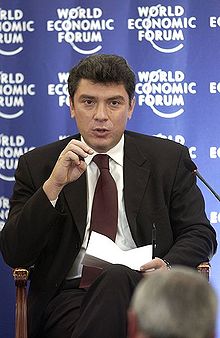
Boris Nemtsov at the World Economic Forum in Russia, 2 October 2003, Moscow
In 1989, Nemtsov ran for the Soviet Congress of People's Deputies. He ran on a platform of reform, which for the time was quite radical; promoting ideas such as multi-party democracy and private enterprise.[9] He was unsuccessful in this election, but returned to run for the Supreme Soviet of the Russian Republic representing Gorky (later renamedNizhny Novgorod) in 1990. This time around Nemtsov defeated the 12 other candidates in the election, most of whom were members of the Communist Party of the Soviet Union nomenklatura (Chinayeva 1996, 36). In Parliament he joined the "Reform Coalition" and "Centre-Left" political groups.[9]
In the Russian parliament, Nemtsov was on the legislative committee,[9] working on agricultural reform and the liberalization of foreign trade. It was in this position that Nemtsov came to meet Boris Yeltsin, who was impressed with the young man’s work (Chinayeva 1996, 36). During the 1991 attack on the government by those opposed to Yeltsin, Nemtsov was a vehement supporter of the president, and stood by him during the entire clash. After the events of October 1991, Nemtsov’s loyalty was rewarded with the position of presidential representative in his home region of Nizhny Novgorod (Chinayeva 1996, 36).
In November 1991, Nemtsov was appointed Governor of the Nizhny Novgorod region. He was re-elected in that position by popular vote in December 1995. His tenure was marked by the implementation of a wide-ranging, chaotic free market reform programme which earned the nickname "Laboratory of Reform" for Nizhny Novgorod and resulted in significant economic growth for the region. Nemtsov's reforms won praise from former British Prime Minister Margaret Thatcher, who visited Nizhny Novgorod in 1993 (Chinayeva 1996, 37).
In December 1993 Nemtsov was elected to the Federation Council, the upper house of the Russian Parliament. During the election campaign he was backed by "Russia's Choice" and "Yabloko", which were then the principal liberal parties in the country.
In March 1997 Nemtsov was appointed First Deputy Prime Minister of the Russian Federation, with special responsibility for reform of the energy sector. He was widely popular with the public and appeared to be the lead candidate to become President of Russia in 2000. In the summer of 1997, opinion polls gave Nemtsov over 50% support as a potential presidential candidate. His political career, however, suffered a blow in August 1998 following the crash of the Russian stock-market and the ensuing economic crisis.

Vladimir Putin with Boris Nemtsov, leader of the Union of Right Forces parliamentary party, July 2000
As part of Chubais' economic team, Nemtsov was forced to resign his position of Deputy Prime Minister (Yeltsin 2000, 99). After the dismissal of Prime Minister Chernomyrdin in 1998, Nemtsov was reappointed by Yeltsin to his post of Deputy Prime Minister, but again resigned shortly after when Yeltsin dissolved the government. In August 1999 Nemtsov became one of the co-founders of the Union of Rightist Forces, a new liberal-democratic coalition which received nearly 6 million votes, or 8.6%, in the parliamentary elections in December 1999. Nemtsov himself was elected to the State Duma, or lower house of Parliament, and consequently became its Deputy Speaker in February 2000. In May 2000, after the resignation of Sergei Kiriyenko, Nemtsov was elected leader of the Union of Rightist Forces and its parliamentary group in the State Duma. His position as party leader was confirmed at the Union of Rightist Forces congress in May 2001, where he was backed by over 70% of delegates. In 2002 he took part in the negotiations with the hostage-takers during theMoscow theater hostage crisis.[citation needed]
Between 2000 and 2003 Nemtsov was in a difficult political position. While he vehemently opposed what he believed to be President Vladimir Putin's policies of rolling back democracy and civic freedoms in Russia, he had to collaborate with the powerful co-chairman of the Union of Rightist Forces, Anatoly Chubais, who favoured a more conciliatory line towards the Kremlin. As a consequence, the Union of Rightist Forces's message appeared muddled and confused, thus alienating many liberal voters. In the parliamentary elections of December 2003 the Union of Rightist Forces, whose list was headed by both Nemtsov and Chubais, received just 2.4 million votes, or 4% of the total, thus falling short of the 5% threshold necessary to enter Parliament and losing all of its seats in the State Duma. In January 2004, Nemtsov resigned from the party leadership, accepting his responsibility for the election defeat. [lease clarify" href="http://en.wikipedia.org/wiki/Wikipedia lease_clarify">clarification neede
http://en.wikipedia.org/wiki/Boris_Nemtsov


