| This article needs to be updated.  lease update this article to reflect recent events or newly available information. (January 2020) lease update this article to reflect recent events or newly available information. (January 2020) |
Qasem Soleimani (Persian: قاسم سلیمانی, pronounced [ɢɒːseme solejmɒːniː]; 11 March 1957 – 3 January 2020), also spelled Qassem Suleimani or Qassim Soleimani, was an Iranian major general in the Islamic Revolutionary Guard Corps (IRGC) and, from 1998 until his death, commander of its Quds Force, a division primarily responsible for extraterritorial military and clandestine operations.
Soleimani began his military career in the beginning of the Iran–Iraq War of the 1980s, during which he eventually commanded the 41st Division. He was later involved in extraterritorial operations, providing military assistance to Hezbollah in Lebanon. In 2012, Soleimani helped bolster the Syrian government, a key Iranian ally, during the Syrian Civil War, particularly in its operations against ISIL and its offshoots. Soleimani also assisted in the command of combined Iraqi government and Shia militia forces that advanced against ISIL in 2014–2015.
Soleimani was killed in a targeted U.S. drone strike on 3 January 2020 in Baghdad, Iraq. Also killed were Iraqi Popular Mobilization Forces members and its deputy head, Abu Mahdi al-Muhandis.[19] Soleimani was posthumously promoted to lieutenant general.[20] He was suceeded by Esmail Ghaani as commander of the Quds Force.[21]
Early life
Soleimani was born on 11 March 1957 in the village of Qanat-e Malek, Kerman Province,[22] to an impoverished peasant family. In his youth, he moved to the city of Kerman and worked as a construction worker to help repay a debt his father owed. In 1975, he began working as a contractor for the Kerman Water Organization.[23][24] When not at work, he spent his time lifting weights in local gyms and attending the sermons of a traveling preacher, Hojjat Kamyab, a protege of Ayatollah Khomeini.[25]
Military career
Soleimani joined the Revolutionary war Guard (IRGC) in 1979 following the Iranian Revolution, which saw the Shah fall and Ayatollah Khomeini take power. Reportedly, his training was minimal, but he advanced rapidly. Early in his career as a guardsman, he was stationed in northwestern Iran, and participated in the suppression of a Kurdish separatist uprising in West Azerbaijan Province.[25]
| “ | I entered the [Iran-Iraq] war on a fifteen-day mission, and ended up staying until the end. … We were all young and wanted to serve the revolution. | ” |
| — Qassem Soleimani, Quoted in Dexter Filkins (30 September 2013). "The Shadow Commander". The New Yorker. |
On 22 September 1980, when Saddam Hussein launched an invasion of Iran, setting off the Iran–Iraq War (1980–1988), Soleimani joined the battlefield serving as the leader of a military company, consisting of men from Kerman whom he personally assembled and trained.[26] He quickly earned a reputation for bravery,[27] and rose through the ranks because of his role in the successful operations in retaking the lands Iraq had occupied, eventually becoming the commander of the 41st Sarallah Division while still in his 20s, participating in most major operations. He was mostly stationed at the southern front.[26][28] He was seriously injured in Operation Tariq-ol-Qods. In a 1990 interview, he mentioned Operation Fath-ol-Mobin as "the best" operation he participated in and "very memorable", due to its difficulties yet positive outcome.[29] He was also engaged in leading and organizing irregular warfare missions deep inside Iraq carried out by the Ramadan Headquarters. It was at this point that Suleimani established relations with Kurdish Iraqi leaders and the Shia Badr Organization, both of which were opposed to Iraq's Saddam Hussein.[26]
On 17 July 1985, Soleimani opposed the IRGC leadership’s plan to deploy forces to two islands in western Arvandroud (Shatt al-Arab).[30]
After the war, during the 1990s, he was an IRGC commander in Kerman Province.[28] In this region, which is relatively close to Afghanistan, Afghan-grown opium travels to Turkey and on to Europe. Soleimani's military experience helped him earn a reputation as a successful fighter against drug trafficking.[25]
During the 1999 student revolt in Tehran, Soleimani was one of the IRGC officers who signed a letter to President Mohammad Khatami. The letter stated that if Khatami did not crush the student rebellion the military would, and it might also launch a coup against Khatami.[25][31]
Command of Quds Force
The exact date of his appointment as commander of the IRGC's Quds Force is not clear, but Ali Alfoneh cites it as between 10 September 1997 and 21 March 1998.[24] He was considered one of the possible successors to the post of commander of the IRGC, when General Yahya Rahim Safavi left this post in 2007. In 2008, he led a group of Iranian investigators looking into the death of Imad Mughniyah. Soleimani helped arrange a ceasefire between the Iraqi Army and Mahdi Army in March 2008.[32]
Following the September 11 attacks in 2001, Ryan Crocker, a senior State Department official in the United States, flew to Geneva to meet with Iranian diplomats who were under the direction of Soleimani with the purpose of collaborating to destroy the Taliban, which had targeted Shia Afghanis.[25] This collaboration was instrumental in defining the targets of bombing operations in Afghanistan and in capturing key Al-Qaeda operatives, but abruptly ended in January 2002, when President George W. Bush named Iran as part of the "Axis of evil" in his State of the Union address.[25]
In 2009, a leaked report stated that General Soleimani met Christopher R. Hill and General Raymond T. Odierno (America's two most senior officials in Baghdad at the time) in the office of Iraq’s president, Jalal Talabani (who knew General Soleimani for decades). Hill and General Odierno denied the occurrence of the meeting.[33]
On 24 January 2011, Soleimani was promoted to Major General by Supreme Leader Ali Khamenei.[28][34] Khamenei was described as having a close relationship with him, calling Soleimani a "living martyr" and helping him financially.[25]
Soleimani was described as "the single most powerful operative in the Middle East today" and the principal military strategist and tactician in Iran's effort to combat Western influence and promote the expansion of Shiite and Iranian influence throughout the Middle East.[25] In Iraq, as the commander of the Quds force, he was believed to have strongly influenced the organization of the Iraqi government, notably supporting the election of previous Iraqi Prime Minister Nuri Al-Maliki.[25][35] Soleimani has even been described as being "Iran’s very own Erwin Rommel".[36]
According to some sources, Soleimani was the principal leader and architect of the military wing of the Lebanese Shia party Hezbollah since his appointment as Quds commander in 1998.[25] In an interview aired in October 2019, he said he was in Lebanon during the 2006 Israel-Hezbollah war to oversee the conflict.[37]
Syrian Civil War
According to several sources, including Riad Hijab, a former Syrian premier who defected in August 2012, he was also one of the staunchest supporters of the Syrian government of Bashar al-Assad in the Syrian Civil War.[25][35] In the later half of 2012, Soleimani assumed personal control of the Iranian intervention in the Syrian Civil War, when Iranians became deeply concerned about the Assad government's lack of ability to fight the opposition, and the fallout to the Islamic Republic if the Syrian government fell. He was reported to have coordinated the war from a base in Damascus at which a Lebanese Hezbollah commander and an Iraqi Shiite militia coordinator have been mobilized, in addition to Syrian and Iranian officers. Brigadier General Hossein Hamadani, the Basij’s former deputy commander, helped to run irregular militias that Soleimani hoped to continue the fight if Assad fell.[25] Under Soleimani the command "coordinated attacks, trained militias, and set up an elaborate system to monitor rebel communications". According to a Middle Eastern security official Dexter Filkins talked to, thousands of Quds Force and Iraqi Shiite militiamen in Syria were "spread out across the entire country.”[25] The retaking of Qusayr in May 2013 from rebel forces was, according to John Maguire, a former CIA officer in Iraq, "orchestrated" by Soleimani.[25]
Soleimani was much credited in Syria for the strategy that assisted President Bashar al-Assad in finally repulsing rebel forces and recapture key cities and towns.[38] He was involved in the training of government-allied militias and the coordination of decisive military offensives.[25] The sighting of Iranian UAVs in Syria strongly suggested that his command, the Quds force, was involved in the civil war.[25] In a visit to the Lebanese capital Beirut on Thursday 29 January 2015, Soleimani laid wreaths at the graves of the slain Hezbollah members, including Jihad Mughniyah, the son of late Hezbollah commander Imad Mughniyah which strengthens some possibilities about his role in Hezbollah military reaction on Israel.[39]
Soleimani helped form of the National Defence Forces (NDF) in Syria.[40]
In October 2015, it was reported that he had been instrumental in devising during his visit to Moscow in July 2015 the Russian–Iranian–Syrian offensive in October 2015.[41]
War on ISIS in Iraq
Qasem Soleimani was in the Iraqi city of Amirli, to work with the Iraqi forces to push back militants from ISIL.[43][44] According to the Los Angeles Times, which reported that Amerli was the first town to successfully withstand an ISIS invasion, it was secured thanks to "an unusual partnership of Iraqi and Kurdish soldiers, Iranian-backed Shiite militias and U.S. warplanes". The US acted as a force multiplier for a number of Iranian-backed armed groups—at the same time that was present on the battlefield.[45][46]
asem_Soleimani_in_Syrian_Desert_(June_2017).jpg" class="image" style="text-decoration-line: none; color: rgb(11, 0, 128); background: none;">
asem_Soleimani_in_Syrian_Desert_(June_2017).jpg" class="internal" title="Enlarge" style="text-decoration-line: none; color: rgb(11, 0, 128); background: linear-gradient(transparent, transparent), url("/w/resources/src/mediawiki.skinning/images/magnify-clip-ltr.svg?8330e"); display: block; text-indent: 15px; white-space: nowrap; overflow: hidden; width: 15px; height: 11px; user-select: none;">
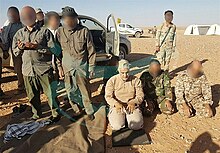
Iranian Major General Qasem Soleimani prays in the Syrian desert during a local pro-government offensive in 2017.
A senior Iraqi official told the BBC that when the city of Mosul fell, the rapid reaction of Iran, rather than American bombing, was what prevented a more widespread collapse.[10] Qasem Soleimani also seems to have been instrumental in planning the operation to relieve Amirli in Saladin Governorate, where ISIL had laid siege to an important city.[42] In fact the Quds force operatives under Soleimani's command seem to have been deeply involved with not only the Iraqi army and Shi'ite militias but also the Kurdish in the battle of Amirli,[47] not only providing liaisons for intelligence sharing but also the supply of arms and munitions in addition to "providing expertise".[48]
In the operation to liberate Jurf Al Sakhar, he was reportedly "present on the battlefield". Some Shia militia commanders described Soleimani as "fearless"—one pointing out that the Iranian general never wears a flak jacket, even on the front lines.[49]
Hadi al-Amiri, the former Iraqi minister of transportation and the head of the Badr Organization [an official Iraqi political party whose military wing is one of the largest armed forces in the country] highlighted the pivotal role of General Qasem Soleimani in defending Iraq's Kurdistan Region against the ISIL terrorist group, maintaining that if it were not for Iran, Heidar al-Ebadi's government would have been a government-in-exile right now[52] and he added there would be no Iraq if Gen. Soleimani hadn't helped us.[53]
There were reports by some Western sources that Soleimani was seriously wounded in action against ISIL in Samarra. The claim was rejected by Iranian Deputy Foreign Minister for Arab and African Affairs Hossein Amir-Abdollahian.[54]
Soleimani played an integral role in the organisation and planning of the crucial operation to retake the city of Tikrit in Iraq from ISIS. The city of Tikrit rests on the left bank of the Tigris river and is the largest and most important city between Baghdad and Mosul, gifting it a high strategic value. The city fell to ISIS during 2014 when ISIS made immense gains in northern and central Iraq. After its capture, ISIL's massacre at Camp Speicher led to 1,600 to 1,700 deaths of Iraqi Army cadets and soldiers. After months of careful preparation and intelligence gathering an offensive to encircle and capture Tikrit was launched in early March 2015.[51] Soleimani was directing the operations on the eastern flank from a village about 35 miles from Tikrit called Albu Rayash, captured over the weekend.[citation needed] The offensive was the biggest military operation in the Salahuddin region since the previous summer, when ISIS fighters killed hundreds of Iraq army soldiers who had abandoned their military base at Camp Speicher outside Tikrit.[citation needed]
Orchestration of military escalation in 2015
In 2015 Soleimani started to gather support from various sources in order to combat the newly resurgent ISIL and rebel groups which were both successful in taking large swathes of territory away from Assad's forces. He was reportedly the main architect of the joint intervention involving Russia as a new partner with Assad and Hezbollah.[55][56][57]
According to Reuters, at a meeting in Moscow in July, Soleimani unfurled a map of Syria to explain to his Russian hosts how a series of defeats for President Bashar al-Assad could be turned into victory—with Russia's help. Qasem Soleimani's visit to Moscow was the first step in planning for a Russian military intervention that has reshaped the Syrian war and forged a new Iranian–Russian alliance in support of the Syrian (and Iraqi) governments. Iran's supreme leader, Ali Khamenei also sent a senior envoy to Moscow to meet President Vladimir Putin. "Putin reportedly told the envoy 'Okay we will intervene. Send Qassem Soleimani'. General Soleimani went to explain the map of the theatre and coordinate the strategic escalation of military forces in Syria.[56]
Operations in Aleppo
Soleimani had a decisive impact on the theatre of operations and led to a strong advance in southern Aleppo with the government and allied forces re-capturing two military bases and dozens of towns and villages in a matter of weeks. There was also a series of major advances towards Kuweiris air-base to the north-east.[64] By mid-November, the Syrian army and its allies had gained ground in southern areas of Aleppo Governorate, capturing numerous rebel strongholds. Soleimani was reported to have personally led the drive deep into the southern Aleppo countryside where many towns and villages fell into government hands. He reportedly commanded the Syrian Arab Army’s 4th Mechanized Division, Hezbollah, Harakat Al-Nujaba (Iraqi), Kata'ib Hezbollah (Iraqi), Liwaa Abu Fadl Al-Abbas (Iraqi), and Firqa Fatayyemoun (Afghan/Iranian volunteers).[65]
Soleimani was lightly wounded while fighting in Syria, outside of Al-Eis. Reports initially speculated that he was seriously or gravely injured.[66] He was quoted as saying, "Martyrdom is what I seek in mountains and valleys, but it isn't granted yet".[67]
In early February 2016, backed by Russian and Syrian air force airstrikes, the 4th Mechanized Division – in close coordination with Hezbollah, the National Defense Forces (NDF), Kata'eb Hezbollah, and Harakat Al-Nujaba – launched an offensive in Aleppo Governorate's northern countryside,[68] which eventually broke the three-year siege of Nubl and Al-Zahraa and cut off rebel's main supply route from Turkey. According to a senior, non-Syrian security source close to Damascus, Iranian fighters played a crucial role in the conflict. "Qassem Soleimani is there in the same area", he said.[69] In December 2016, new photos emerged of Soleimani at the Citadel of Aleppo, though the exact date of the photos is unknown.[70][71]
Operations in 2016 and 2017
In 2016, photos published by a Popular Mobilization Forces (PMF) source showed Iran's Quds Force commander Qassem Suleimani and other PMF commanders discussing the Battle of Fallujah.[72]
In late March 2017, Soleimani was seen in the northern Hama Governorate countryside, reportedly aiding Maj. Gen. Suheil al-Hassan in repelling a major rebel offensive.[16]
CIA chief Mike Pompeo said that he sent Soleimani and other Iranian leaders a letter holding them responsible for any attacks on US interests by forces under their control. According to Mohammad Mohammadi Golpayegani, a senior aide for Iran's supreme leader, Soleimani ignored the letter when it was handed over to him during the Abu Kamal offensive against ISIL, saying "I will not take your letter nor read it and I have nothing to say to these people."[73][74]
In politics
asem_Soleimani_in_Imam_Khomeini_Hossainiah01.jpg" class="image" style="text-decoration-line: none; color: rgb(11, 0, 128); background: none;">

asem_Soleimani_in_Imam_Khomeini_Hossainiah01.jpg" class="internal" title="Enlarge" style="text-decoration-line: none; color: rgb(11, 0, 128); background: linear-gradient(transparent, transparent), url("/w/resources/src/mediawiki.skinning/images/magnify-clip-ltr.svg?8330e"); display: block; text-indent: 15px; white-space: nowrap; overflow: hidden; width: 15px; height: 11px; user-select: none;">
General Soleimani in civilian attire during a public ceremony in 2015
In 1999, Soleimani, along with other senior IRGC commanders, signed a letter to then-President Mohammad Khatami regarding the student protests in July. They wrote "Dear Mr. Khatami, how long do we have to shed tears, sorrow over the events, practice democracy by chaos and insults, and have revolutionary patience at the expense of sabotaging the system? Dear president, if you don't make a revolutionary decision and act according to your Islamic and national missions, tomorrow will be so late and irrecoverable that cannot be even imagined."[75]
Iranian media reported in 2012 that he might be replaced as the commander of Quds Force in order to allow him to run in the 2013 presidential election.[76] He reportedly refused to be nominated for the election.[75] According to BBC News, in 2015 a campaign started among conservative bloggers for Soleimani to stand for 2017 presidential election.[77] In 2016, he was speculated as a possible candidate,[75][78] however in a statement published on 15 September 2016, he called speculations about his candidacy as "divisive reports by the enemies" and said he will "always remain a simple soldier serving Iran and the Islamic Revolution".[79]
In the summer of 2018, Soleimani and Tehran exchanged public remarks related to Red Sea shipping with American President Donald Trump which heightened tensions between the two countries and their allies in the region.[80]
Personal life
asem_Soleimani_Praying_in_Imam_Khomeini_Hossainiah03.jpg" class="image" style="text-decoration-line: none; color: rgb(11, 0, 128); background: none;">

asem_Soleimani_Praying_in_Imam_Khomeini_Hossainiah03.jpg" class="internal" title="Enlarge" style="text-decoration-line: none; color: rgb(11, 0, 128); background: linear-gradient(transparent, transparent), url("/w/resources/src/mediawiki.skinning/images/magnify-clip-ltr.svg?8330e"); display: block; text-indent: 15px; white-space: nowrap; overflow: hidden; width: 15px; height: 11px; user-select: none;">
Qasem Soleimani while
prayingSoleimani was a Persian from Kerman. His father was a farmer who died in 2017. His mother, Fatemeh, died in 2013.[81] He came from a family of nine and had five sisters and one brother, Sohrab, who lived and worked with Soleimani in his youth.[82] Sohrab Soleimani is a warden and former director general of the Tehran Prisons Organization. The United States imposed sanctions on Sohrab Soleimani in April 2017 "for his role in abuses in Iranian prisons".[83]
Soleimani had dan in karate and was a fitness trainer in his youth. He had four children: two sons and two daughters.[84]
Sanctions
In March 2007, Soleimani was included on a list of Iranian individuals targeted with sanctions in United Nations Security Council Resolution 1747.[85] On 18 May 2011, he was sanctioned again by the United States along with Syrian president Bashar al-Assad and other senior Syrian officials due to his alleged involvement in providing material support to the Syrian government.[86]
On 24 June 2011, the Official Journal of the European Union said the three Iranian Revolutionary Guard members now subject to sanctions had been "providing equipment and support to help the Syrian government suppress protests in Syria".[87] The Iranians added to the EU sanctions list were two Revolutionary Guard commanders, Soleimani, Mohammad Ali Jafari, and the Guard's deputy commander for intelligence, Hossein Taeb.[88] Soleimani was also sanctioned by the Swiss government in September 2011 due to the same grounds cited by the European Union.[89]
He was listed by the United States as a known terrorist, which forbade U.S. citizens from doing business with him.[32][90] The list, published in the EU's Official Journal on 24 June 2011, also included a Syrian property firm, an investment fund and two other enterprises accused of funding the Syrian government. The list also included Mohammad Ali Jafari and Hossein Taeb.[91]
On 13 November 2018, the United States sanctioned an Iraqi military leader named Shibl Muhsin ‘Ubayd Al-Zaydi and others who allegedly were acting on Qasem Soleimani's behalf in financing military actions in Syria or otherwise providing support for terrorism in the region.[92]
Death

Qasem Soleimani (left) with
Abu Mahdi al-Muhandis (right) at a 2017 ceremony commemorating the father of Soleimani, in Mosalla, Tehran.
Soleimani was killed on 3 January 2020 around 1 am local time (22:00 UTC on 2 January)[93], after missiles shot from American drones targeted his convoy near Baghdad International Airport.[94] He had just left his plane, which arrived in Iraq from Lebanon or Syria.[95] His body was identified using a ring he wore on his finger, with DNA confirmation still pending.[96] Also killed were four members of the Popular Mobilization Forces, including Abu Mahdi al-Muhandis, the Iraqi-Iranian military commander who headed the PMF.[97]
The airstrike followed attacks on the American embassy in Baghdad by supporters of an Iran-backed Iraqi Shia militia and the 2019 K-1 Air Base attack.[98]
The United States Department of Defense issued a statement that said the U.S. strike was carried out "at the direction of the President" and asserted that Soleimani had been planning further attacks on American diplomats and military personnel and had approved the attacks on the American embassy in Baghdad in response to U.S. airstrikes in Iraq and Syria on 29 December 2019, and that the strike was meant to deter future attacks.[99][100]
Soleimani was posthumously promoted to lieutenant general.[101][20] He was suceeded by Esmail Ghaani as commander of the Quds Force.[21]
Cultural depictions
He was described as having "a calm presence",[102] and as carrying himself "inconspicuously and rarely rais[ing] his voice", exhibiting "understated charisma".[27] In Western sources, Suleimani's personality was compared to the fictional characters Karla, Keyser Söze,[27] and The Scarlet Pimpernel.[103]
Unlike other IRGC commanders, he usually did not appear in his official military clothing, even in the battlefield.[104][105]
In January 2015, Hadi Al-Ameri the head of the Badr Organization in Iraq said of him: "If Qasem Soleimani were not present in Iraq, Haider al-Abadi would not be able to form his cabinet within Iraq".[106]
The British magazine The Week featured a cartoon Soleimani of in bed with Uncle Sam in 2015, which indicated to both sides fighting ISIS, although Soleimani was leading militant groups that killed hundreds of Americans during the Iraq War.[107]
The 2016 movie Bodyguard, directed by Ebrahim Hatamikia, was inspired by Soleimani's activities.[108]
The 2016 Persian book Noble Comrades 17: Hajj Qassem, written by Ali Akbari Mozdabadi, contains memoirs of Qassem Soleimani.[109]
Gallery
asem_Soleymani_in_Imam_Khomeini_Hossainiah.jpg" class="image" style="text-decoration-line: none; color: rgb(11, 0, 128); background: none;">
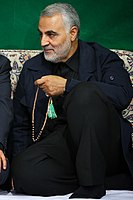
Soleimani in the NAC conference.


 ine;cpos:1;subsec:hl-view;uuid:899d3b7d-cb0e-3f80-9026-7b634d99a939;tar:lineit.line.me" aria-label="Line" class="line ButtonNaked My(0) nofollow O(0) Ov(v) P(0) Pos(r) Va(b) D(ib) rapid-noclick-resp react-button" href="https://lineit.line.me/share/ui?url=https%3A%2F%2Ftw.news.yahoo.com%2F%25E8%2598%2587%25E9%259B%25B7%25E6%259B%25BC%25E5%25B0%25BC%25E5%2585%25B6%25E4%25BA%25BA-%25E5%258D%25A1%25E5%258D%25A1-007-%25E9%259A%2586%25E7%25BE%258E%25E7%2588%25BE-224446823.html%3Fsoc_src%3Dsocial-sh%26soc_trk%3Dli" target="_blank" data-reactid="20" style="background-color: transparent; color: rgb(88, 195, 69); text-decoration-line: none; zoom: 1; display: inline-block; margin-top: 0px; margin-bottom: 0px; outline: 0px; overflow: visible; padding: 0px; position: relative; vertical-align: bottom; margin-right: 0px; border-radius: 0px; border-width: 0px; width: 40px; height: 40px; line-height: 38px; max-width: 40px; min-width: 40px; max-height: 40px; min-height: 40px; border-color: rgb(88, 195, 69);">


.svg)


 asem Soleimani" style="text-decoration-line: none; color: rgb(11, 0, 128); background: none;">talk page.


_(digitized).jpg)


