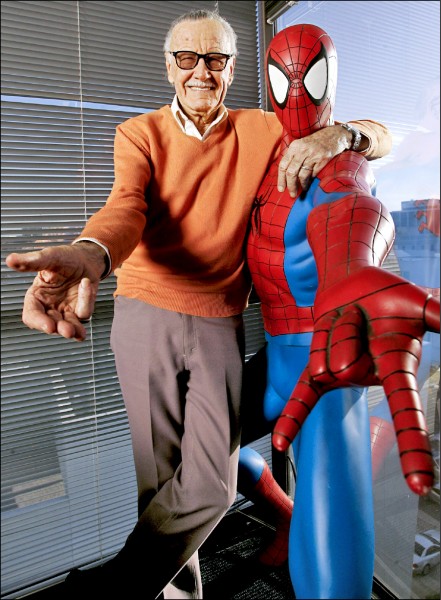
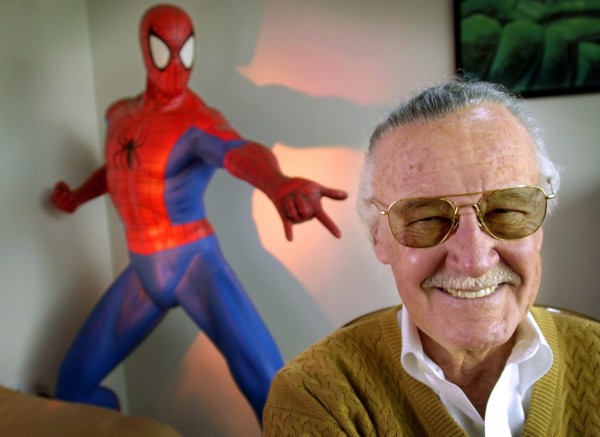
Stan Lee[1] (born Stanley Martin Lieber, December 28, 1922 – November 12, 2018) was an American comic-book writer, editor, and publisher. He was editor-in-chief ofMarvel Comics,[2] and later its publisher[3] and chairman,[4] leading its expansion from a small division of a publishing house to a largemultimedia corporation.
In collaboration with several artists—particularly Jack Kirby and Steve Ditko—he co-created fictional characters includingSpider-Man, the Hulk, Doctor Strange, theFantastic Four, Daredevil, Black Panther, theX-Men, and—with co-writer Larry Lieber—the characters Ant-Man, Iron Man, and Thor. In doing so, he pioneered a more complex approach to writing superheroes in the 1960s, and in the 1970s challenged the standards of the Comics Code Authority, indirectly leading to it updating its policies.
Following his retirement from Marvel, he remained a public figurehead for the company, and frequently made cameo appearances inMarvel Cinematic Universe films. Meanwhile, he continued independent creative ventures into his 90s.
Lee was inducted into the comic book industry's Will Eisner Award Hall of Fame in 1994 and the Jack Kirby Hall of Fame in 1995. He received a National Medal of Arts in 2008.
Early life
Stanley Martin Lieber was born on December 28, 1922, in Manhattan, New York City,[5] in the apartment of his Romanian-born Jewish immigrant parents, Celia (née Solomon) and Jack Lieber, at the corner of West 98th Street and West End Avenue in Manhattan.[6][7] His father, trained as a dress cutter, worked only sporadically after the Great Depression,[6]and the family moved further uptown to Fort Washington Avenue,[8] in Washington Heights, Manhattan. Lee had one younger brother named Larry Lieber.[9] He said in 2006 that as a child he was influenced by books and movies, particularly those with Errol Flynn playing heroic roles.[10] By the time Lee was in his teens, the family was living in an apartment at 1720 University Avenue in The Bronx. Lee has described it as "a third-floor apartment facing out back". Lee and his brother shared the bedroom, while their parents slept on a foldout couch.[9]
Lee attended DeWitt Clinton High School in the Bronx.[11] In his youth, Lee enjoyed writing, and entertained dreams of one day writing the "Great American Novel".[12] He has said that in his youth he worked such part-time jobs as writing obituaries for a news service andpress releases for the National Tuberculosis Center;[13] delivering sandwiches for the Jack May pharmacy to offices in Rockefeller Center; working as an office boy for a trouser manufacturer; ushering at the Rivoli Theater on Broadway;[14] and selling subscriptions to the New York Herald Tribune newspaper.[15] He graduated from high school early, aged 16½ in 1939, and joined the WPA Federal Theatre Project.[16]
Career
Early career
With the help of his uncle Robbie Solomon,[17] Lee became an assistant in 1939 at the newTimely Comics division of pulp magazine and comic-book publisher Martin Goodman's company. Timely, by the 1960s, would evolve into Marvel Comics. Lee, whose cousin Jean[18] was Goodman's wife, was formally hired by Timely editor Joe Simon.[n 1]
His duties were prosaic at first. "In those days [the artists] dipped the pen in ink, [so] I had to make sure the inkwells were filled", Lee recalled in 2009. "I went down and got them their lunch, I did proofreading, I erased the pencils from the finished pages for them".[20]Marshaling his childhood ambition to be a writer, young Stanley Lieber made his comic-book debut with the text filler "Captain America Foils the Traitor's Revenge" in Captain America Comics #3 (cover-dated May 1941), using the pseudonym Stan Lee,[21] which years later he would adopt as his legal name.[citation needed] Lee later explained in his autobiography and numerous other sources that he had intended to save his given name for more literary work. This initial story also introduced Captain America's trademark ricocheting shield-toss.[22]:11
He graduated from writing filler to actual comics with a backup feature, "'Headline' Hunter, Foreign Correspondent", two issues later. Lee's first superhero co-creation was theDestroyer, in Mystic Comics #6 (August 1941). Other characters he co-created during this period fans and historians call the Golden Age of Comic Books include Jack Frost, debuting in U.S.A. Comics #1 (August 1941), and Father Time, debuting in Captain America Comics#6 (August 1941).[22]:12–13
When Simon and his creative partner Jack Kirby left late in 1941, following a dispute with Goodman, the 30-year-old publisher installed Lee, just under 19 years old, as interim editor.[22]:14[23] The youngster showed a knack for the business that led him to remain as the comic-book division's editor-in-chief, as well as art director for much of that time, until 1972, when he would succeed Goodman as publisher.[2][24]
Lee entered the United States Army in early 1942 and served within the US as a member of the Signal Corps, repairing telegraph poles and other communications equipment.[25] He was later transferred to the Training Film Division, where he worked writing manuals, training films, slogans, and occasionally cartooning.[26] His military classification, he says, was "playwright"; he adds that only nine men in the U.S. Army were given that title.[27] Vincent Fago, editor of Timely's "animation comics" section, which put out humor and funny animal comics, filled in until Lee returned from his World War IImilitary service in 1945. Lee was inducted into the Signal Corps Regimental Association and gave him honorary membership of the 2nd Battalion of 3rd U.S. Infantry Regiment out of Joint Base Lewis-McChord at the 2017 Emerald City Comic Con for his prior service.[28]
In the mid-1950s, by which time the company was now generally known as Atlas Comics, Lee wrote stories in a variety of genres including romance, Westerns, humor, science fiction, medieval adventure, horror and suspense. In the 1950s, Lee teamed up with his comic book colleague Dan DeCarlo to produce the syndicated newspaper strip, My Friend Irma, based on the radio comedy starring Marie Wilson.[29] By the end of the decade, Lee had become dissatisfied with his career and considered quitting the field.[30][31]
Marvel revolution
In the late 1950s, DC Comics editor Julius Schwartz revived the superhero archetype and experienced a significant success with its updated version of the Flash, and later with super-team the Justice League of America. In response, publisher Martin Goodman assigned Lee to come up with a new superhero team. Lee's wife suggested that he experiment with stories he preferred, since he was planning on changing careers and had nothing to lose.[30][31]
Lee acted on that advice, giving his superheroes a flawed humanity, a change from the ideal archetypes that were typically written for preteens. Before this, most superheroes were idealistically perfect people with no serious, lasting problems.[32] Lee introduced complex, naturalistic characters[33] who could have bad tempers, fits of melancholy, and vanity; they bickered amongst themselves, worried about paying their bills and impressing girlfriends, got bored or even were sometimes physically ill.
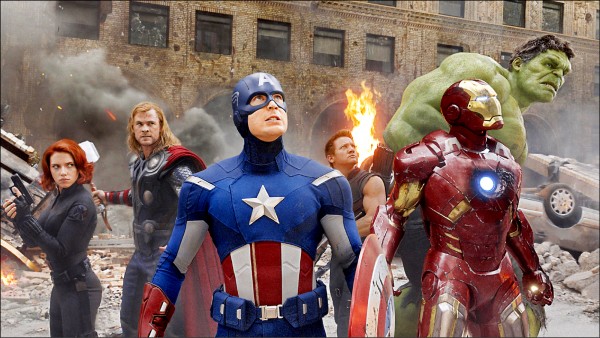
The first superhero group Lee and artist Jack Kirby created together was the Fantastic Four, based on previous Kirby superhero team Challengers of the Unknown published by DC Comics.[34] The team's immediate popularity[35] led Lee and Marvel's illustrators to produce a cavalcade of new titles. Again working with Kirby, Lee co-created the Hulk,[36]Thor,[37] Iron Man,[38] and the X-Men;[39] with Bill Everett, Daredevil;[40] and with Steve Ditko, Doctor Strange[41] and Marvel's most successful character, Spider-Man,[42] all of whom lived in a thoroughly shared universe.[43] Lee and Kirby gathered several of their newly created characters together into the team title The Avengers[44] and would revive characters from the 1940s such as the Sub-Mariner[45] and Captain America.[46]
Comics historian Peter Sanderson wrote that in the 1960s:
DC was the equivalent of the big Hollywood studios: After the brilliance of DC's reinvention of the superhero ... in the late 1950s and early 1960s, it had run into a creative drought by the decade's end. There was a new audience for comics now, and it wasn't just the little kids that traditionally had read the books. The Marvel of the 1960s was in its own way the counterpart of the French New Wave... Marvel was pioneering new methods of comics storytelling and characterization, addressing more serious themes, and in the process keeping and attracting readers in their teens and beyond. Moreover, among this new generation of readers were people who wanted to write or draw comics themselves, within the new style that Marvel had pioneered, and push the creative envelope still further.[47]
Lee's revolution extended beyond the characters and storylines to the way in which comic books engaged the readership and built a sense of community between fans and creators.[48] He introduced the practice of regularly including a credit panel on the splash page of each story, naming not just the writer and penciller but also the inker and letterer. Regular news about Marvel staff members and upcoming storylines was presented on theBullpen Bulletins page, which (like the letter columns that appeared in each title) was written in a friendly, chatty style. Lee remarked that his goal was for fans to think of the comics creators as friends, and considered it a mark of his success on this front that, at a time when letters to other comics publishers were typically addressed "Dear Editor", letters to Marvel addressed the creators by first name (e.g. "Dear Stan and Jack").[25] By 1967, the brand was well-enough ensconced in popular culture that a March 3 WBAI radio program with Lee and Kirby as guests was titled "Will Success Spoil Spiderman" [sic].[49]
Throughout the 1960s, Lee scripted, art-directed and edited most of Marvel's series, moderated the letters pages, wrote a monthly column called "Stan's Soapbox", and wrote endless promotional copy, often signing off with his trademark motto, "Excelsior!" (which is also the New York state motto). To maintain his workload and meet deadlines, he used a system that was used previously by various comic-book studios, but due to Lee's success with it, became known as the "Marvel Method". Typically, Lee would brainstorm a story with the artist and then prepare a brief synopsis rather than a full script. Based on the synopsis, the artist would fill the allotted number of pages by determining and drawing the panel-to-panel storytelling. After the artist turned in penciled pages, Lee would write the word balloons and captions, and then oversee the lettering and coloring. In effect, the artists were co-plotters, whose collaborative first drafts Lee built upon. Lee recorded messages to the newly formed Merry Marvel Marching Society fan club in 1965.[50]
Following Ditko's departure from Marvel in 1966, John Romita Sr. became Lee's collaborator on The Amazing Spider-Man. Within a year, it overtook Fantastic Four to become the company's top seller.[51] Lee and Romita's stories focused as much on the social and college lives of the characters as they did on Spider-Man's adventures.[52] The stories became more topical, addressing issues such as the Vietnam War,[53] political elections,[54] and student activism.[55] Robbie Robertson, introduced in The Amazing Spider-Man #51 (August 1967) was one of the first African-American characters in comics to play a serious supporting role.[56] In the Fantastic Four series, the lengthy run by Lee and Kirby produced many acclaimed storylines as well as characters that have become central to Marvel, including the Inhumans[57][58] and the Black Panther,[59] an African king who would be mainstream comics' first black superhero.[60]
The story frequently cited as Lee and Kirby's finest achievement[61][62] is the three-part "Galactus Trilogy" that began in Fantastic Four #48 (March 1966), chronicling the arrival ofGalactus, a cosmic giant who wanted to devour the planet, and his herald, the Silver Surfer.[63][64] Fantastic Four #48 was chosen as #24 in the 100 Greatest Marvels of All Time poll of Marvel's readers in 2001. Editor Robert Greenberger wrote in his introduction to the story that "As the fourth year of the Fantastic Four came to a close, Stan Lee and Jack Kirby seemed to be only warming up. In retrospect, it was perhaps the most fertile period of any monthly title during the Marvel Age."[65] Comics historian Les Daniels noted that "[t]he mystical and metaphysical elements that took over the saga were perfectly suited to the tastes of young readers in the 1960s", and Lee soon discovered that the story was a favorite on college campuses.[66] Lee and artist John Buscema launched The Silver Surferseries in August 1968.[67][68]
The following year, Lee and Gene Colan created the Falcon, comics' first African-American superhero in Captain America #117 (September 1969).[69] Then in 1971, Lee indirectly helped reform the Comics Code.[70] The U. S. Department of Health, Education and Welfare had asked Lee to write a comic-book story about the dangers of drugs and Lee conceived a three-issue subplot in The Amazing Spider-Man #96–98 (cover-dated May–July 1971), in which Peter Parker's best friend becomes addicted to prescription drugs. The Comics Code Authority refused to grant its seal because the stories depicted drug use; the anti-drug context was considered irrelevant. With Goodman's cooperation and confident that the original government request would give him credibility, Lee had the story published without the seal. The comics sold well and Marvel won praise for its socially conscious efforts.[71] The CCA subsequently loosened the Code to permit negative depictions of drugs, among other new freedoms.[72][73]
Lee also supported using comic books to provide some measure of social commentary about the real world, often dealing with racism and bigotry.[74] "Stan's Soapbox", besides promoting an upcoming comic book project, also addressed issues of discrimination, intolerance, or prejudice.[75][76]
In 1972, Lee stopped writing monthly comic books to assume the role of publisher. His final issue of The Amazing Spider-Man was #110 (July 1972)[77] and his last Fantastic Fourwas #125 (August 1972).[78]
Later career
In later years, Lee became a figurehead and public face for Marvel Comics. He made appearances at comic book conventions around America, lecturing at colleges and participating in panel discussions. Lee and John Romita Sr. launched the Spider-Man newspaper comic strip on January 3, 1977.[79] Lee's final collaboration with Jack Kirby, The Silver Surfer: The Ultimate Cosmic Experience, was published in 1978 as part of the Marvel Fireside Booksseries and is considered to be Marvel's first graphic novel.[80] Lee and John Buscema produced the first issue of The Savage She-Hulk (February 1980), which introduced the female cousin of the Hulk[81] and crafted a Silver Surfer story for Epic Illustrated #1 (Spring 1980).[82] He moved to California in 1981 to develop Marvel's TV and movie properties. He was an executive producer for, and madecameo appearances in Marvel film adaptations and other movies. He occasionally returned to comic book writing with various Silver Surfer projects including a 1982 one-shot drawn by John Byrne,[83] the Judgment Day graphic novel illustrated by John Buscema,[84] theParable limited series drawn by French artist Mœbius,[85] and The Enslavers graphic novel with Keith Pollard.[86] Lee was briefly president of the entire company, but soon stepped down to become publisher instead, finding that being president was too much about numbers and finance and not enough about the creative process he enjoyed.[87]
Peter Paul and Lee began a new Internet-based superhero creation, production, and marketing studio, Stan Lee Media, in 1998.[88] It grew to 165 people and went public through a reverse merger structured by investment banker Stan Medley in 1999, but, near the end of 2000, investigators discovered illegal stock manipulation by Paul and corporate officer Stephan Gordon.[89] Stan Lee Media filed for Chapter 11 bankruptcy protection in February 2001.[90]  aul was extradited to the U.S. from Brazil and pleaded guilty to violating SEC Rule 10b-5 in connection with trading of his stock in Stan Lee Media.[91][92]Lee was never implicated in the scheme. In 2001, Lee, Gill Champion, and Arthur Lieberman formed POW! (Purveyors of Wonder) Entertainment to develop film, television and video game properties. Lee created the risqué animated superhero series Stripperellafor Spike TV. In 2004 POW! Entertainment went public. Also that year, Lee announced a superhero program that would feature Ringo Starr, the former Beatle, as the lead character.[93][94] Additionally, in August of that year, Lee announced the launch of Stan Lee's Sunday Comics,[95] a short-lived subscription service hosted by Komikwerks.com. From July of 2006 until September of 2007 Lee hosted, co-created, executive produced, abd judged the reality television game show competition Who Wants to be a Superhero on the SciFi Channel.[96] On March 15, 2007, after Stan Lee Media had been purchased by Jim Nesfield, the company filed a lawsuit against Marvel Entertainment for $5 billion, claiming Lee had given his rights to several Marvel characters to Stan Lee Media in exchange for stock and a salary.[97] On June 9, 2007, Stan Lee Media sued Lee; his newer company, POW! Entertainment; and POW! subsidiary QED Entertainment.[98][99]
In 2008, Lee wrote humorous captions for the political fumetti book Stan Lee Presents Election Daze: What Are They Really Saying?.[100] In April of that year, Brighton Partners and Rainmaker Animation announced a partnership POW! to produce a CGI film series,Legion of 5.[101] Other projects by Lee announced in the late 2000s included a line of superhero comics for Virgin Comics,[102] a TV adaptation of the novel Hero,[103] a foreword to Skyscraperman by skyscraper fire-safety advocate and Spider-Man fan Dan Goodwin,[104] a partnership with Guardian Media Entertainment and The Guardian Projectto create NHL superhero mascots[105] and work with the Eagle Initiative program to find new talent in the comic book field.[106]
In October 2011, Lee announced he would partner with 1821 Comics on a multimedia imprint for children, Stan Lee's Kids Universe, a move he said addressed the lack of comic books targeted for that demographic; and that he was collaborating with the company on its futuristic graphic novel Romeo & Juliet: The War, by writer Max Work and artist Skan Srisuwan.[107][108] At the 2012 San Diego Comic-Con International, Lee announced his YouTube channel, Stan Lee's World of Heroes, which airs programs created by Lee, Mark Hamill, Peter David, Adrianne Curryand Bonnie Burton, among others.[109][110][111][112] Lee wrote the book Zodiac, released in January 2015, withStuart Moore.[113] The film Stan Lee's Annihilator, based on a Chinese prisoner-turned-superhero named Ming and in production since 2013, was released in 2015.[114][115][116]
In his later career, Lee's contributions continued to expand outside the style that he helped pioneer. An example of this is his first work for DC Comics in the 2000s, launching the Just Imagine... series, in which Lee re-imagined the DC superheroes Superman, Batman,Wonder Woman, Green Lantern, and the Flash.[117] Manga projects involving Lee includeKarakuridôji Ultimo, a collaboration with Hiroyuki Takei, Viz Media and Shueisha,[118] andHeroman, serialized in Square Enix's Monthly Shōnen Gangan with the Japanese companyBones.[119][120] In 2011, Lee started writing a live-action musical, The Yin and Yang Battle of Tao.[121]
This period also saw a number of collaborators honor Lee for his influence on the comics industry. In 2006, Marvel commemorated Lee's 65 years with the company by publishing a series of one-shot comics starring Lee himself meeting and interacting with many of his co-creations, including Spider-Man, Doctor Strange, the Thing, Silver Surfer, and Doctor Doom. These comics also featured short pieces by such comics creators as Joss Whedonand Fred Hembeck, as well as reprints of classic Lee-written adventures.[122] At the 2007Comic-Con International, Marvel Legends introduced a Stan Lee action figure. The body beneath the figure's removable cloth wardrobe is a re-used mold of a previously released Spider-Man action figure, with minor changes.[123] Comikaze Expo, Los Angeles' largest comic book convention, was rebranded as Stan Lee's Comikaze Presented by POW! Entertainment in 2012.[124]
At the 2016 Comic-Con International, Lee introduced his digital graphic novel Stan Lee's 'God Woke',[125][126][127] with text originally written as a poem he presented at Carnegie Hall in 1972.[128] The print-book version won the 2017 Independent Publisher Book Awards' Outstanding Books of the Year Independent Voice Award.[129]
Charity work
The Stan Lee Foundation was founded in 2010 to focus on literacy, education, and the arts. Its stated goals include supporting programs and ideas that improve access to literacy resources, as well as promoting diversity, national literacy, culture and the arts.[130]
Lee donated portions of his personal effects to the University of Wyoming at various times, between 1981 and 2001.[131]
Fictional portrayals
Lee and his collaborator Jack Kirby appear as themselves in The Fantastic Four #10 (January 1963), the first of several appearances within the fictionalMarvel Universe.[132] The two are depicted as similar to their real-world counterparts, creating comic books based on the "real" adventures of the Fantastic Four.
Lee was parodied by Kirby in comics published by rivalDC Comics as Funky Flashman.[133] Kirby later portrayed himself, Lee, production executive Sol Brodsky, and Lee's secretary Flo Steinberg as superheroes in What If #11 (October 1978), "What If the Marvel Bullpen Had Become the Fantastic Four?", in which Lee played the part of Mister Fantastic. Lee has also made numerous cameo appearances in many Marvel titles, appearing in audiences and crowds at many characters' ceremonies and parties, and hosting an old-soldiers reunion in Sgt. Fury and his Howling Commandos #100 (July 1972). Lee appeared, unnamed, as the priest at Luke Cage and Jessica Jones' wedding in New Avengers Annual #1 (June 2006). He pays his respects to Karen Page at her funeral in Daredevil vol. 2, #8 (June 1998), and appears in The Amazing Spider-Man #169 (June 1977).
In 1994, artist Alex Ross rendered Lee as a bar patron on page 44 of Marvels #3.[134]
In Marvel's "Flashback" series of titles cover-dated July 1997, a top-hatted caricature of Lee as a ringmaster introduced stories that detailed events in Marvel characters' lives before they became superheroes, in special "-1" editions of many Marvel titles. The "ringmaster" depiction of Lee was originally from Generation X #17 (July 1996), where the character narrated a story set primarily in an abandoned circus. Though the story itself was written byScott Lobdell, the narration by "Ringmaster Stan" was written by Lee, and the character was drawn in that issue by Chris Bachalo.
Lee and other comics creators are mentioned on page 479 of Michael Chabon's 2000 novel about the comics industry The Amazing Adventures of Kavalier and Clay. Chabon also acknowledges a debt to Lee and other creators on the book's Author's Note page.
On one of the last pages of Truth: Red, White & Black, Lee appears in a real photograph among other celebrities on a wall of the Bradley home.[135] Under his given name of Stanley Lieber, Stan Lee appears briefly in Paul Malmont's 2006 novel The Chinatown Death Cloud Peril.[136]
In Stan Lee Meets Superheroes, which Lee wrote, he comes into contact with some of his favorite creations.[122] Stan Lee and Jack Kirby appear as professors in Marvel Adventures Spider-Man #19.
In Lavie Tidhar's 2013 The Violent Century, Lee appears – under his birth name of "Stanley Martin Lieber" – as a historian of superhumans.[137]
Film and television appearances
Lee had cameo appearances in many Marvel film and television projects, including those within the Marvel Cinematic Universe. A few of these appearances are self-aware and sometimes reference Lee's involvement in the creation of certain characters. Lee was a credited executive producer on most Marvel film and television projects beginning with the1990 direct-to-video Captain America film.[138][139]
Personal life
Lee was raised in a Jewish family, but in a 2002 survey of whether he believed in God, he stated, "Well, let me put it this way... [Pauses.] No, I'm not going to try to be clever. I really don't know. I just don't know."[140]
From 1945 to 1947, Lee lived in the rented top floor of a brownstone in the East 90s in Manhattan.[141] He married Joan Clayton Boocock on December 5, 1947,[142][143] and in 1949, the couple bought a house in Woodmere, New York, on Long Island, living there through 1952.[144] Their daughter Joan Celia "J. C." Lee was born in 1950. Another child, daughter Jan Lee, died three days after delivery in 1953.[145]
The Lees resided in the Long Island town of Hewlett Harbor, New York, from 1952 to 1980.[146] They also owned a condominium on East 63rd Street in Manhattan from 1975 to 1980,[147] and during the 1970s owned a vacation home in Remsenburg, New York.[148]For their move to the West Coast in 1981, they bought a home in West Hollywood, California, previously owned by comedian Jack Benny's radio announcer Don Wilson.[149]
In September 2012, Lee underwent an operation to insert a pacemaker, which required cancelling planned appearances at conventions.[150][151]
On July 6, 2017, his wife of 69 years, Joan, died of complications from a stroke. She was 95 years old.[152]
In April 2018, The Hollywood Reporter published a report that claimed Lee was a victim ofelder abuse; the report asserted that among others, Keya Morgan, a memorabilia collector, had been isolating Lee from his trusted friends and associates following his wife's death, as to get access to Lee's wealth, estimated to be worth US$50 million.[153][154] Ultimately, in August 2018, Morgan was issued a restraining order to stay away from Lee, his daughter, or his associates for three years.[155]
Death
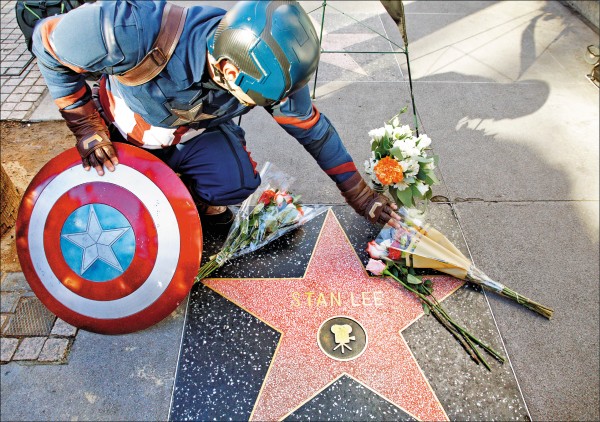
Lee died at the age of 95 at Cedars-Sinai Medical Center in Los Angeles, California, on November 12, 2018, after being rushed there in a medical emergency earlier in the day.[156][157]
His death was met with a wave of tributes, including Marvel stars and friends Robert Downey Jr., Chris Evans, Mark Ruffalo, Dwayne "The Rock" Johnson, and many more. [158]
https://en.wikipedia.org/wiki/Stan_Lee




.jpg)

.jpg)