返回列表 發帖

[轉貼] 土耳其總統艾爾段Recep Tayyip Erdogan命盤

雷傑普·塔伊普·艾爾多安[編輯]

維基百科,自由的百科全書
跳至導覽跳至搜尋
雷傑甫·塔伊甫·艾爾多安
Recep Tayyip Erdoğan
Recep Tayyip Erdogan 2017.jpg
 土耳其第12任總統
現任
就任日期
2014年8月28日
總理艾哈邁德·達夫歐魯(2014年-2016年)
比納利·葉德仁(至2018年)
副總統福阿德·奧克塔伊(2018年-)
前任阿卜杜拉·莒內
 土耳其第25任總理
任期
2003年3月14日-2014年8月28日
總統阿赫邁特·內吉代特·塞翟
阿卜杜拉·莒內
前任阿卜杜拉·莒內
繼任艾哈邁德·達夫歐魯
正義與發展黨領袖
現任
就任日期
2017年5月21日
前任比納利·葉德仁
任期
2001年8月14日-2014年8月27日
前任職位創立
繼任艾哈邁德·達夫歐魯
伊斯坦堡市長
任期
1994年3月27日-1998年11月6日
前任Nurettin Sözen
繼任Ali Müfit Gürtuna
個人資料
出生1954年2月26日64歲)
 土耳其伊斯坦堡貝伊奧盧區
國籍 土耳其
政黨福利黨(1981-1998)
美德黨(1998-2001)
正義與發展黨(2001-2014、2017~)
配偶埃米內·艾爾多安(1978年結婚)
兒女巴拉克(子)
比拉爾(子)
艾斯拉(女)
蘇梅耶(女)
母校Marmara University of Istanbul
宗教信仰伊斯蘭教遜尼派
網站www.rte.gen.tr
Erdoğan」的各地常用別名
中國大陸埃爾多安
臺灣艾爾多安[1]、艾爾段[2]、艾多根[3]
港澳埃爾多安

雷傑甫·塔伊甫·艾爾多安土耳其語Recep Tayyip Erdoğan土耳其語發音:[ɾeˈd͡ʒep tajˈjip ˈæɾdo.an] 聆聽;1954年2月26日),土耳其政治人物、伊斯蘭主義[4]新鄂圖曼主義民族保守主義者,曾連任3屆土耳其總理,現任土耳其總統正義與發展黨領袖。他是土耳其第一位通過直選方式先後擔任總理、總統職務的政治人物。

早期生活[編輯]

艾爾多安的父系先祖是喬治亞人。艾爾多安出生在伊斯坦堡貝伊奧盧的Kasımpaşa社區,他的家人搬到了里澤省。他的父母是Ahmet Erdoğan 和Tenzile Erdoğan。據說,艾爾多安在2003年說:「我是一個喬治亞人,我的家人來自一個喬治亞的家庭,從巴統遷到里澤。」然而,在2014年的NTV新聞網電視採訪中,他說:你不會相信他們對我說的話,他們說我是喬治亞人,原諒我說更糟糕的事情,他們甚至叫我亞美尼亞人,但我是土耳其人。

艾爾多安在里澤度過了他的童年,他的父親艾哈邁德·艾爾多安(Ahmet Erdoğan,1905年-1988年)是土耳其海岸警衛隊的船長。艾爾多安有兩個弟妹,Mustafa(1958年出生)和Vesile(1965年出生)。他的暑假主要是在里澤的居內伊蘇(Güneysu)度過。在他的一生中,他經常回到這個精神家園,2015年他在這個村莊附近的山頂上建了一座廣闊的清真寺。當艾爾多安13歲時,家人返回伊斯坦堡。

作為一個十幾歲的孩子,他在城市的艱困地區的街道上賣檸檬水和芝麻燒餅,以賺取額外的錢。艾爾多安於1965年畢業於Piyale小學,1973年畢業於宗教職業高中Imam Hatip school。他從Eyüp high school高中獲得高中畢業證書。他後來在Aksaray school經濟商業科學學院學習工商管理,現在被稱為馬爾馬拉大學經濟與行政科學學院 。

在他年輕的時候,艾爾多安在當地的俱樂部打了半職業足球。費內巴切體育俱樂部足球隊希望他來足球隊,但他的父親阻止了他。在他長大的地區的當地足球俱樂部卡森柏沙體育會的體育場以他命名。

艾爾多安於1978年7月4日與Emine Gülbaran(1955年出生)結婚。他們有兩個兒子:長子巴拉克於1979年出生,二子比拉爾於1981年出生;兩個女兒:三女艾斯拉於1983年出生,四女蘇梅耶於1985年出生。他的父親艾哈邁德·艾爾多安於1988年去世,他的88歲的母親Tenzile Erdoğan於2011年去世。

1981年加入主張政教合一的福利黨。1994年3月的地方選舉,他當選伊斯坦堡市長,任至1998年。

1998年1月16日,土耳其憲法法院取締了福利黨,艾爾多安與其他福利黨成員一同轉入新成立的美德黨,任伊斯坦堡黨部主席。1998年11月被迫辭職。1999年4月他因在1997年12月公開朗誦一首帶有宗教涵義的詩歌而入獄,土耳其國家安全法院以「發表煽動宗教仇恨言論」為由判處艾爾多安10個月監禁(實際上他只被監禁四個月),剝奪其政治權利五年,不能參選大國民議會。

2001年8月,美德黨被憲法法院取締,艾爾多安率領相對溫和的前美德黨新生派,創建正義與發展黨並出任領袖。正義與發展黨走表面上親西方的中間偏右路線,[5]也宣稱堅持世俗主義政教分離,但不同於以強硬手段推行世俗化的凱末爾主義,有意見認為正義與發展黨採取的是一種「政府與宗教互不干涉」的做法[6]

總理:2003-2014[編輯]

2001年上半年,土耳其經濟出現崩潰,國家的命運面臨危機,政府從國際貨幣基金組織獲得了巨額貸款。

2002年,正義與發展黨壓倒性贏得大選,在550席中獲得363席,共和人民黨分得178席,成立自1950年首個多數黨政府,按照規定艾爾多安本應成為新總理,但由於他被剝奪從政資格(五年內禁止參政),因此由副主席阿卜杜拉·莒內出任總理。其後國會對相應憲法條款進行修改,從而恢復了艾爾多安的從政資格。

2003年3月9日,艾爾多安參加補選並當選議員,3月11日,原總理,正義和發展黨副主席阿卜杜拉·莒內辭職,之後總統阿赫邁特·內吉代特·塞翟任命艾爾多安為總理並授權組閣。莒內改在其內閣中任職,擔任副總理兼外交部長。

正義與發展黨在當時獲大受民眾支持下,艾爾多安修改了憲法,取消了死刑,給庫爾德族人更大的自治和文化權利,並嚴厲打擊侵犯人權的行為。

艾爾多安政府在2004年提出把通姦刑事化的法案,遭到歐盟強烈反對,最終土耳其政府撤回通姦刑事化的提案。[7]

2005年1月,土耳其經濟的發展已非常穩定,開始採用新的土耳其里拉,每張鈔票的面額相應縮小至原先的一百萬分之一。2005年10月,土耳其在經過長期的努力之後,終於促使歐盟就其加入問題開始了正式談判。

2007年4月24日,提名盟友、原副總理莒內為總統候選人,[8]但因為反對黨聯合抵制,出席選舉的議員人數不足,投票未能舉行,莒內遂於5月6日宣布退出總統競選。[9]同年7月22日舉行的大國民議會選舉,正義與發展黨取得46.66%選票(341席),繼續取得勝利,成功連任,第二次擔任總理。8月13日,執政正義與發展黨宣布再次提名莒內競選總統。[10]8月28日,他在第三輪投票以過半數的339票擊敗民族主義行動黨民主左翼黨的候選人,當選土耳其總統。[11]10月21日,土耳其全民公決通過憲法修正案,這項憲法修正案將現行的議會選舉總統制改為全民直選;總統任期2014年起由7年降至5年,可以連任一屆。艾爾多安計劃參選首屆民選總統。

2010年土耳其修憲公投通過了新的憲法,限制了軍隊的權力,由文人掌管軍隊。[12][13]

艾爾多安其後提前於2011年6月12日舉行大國民議會選舉,他領導的正義與發展黨取得49.83%選票(327席),繼續取得勝利,第二度成功連任,第三次擔任總理。

2013年土耳其反政府抗議運動在5月底爆發以來,成為艾爾多安執政十年來的最大挑戰。他認為塔克西姆廣場「不能成為極端主義分子猖獗的地區」,呼籲伊斯坦堡民眾停止抗議,同時,他表示願意同抗議者展開對話,但是抗議者沒有明確的代表組織或個人。6月6日,土耳其總理艾爾多安反駁抗議行為是由不民主和極端分子操縱,示威者包括「極端分子,他們中的一些人和恐怖主義有牽連」。他說,重建計劃將繼續進行。[14] 這些講話播出不久,土耳其股市下跌5%。[15]艾爾多安結束他的外交之旅時,正義與發展黨大量散發短訊,並組織巴士,向阿塔圖爾克機場運送支持他的人群,並高呼口號「艾爾多安,我們會為你死」。

2014年3月21日,艾爾多安宣布全面禁止社交媒體「推特」的使用,此舉引發了土耳其社會輿論的強烈反響。自從土耳其去年年底爆發了執政的正義與發展黨部分官員牽涉貪腐醜聞的事件後,「推特」以及社交媒體「臉書」(Facebook)上就不時會有貪腐醜聞內幕和檢方辦案的內部文件被爆出。在去年6月的「蓋齊公園」抗議事件中,社交媒體成為了「社會最嚴重的威脅」。艾爾多安說,他並不在乎國際社會是如何評論的,所有人都將看到土耳其共和國的強大。隨後,土耳其總理府發表聲明稱,由於未能遵守法院要求刪除部分消息的規定,「推特」因此遭到禁用。聲明稱,如果「推特」堅持不遵守規定,那麼除了禁用將別無選擇。[16]

外交[編輯]

艾爾多安意圖恢復土耳其於昔日奧斯曼帝國時代在區內的影響力。[17]在他於2014年擔任土耳其總統後,繼任總理的艾哈邁德·達夫歐魯基本上跟隨艾爾多安的外交政策。

艾爾多安任內一直致力加強和中國的關係,不過土耳其被指包庇縱容東突分裂分子,更容許多個東突組織在土耳其活動[18][19]。2009年7月發生的烏魯木齊七·五暴力事件中,艾爾多安於7月8日表示,「我們居住在土耳其的維吾爾族同胞和土耳其人民心中感到萬分悲痛,舉行抗議要求制裁相關事件。我們一向視我們維族同胞是土中之間的橋樑。因此,歷史上我們的國家一直保持著聯繫。中國必須採取必要的措施,制止這一野蠻行徑。2009年至2010年,我們是聯合國安理會非常任理事國,我們會將此事遞交安理會審議。」艾爾多安指責中國對維吾爾人進行種族滅絕,[20]引起中國輿論反駁[21]

2012年4月8至11日,艾爾多安對中國進行為期4天的訪問。這是27年來土耳其總理首次訪問中國,也是土耳其總理首次訪問中國新疆維吾爾族自治區。[22]

艾爾多安執政後,土耳其與以色列關係開始惡化。雖然土耳其與其他阿拉伯國家相比之下,仍然承認以色列並與以色列維持外交關系,但土耳其和以色列的關系一直緊張。艾爾多安更在2009年出席瑞士世界經濟論壇會議期間離席抗議同場的以色列總統西蒙·佩雷斯及以色列的對巴勒斯坦的政策。[23]艾爾多安也被指有反以色列和反猶太傾向。[24]以色列在2010年5月襲擊多國民間人士為加沙提供物資的國際援助船隊,導致了慘重的人員傷亡,其中土耳其蒙受的損失最嚴重。當船隊行至距離加沙海岸40多海里的公海上時,以色列武裝部隊對船隊進行攔截,並與船上救援人員發生衝突,過程中導致九人死亡、多人受傷。死者幾乎全部是土耳其人。這一事件在國際社會引起了軒然大波,在土耳其國內更是引發了大規模的抗議示威。[25]土耳其與以色列關係至此十分緊張。艾爾多安支持巴勒斯坦自治政府的同時,被指同時支持主張消滅以色列的哈馬斯,而土耳其被外界認為是哈馬斯的盟友之一。[26][27]以色列批評土耳其政府容許哈馬斯從土耳其策劃針對以色列的恐怖襲擊,而土耳其則反駁指以色列的指控無真憑實據。[28]

艾爾多安執政後,直至敘利亞爆發內戰前,土耳其與敘利亞關係良好。[29]然而在敘利亞內戰開始後,艾爾多安政府支持敘利亞叛軍對抗巴沙爾·阿薩德政府,[30]同時又敵視在敘利亞北部興起的親庫爾德工人黨敘利亞庫爾德族武裝。土耳其也被批評暗中包庇縱容伊斯蘭國恐怖分子。[31]

艾爾多安於2008年2月到德國向在德的土耳其人發表演說時警告他們不要被其它文化同化,並表示「這種文化融合是反人類罪行」,[32]引起德國總理安格拉·默克爾的異議[33]

艾爾多安於2012年埃及總統選舉,支持有穆斯林兄弟會背景的埃及民選總統穆罕默德·穆爾西[17]埃及軍方於2013年發動政變推翻穆爾西政府後,土耳其與埃及關係惡化,艾爾多安更稱埃及新總統阿卜杜勒-法塔赫·塞西為暴君。[34]

利比亞於2014年出現兩個政府對峙的局面,當中土耳其支持控制的黎波里的伊斯蘭主義者政府。[35]

總統[編輯]

2014年8月10日,艾爾多安在土耳其歷史首次總統直選中以51.71%的得票率成功當選總統一職,8月28日正式就職,他在就職儀式上發表演講表示:「作為總統,我發誓維護國家的存在和獨立;維護國家和民族不可分割的完整性;遵守憲法、法治、民主和阿塔圖爾克的原則,遵守世俗共和國的原則;不與國家和平與繁榮、民族團結與正義以及公民權利與自由的意志相背離;維護國家榮譽;為公正履行我的職責而努力。」「將繼續推行和平、團結和繁榮的外交政策,並將繼續推動加入歐盟的談判進程。」[36]

耗資超過6億美元興建的新總統官邸「白宮」

2014年8月30日,艾爾多安為耗資超過6億美元興建的新總統官邸剪綵。[37]該個被稱為「白宮」的建築群原定用作總理官邸,在艾爾多安改任總統後改作總統官邸。[38]

2015年[編輯]

艾爾多安於2015年在總統府會見巴勒斯坦自治政府主席馬哈茂德·阿巴斯,背後的16個衛兵裝扮成古代戰士,象徵從匈奴奧斯曼帝國16個被土耳其政府認為是土耳其民族歷史上的帝國[39]

正義與發展黨在2015年6月土耳其國會選舉未能取得過半數議席,而親庫爾德人的人民民主黨則首次成功突破10%全國得票率門檻而得以晉身國會。隨後伊斯蘭國蘇魯奇以自殺炸彈襲擊親庫爾德人的集會。一些庫爾德人懷疑土耳其政府串通伊斯蘭國對庫爾德人發動襲擊,庫爾德工人黨再度襲擊土耳其軍警,土耳其政府則大舉搜捕工人黨成員並動用軍隊攻擊伊拉克北部的工人黨目標,雙方維持兩年多的停火全面破裂。[40]艾爾多安被指企圖藉打擊庫爾德工人黨,為正發黨在下一次國會選舉爭取民族主義者選票。[41]同年10月安卡拉一個親庫爾德族集會發生死傷更慘重的恐怖襲擊[40]最終正發黨在同年11月的國會選舉成功取得過半數議席。

2015年11月,土耳其空軍撃落一架俄羅斯戰機,引致俄土關係急劇惡化,俄羅斯宣布對土耳其實施多項制裁。[42]直至2016年6月俄土關係才有所改善。[43]

2016年[編輯]

2016年2月,艾爾多安威脅開放希臘和保加利亞的邊境,讓數百萬難民湧入歐洲[44]同月土耳其表示有意與沙烏地阿拉伯聯手出動地面部隊進入敘利亞,只待以美國為首的反伊斯蘭國多國聯盟同意,[45]俄羅斯總理梅德韋傑夫警告此舉將會引發第三次世界大戰[46]

2016年3月20日,土耳其與歐盟關於阻止難民從土耳其偷渡往歐洲的新協議開始生效,歐盟每遣返一名非法移民回土耳其,需同時從土耳其接收一名合資格的敘利亞難民,歐盟並同意向土耳其提供最多60億歐元,並在滿足指定條件後向土耳其國民給予免簽證進入歐盟待遇。[47]比利時首相夏爾·米歇爾形容歐盟與土耳其的談判遇到敲詐[48]同月17日,北德廣播公司在一檔諷刺節目中播出根據《無論怎樣,無論何地,無論何時》改編以調侃艾爾多安的歌曲《Erdowie, Erdowo, Erdoğan》,導致安卡拉方面召見德國駐土大使馬丁·艾德曼,表示抗議。[49]此後,德國電視主持人揚·伯默爾曼更因在節目中朗讀諷刺艾爾多安鎮壓少數族裔、虐待庫德人和基督教徒等行為的打油詩而被艾爾多安起訴,是為伯默爾曼事件[50][51][52]

艾哈邁德·達夫歐魯接替艾爾多安擔任總理後,與總統艾爾多安在政策上出現分歧。達夫歐魯被認為不支持艾爾多安以修憲擴大總統權力的計劃,達夫歐魯也比較傾向與庫爾德工人黨恢復談判。[53]有意見認為達夫歐魯與艾爾多安在土耳其成功爭取歐盟同意在滿足指定條件後給予土耳其國民免簽證待遇上爭功,加劇兩人不和。[54]2016年5月5日,達夫歐魯宣布將會辭去正義與發展黨主席及土耳其總理職務。[53]比納利·葉德仁接任總理。

2016年7月15日,一批反對正義與發展黨的軍人發動軍事政變意圖推翻艾爾多安政府,迅即被平定。土耳其當局隨即解除數萬人職務並逮捕了近萬人,還向近200名行政法院和上訴法院司法人員發出拘捕令。要求美國引渡土耳其方面認定的政變主謀居倫。[55][56]艾爾多安被指通過未逐政變整肅政治異己,打壓政治異見分子、大規模拘捕教師、法官及記者,破壞新聞自由司法獨立

2017年[編輯]

艾爾多安發動修憲公投,將土耳其現行的議會制改為總統制,廢除總理職務,總統身兼國家元首政府首腦,並被賦予極大的權力。

2017年4月29日起,土耳其政府對維基百科所有語言版本實施網絡封鎖[57]

2018年[編輯]

艾爾多安於2018年4月18日宣布原定於2019年11月3日舉行的總統暨國會大選將提前至2018年6月24日舉行。

艾爾多安在總統選舉首輪投票取得過半數票成功連任。[58]正義與發展黨連同盟右翼土耳其民族發展黨獲得過半數議席組成聯合政府,土耳其正式實行總統制,艾爾多安正式成為擁有行政權力的總統。

家庭[編輯]

觀點[編輯]

艾爾多安認為穆斯林家庭不應該節育[61]他於2014年批評在土耳其推行節育是叛國行為。他曾經呼籲婦女應該至少生育三個孩子,如果生育四至五個更好。[4]他於2016年的一次演講中表示「土耳其將要生育更多後代,這是先知(穆罕默德)指引的道路」。[62]

https://zh.wikipedia.org/wiki/%E9%9B%B7%E6%9D%B0%E6%99%AE%C2%B7%E5%A1%94%E4%BC%8A%E6%99%AE%C2%B7%E5%9F%83%E5%B0%94%E5%A4%9A%E5%AE%89


請從論壇首頁右上角進入「個人中心」,就可以編輯您個人的頭像、簽名檔及自我介紹。請用高級模式回覆,點HTML框,可有更多變化豐富版面。
不怕辛苦,就怕不公平;不怕卑微,就怕不公義。
可以哭泣,不要洩氣;可以悲傷,不要放棄!

Recep Tayyip Erdoğan

From Wikipedia, the free encyclopedia
Jump to navigationJump to search

Recep Tayyip Erdoğan
Recep Tayyip Erdogan 2017.jpg
Erdoğan in 2017
12th President of Turkey
Assumed office 
28 August 2014
Prime MinisterAhmet Davutoğlu (2014-16)
Binali Yıldırım (2016-18)
Vice PresidentFuat Oktay (2018-)
Preceded byAbdullah Gül
Leader of the Justice and Development Party
Assumed office 
21 May 2017
Preceded byBinali Yıldırım
In office
14 August 2001 – 27 August 2014
Preceded byOffice established
Succeeded byAhmet Davutoğlu
25th Prime Minister of Turkey
In office
14 March 2003 – 28 August 2014
President
Deputy
Preceded byAbdullah Gül
Succeeded byAhmet Davutoğlu
28th Mayor of Istanbul
In office
27 March 1994 – 6 November 1998
Preceded byNurettin Sözen
Succeeded byAli Müfit Gürtuna
Member of the Grand National Assembly
In office
9 March 2003 – 28 August 2014
Constituency
Personal details
Born26 February 1954 (age 64)
KasımpaşaIstanbulTurkey
Political party
Spouse(s)
Emine Gülbaran (m. 1978)
Children
ResidencePresidential Complex
Alma materMarmara University[1]
Signature
WebsiteGovernment website
Personal website

Recep Tayyip Erdoğan (/ˈɛərdəwæn/;[2]Turkish: [ɾeˈdʒep tajˈjip ˈæɾdoːan] (About this soundlisten); born 26 February 1954) is a Turkish politician serving as President of Turkey since 2014. He previously served as Prime Minister from 2003 to 2014 and as Mayor of Istanbul from 1994 to 1998. He founded the Justice and Development Party (AKP) in 2001, leading it to general election victories in 20022007 and2011 before standing down upon his election as President in 2014. Coming from an Islamistpolitical background and as a self-describedconservative democrat, he has promotedsocially conservative and liberal economicpolicies in his administration.[3] Under his administration, Turkey has experienceddemocratic backsliding.[4]

Erdoğan played football for Kasımpaşa before being elected in 1994 as the Mayor of Istanbulfrom the Islamist Welfare Party. He was stripped of his position, banned from political office, and imprisoned for four months, for reciting a poem that promoted a religious point of view of government during a speech in 1998.[5] Erdoğan abandoned openly Islamist politics and established the moderate conservative AKP in 2001. Following the AKP's landslide victory in 2002, the party's co-founder Abdullah Gül became Prime Minister, until his government annulled Erdoğan's ban from political office. Erdoğan became Prime Minister in March 2003 after winning a by-election in Siirt.[6]

Erdoğan's government oversaw negotiations for Turkey's membership in the European Union, an economic recovery following afinancial crash in 2001, changes to the constitution via referenda in 2007 and 2010, aNeo-Ottoman foreign policy, and investments in infrastructure including roadsairports, and a high-speed train network,[7][8] and finally theTurkish currency and debt crisis of 2018.[9][10][11] With the help of the Cemaat Movement led by preacher Fethullah Gülen, Erdoğan was able to curb the power of themilitary through the Sledgehammer andErgenekon court cases. In late 2012, his government began peace negotiations with the Kurdistan Workers Party (PKK) to end theongoing PKK insurgency that began in 1978. The ceasefire broke down in 2015, leading to a renewed escalation in conflict. In 2016, acoup d'état was unsuccessfully attemptedagainst Erdoğan and Turkish state institutions. This was followed by purges and an ongoing state of emergency.

Political scientists no longer consider Turkey as a fully fledged democracy, citing the lack of free and fair elections, purges and jailing of opponents, curtailed press freedom, and Erdoğan's efforts to broadening his executive powers and minimize his executive accountability.[4][12][13][14] Widespread 2013 protests broke out against the perceivedauthoritarianism of Erdoğan's policies; he criticized the protestors and then had them suppressed by police, which killed 22 people, injured numerous others and brought international condemnation from foreign governments and human rights organizations. This stalled negotiations related to EU membership. Following a split with Gülen, Erdoğan promulgated sweeping judicial reforms he insisted were needed to purge Gülen's sympathisers, but which were criticised for threatening judicial independence. A US$100 billion corruption scandal in 2013 led to the arrests of Erdoğan's close allies, and incriminated Erdoğan.[15][16][17] His government has since come under fire for alleged human rights violations and crackdown on press and social media, having blocked access to Wikipedia, Twitter, Facebook and YouTube on numerous occasions.[18] Erdoğan's government lifted the bans when directed by court orders,[19][20][21]but later reimposed them.[22][23] In 2016, Turkey under Erdoğan began a crackdown onfreedom of the press; in 2016 and 2017, more journalists have been incarcerated in Turkey than in any other country.[24] He was re-elected in the 2018 general election and assumed the role of Executive President and became both the head of state and head of government.

Personal life and education

Erdoğan and Abdullah Gül with their respective spouses

Erdoğan was born in the Kasımpaşa neighborhood inIstanbul, to which his family had moved from Rize Province. His parents were Ahmet (1905–88) and Tenzile Erdoğan.[25] In August 2003 during his official visit inTbilisi, Erdoğan reportedly explained his Georgian roots. He told the story of his Adjarian forefathers, which migrated after the Russo-Turkish War (1877–78) from Batumi toRize.[26][27] According to journalistic investigation held byOdaTV in 2009, his grandfather's nickname "Bakatalı" is claimed to be originating from the village of Bagata, today in the Tskhinvali District of South Ossetia.[28] Georgians in Turkey are basically Muslims, who had arrived during Ottoman times in several waves of migration from Caucasus, due to the Russo-Turkish Wars.

However in a 2014 televised interview on the NTV news network, he said, "You wouldn't believe the things they have said about me. They have said I am Georgian... forgive me for saying this... even much uglier things, they have even called me an Armenian, but I am Turkish."[29][30]

Erdoğan spent his early childhood in Rize, where his father was a Captain[31] in the Turkish Coast Guard.[32] Erdoğan had a brother Mustafa (b. 1958) and sister Vesile (b. 1965).[31]His summer holidays were mostly spent in GüneysuRize, where his family originates. Throughout his life he often returned to this spiritual home, and in 2015 he opened a vast mosque on a mountaintop near this village.[33] The family returned to Istanbul when Erdoğan was 13 years old.[32]

As a teenager, he sold lemonade and sesame buns (simit) on the streets of the city's rougher districts to earn extra money.[32] Brought up in an observant Muslim family, Erdoğan graduated from Kasımpaşa Piyale primary school in 1965, and İmam Hatip school, a religious vocational high school, in 1973. He received his high school diploma from Eyüp High School. According to his official biography, he subsequently studied Business Administration at the Aksaray School of Economics and Commercial Sciences, now known as Marmara University's Faculty of Economics and Administrative Sciences[1] — although several Turkish sources dispute that he attended or graduated.[34][35][36]

In his youth, Erdoğan played semi-professional football at a local club.[1][37][38] Fenerbahçewanted him to transfer to the club but his father prevented it.[39] The stadium of the local football club in the district where he grew up, Kasımpaşa S.K. is named after him.

Erdoğan married Emine Gülbaran (born 1955, Siirt) on 4 July 1978.[40] They have two sons; Ahmet Burak and Necmettin Bilal, and two daughters, Esra and Sümeyye.[40] His father, Ahmet Erdoğan, died in 1988 and his 88-year-old mother, Tenzile Erdoğan, died in 2011.[41] He is a member of the Community of İskenderpaşa, a Turkish sufistic community of Naqshbandi tariqah.[42][43]

Early political career

While studying business administration[citation needed] and playing semi-professional football, Erdoğan engaged in politics by joining the National Turkish Student Union, an anti-communist action group. In 1974, he wrote, directed and played the lead role in the playMaskomya, which presented FreemasonryCommunism and Judaism as evil.[44] In 1976, he became the head of the Beyoğlu youth branch of the Islamist National Salvation Party(MSP),[45] and was later promoted to chair of the Istanbul youth branch of the party.

After the 1980 military coup, Erdoğan followed most of Necmettin Erbakan's followers into the Islamist Welfare Party. He became the party's Beyoğlu district chair in 1984, and in 1985 he became the chair of the Istanbul city branch. He was elected to parliament in 1991, but barred from taking his seat.[citation needed]

Mayor of Istanbul (1994–98)

In the local elections of 27 March 1994, Erdoğan was elected Mayor of Istanbul, with a plurality (25.19%) of the popular vote. He was pragmatic in office, tackling many chronic problems in Istanbul including water shortage, pollution and traffic chaos. The water shortage problem was solved with the laying of hundreds of kilometers of new pipelines. The garbage problem was solved with the establishment of state-of-the-art recycling facilities. While Erdoğan was in office, air pollution was reduced through a plan developed to switch to natural gas. He changed the public buses to environmentally friendly ones. The city's traffic and transportation jams were reduced with more than fifty bridges, viaducts, and highways built. He took precautions to prevent corruption, using measures to ensure that municipal funds were used prudently. He paid back a major portion of IstanbulMetropolitan Municipality's two billion dollar debt and invested four billion dollars in the city.[46]

Erdoğan initiated the first roundtable of mayors during the Istanbul conference, which led to a global, organized movement of mayors. A seven-member international jury from the United Nations unanimously awarded Erdoğan the UN-HABITAT award.[47][ink_rot" title="Wikipediaink rot" style="text-decoration: none; color: rgb(11, 0, 128); background: none;">dead link]

Imprisonment

In 1998, the fundamentalist Welfare Party was declared unconstitutional on the grounds of threatening the secularism of Turkey and was shut down by the Turkish constitutional court. Erdoğan became a prominent speaker at demonstrations held by his party colleagues.[48]

In December 1997 in Siirt, Erdoğan recited a poem from a work written by Ziya Gökalp, a pan-Turkish activist of the early 20th century.[49] His recitation included verses translated as "The mosques are our barracks, the domes our helmets, the minarets our bayonets and the faithful our soldiers...."[32] which are not in the original version of the poem. Erdoğan said the poem had been approved by the education ministry to be published in textbooks.[50] Under article 312/2 of the Turkish penal code his recitation was regarded as an incitement to violence and religious or racial hatred.[51] He was given a ten-month prison sentence of which he served four months, from 24 March 1999 to 27 July 1999.[5] Due to his conviction, Erdoğan was forced to give up his mayoral position. The conviction also stipulated a political ban, which prevented him from participating in parliamentary elections.[52] He had appealed for the sentence to be converted to a monetary fine, but it was reduced to 120 days instead.[53] In 2017, this period of Erdoğan's life was made into a film titled Reis.[54]

Prime Minister (2003–14)

Erdoğan making a press release at the Prime Minister's Office in Ankara

General elections

An election campaign poster featuring Erdoğan: "Istanbul is Ready, Target 2023", Taksim SquareIstanbul.

In 2001, Erdoğan established the Justice and Development Party (AKP).[citation needed] The elections of 2002 were the first elections in which Erdoğan participated as a party leader. All parties previously elected to parliament failed to win enough votes to re-enter the parliament. The AKP won 34.3% of the national vote and formed the new government. Turkish stocks rose more than 7% on Monday morning. Politicians of the previous generation, such as EcevitBahceli,Yılmaz and Çiller, resigned. The second largest party, the CHP, received 19.4% of the votes. The AKP won a landslide victory in the parliament, taking nearly two-thirds of the seats. Erdoğan could not become Prime Minister as he was still banned from politics by the judiciary for his speech in Siirt. Gül became the Prime Minister instead. In December 2002, the Supreme Election Board canceled the general election results from Siirt due to voting irregularities and scheduled a new election for 9 February 2003. By this time, party leader Erdoğan was able to run for parliament due to a legal change made possible by the opposition Republican People's Party. The AKP duly listed Erdoğan as a candidate for the rescheduled election, which he won, becoming Prime Minister after Gül handed over the post.[55]

Posters of Erdoğan and his rival Ekmeleddin İhsanoğlu during2014 presidential election,Istanbul

On 14 April 2007, an estimated 300,000 people marched inAnkara to protest against the possible candidacy of Erdoğan in the 2007 presidential election, afraid that if elected as President, he would alter the secular nature of the Turkish state.[56] Erdoğan announced on 24 April 2007 that the party had nominated Abdullah Gül as the AKP candidate in the presidential election.[57] The protests continued over the next several weeks, with over one million people reported to have turned out at a 29 April rally in Istanbul,[58] tens of thousands at separate protests on 4 May in Manisa and Çanakkale,[59] and one million in İzmir on 13 May.[60]

The stage of the elections of 2007 was set for a fight for legitimacy in the eyes of voters between his government and the CHP. Erdoğan used the event that took place during the ill-fated Presidential elections a few months earlier as a part of the general election campaign of his party. On 22 July 2007, the AKP won an important victory over the opposition, garnering 46.7% of the popular vote. 22 July elections marked only the second time in the Republic of Turkey's history whereby an incumbent governing party won an election by increasing its share of popular support.[61] On 14 March 2008, Turkey's Chief Prosecutor asked the country's Constitutional Court to ban Erdoğan's governing party.[62]The party escaped a ban on 30 July 2008, a year after winning 46.7% of the vote in national elections, although judges did cut the party's public funding by 50%.[63]

In the June 2011 elections, Erdoğan's governing party won 327 seats (49.83% of the popular vote) making Erdoğan the only prime minister in Turkey's history to win three consecutive general elections, each time receiving more votes than the previous election. The second party, the Republican People's Party (CHP), received 135 seats (25.94%), the nationalist MHP received 53 seats (13.01%), and the Independents received 35 seats (6.58%).[64]

Kurdish issue

In 2009, Prime Minister Erdoğan's government announced a plan to help end the quarter-century-long Turkey–Kurdistan Workers' Party conflict that had cost more than 40,000 lives. The government's plan, supported by the European Union, allowed the Kurdish language to be used in all broadcast media and political campaigns, and restored Kurdish names to cities and towns that had been given Turkish ones.[65] Erdoğan said, "We took a courageous step to resolve chronic issues that constitute an obstacle along Turkey's development, progression and empowerment".[65] Erdoğan passed a partial amnesty to reduce penalties faced by many members of the Kurdish guerrilla movement PKK who had surrendered to the government.[66] On 23 November 2011, during a televised meeting of his party in Ankara, he apologised on behalf of the state for the Dersim massacre, where many Alevis and Zazas were killed.[67]

Armenian Genocide

Prime Minister Erdoğan expressed multiple times that Turkey would acknowledge the mass killings of up to 1.5 million Armenians during World War I as genocide only after a thorough investigation by a joint Turkish-Armenian commission consisting of historians,archaeologistspolitical scientists and other experts.[68][69][better source needed] In 2005, Erdoğan and the main opposition party leader Deniz Baykal wrote a letter to Armenian President Robert Kocharian, proposing the creation of a joint Turkish-Armenian commission.[70] Armenian Foreign Minister Vartan Oskanian rejected the offer because he asserted that the proposal itself was "insincere and not serious." He added: "This issue cannot be considered at historical level with Turks, who themselves politicized the problem."[71][72]

In December 2008, Erdoğan criticised the I Apologize campaign by Turkish intellectuals to recognize the Armenian Genocide, saying, "I neither accept nor support this campaign. We did not commit a crime, therefore we do not need to apologise ... It will not have any benefit other than stirring up trouble, disturbing our peace and undoing the steps which have been taken."[73] In November 2009, he said, "it is not possible for those who belong to the Muslim faith to carry out genocide."[74][75]
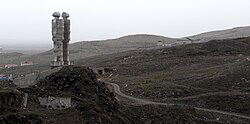
In 2011, Recep Tayyip Erdoğan ordered the Monument to Humanity, a statue dedicated to fostering Armenian and Turkish relations, to be destroyed.

In 2011, Erdoğan ordered the tearing-down of theStatue of Humanity, a Turkish-Armenian friendship monument in Kars, which was commissioned in 2006 and represented a metaphor of the rapprochement of the two countries after many years of dispute over the events of 1915. Erdoğan justified the removal by stating that the monument was offensively close to the tomb of an 11th-century Islamic scholar, and that its shadow ruined the view of that site, while Kars municipality officials said it was illegally erected in a protected area. However, the former mayor of Kars who approved the original construction of the monument said the municipality was destroying not just a "monument to humanity" but "humanity itself". The demolition was not unopposed; among its detractors were several Turkish artists. Two of them, the painter Bedri Baykam and his associate, Pyramid Art Gallery general coordinator Tugba Kurtulmus, were stabbed after a meeting with other artists at the Istanbul Akatlar cultural center.[76]

On 23 April 2014, Erdoğan's office issued a statement in nine languages (including two dialects of Armenian), offering condolences for the mass killings of Armenians and stating that the events of 1915 had inhumane consequences. The statement described the mass killings as the two nations' shared pain and said: "Having experienced events which had inhumane consequences – such as relocation – during the First World War, (it) should not prevent Turks and Armenians from establishing compassion and mutually humane attitudes among one another".[77]

Human rights

During Erdoğan's time as Prime Minister, the far-reaching powers of the 1991 Anti-Terror Law were reduced and the Democratic initiative process was initiated, with the goal to improve democratic standards in general and the rights of ethnic and religious minorities in particular. However, after Turkey's bid to join the European Union stalled, European officials noted a return to more authoritarian ways,[78] notably on freedom of speech,[79][80][81] freedom of the press[82][83][84] and Kurdish minority rights.[85][86][87][88]Demands by activists for the recognition of LGBT rights were publicly rejected by government members,[89] and members of the Turkish LGBT community were insulted by cabinet members.[90]

Reporters Without Borders observed a continuous decrease in Freedom of the Press during Erdoğan's later terms, with a rank of around 100 on the Press Freedom Index during his first term and a rank of 154 out of a total of 179 countries in 2013.[91] Freedom House saw a slight recovery in later years and awarded Turkey a Press Freedom Score of 55/100 in 2012 after a low point of 48/100 in 2006.[92][93][94][95]

In 2011, Erdoğan's government made legal reforms to return properties of Christian and Jewish minorities which were seized by the Turkish government in the 1930s.[96] The total value of the properties returned reached $2 billion (USD).[97]

Under Erdoğan, the Turkish government tightened the laws on the sale and consumption of alcohol, banning all advertising and increasing the tax on alcoholic beverages.[98]

Economy
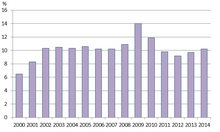
Unemployment rate of Turkey between 2000 and 2014

In 2002, Erdoğan inherited a Turkish economy that was beginning to recover from a recession as a result of reforms implemented by Kemal Derviş.[99] Erdoğan supported Finance MinisterAli Babacan in enforcing macro-economic policies. Erdoğan tried to attract more foreign investors to Turkey and lifted many government regulations. The cash-flow into the Turkish economy between 2002 and 2012 caused a growth of 64% in real GDP and a 43% increase in GDP per capita; considerably higher numbers were commonly advertised but these did not account for the inflation of the US dollar between 2002 and 2012.[100] The average annual growth in GDP per capita was 3.6%. The growth in real GDP between 2002 and 2012 was higher than the values from developed countries, but was close to average when developing countries are also taken into account. The ranking of the Turkish economy in terms of GDP moved slightly from 17 to 16 during this decade. A major consequence of the policies between 2002 and 2012 was the widening of the current account deficit from 600 million USD to 58 billion USD (2013 est.)[101]

Since 1961, Turkey has signed 19 IMF loan accords. Erdoğan's government satisfied the budgetary and market requirements of the two during his administration and received every loan installment, the only time any Turkish government has done so.[102] Erdoğan inherited a debt of $23.5 billion to the IMF, which was reduced to $0.9 billion in 2012. He decided not to sign a new deal. Turkey's debt to the IMF was thus declared to be completely paid and he announced that the IMF could borrow from Turkey.[103] In 2010, five-year credit default swaps for Turkey's sovereign debt were trading at a record low of 1.17%, below those of nine EU member countries and Russia. In 2002, the Turkish Central Bank had $26.5 billion in reserves. This amount reached $92.2 billion in 2011. During Erdoğan's leadership, inflation fell from 32% to 9.0% in 2004. Since then, Turkish inflation has continued to fluctuate around 9% and is still one of the highest inflation rates in the world.[104] The Turkish public debt as a percentage of annual GDP declined from 74% in 2002 to 39% in 2009. In 2012, Turkey had a lower ratio of public debt to GDP than 21 of 27 members of the European Union and a lower budget deficit to GDP ratio than 23 of them.[105]

In 2003, Erdoğan's government pushed through the Labor Act, a comprehensive reform of Turkey's labor laws. The law greatly expanded the rights of employees, establishing a 45-hour workweek and limiting overtime work to 270 hours a year, provided legal protection against discrimination due to sex, religion, or political affiliation, prohibited discrimination between permanent and temporary workers, entitled employees terminated without "valid cause" to compensation, and mandated written contracts for employment arrangements lasting a year or more.[106][107]

Education

Erdoğan increased the budget of the Ministry of Education from 7.5 billion lira in 2002 to 34 billion lira in 2011, the highest share of the national budget given to one ministry.[108]Before his prime ministership the military received the highest share of the national budget.Compulsory education was increased from eight years to twelve.[109] In 2003, the Turkish government, together with UNICEF, started a campaign called "Come on girls, let's go to school!" (TurkishHaydi Kızlar Okula!). The goal of this campaign was to close the gender-gap in primary school enrollment through the provision of a quality basic education for all girls, especially in southeast Turkey.[110]

In 2005, the parliament granted amnesty to students expelled from universities before 2003. The amnesty applied to students dismissed on academic or disciplinary grounds.[111] In 2004, textbooks became free of charge and since 2008 every province in Turkey has its own university.[112] During Erdoğan's Premiership, the number of universities in Turkeynearly doubled, from 98 in 2002 to 186 in October 2012.[113]

The Prime Minister kept his campaign promises by starting the f@tih project in which all state schools, from preschool to high school level, received a total of 620,000 smart boards, while tablet computers were distributed to 17 million students and approximately one million teachers and administrators.[114]

In June 2017 a draft proposal by the ministry of education was approved by Erdoğan, in which the curriculum for schools excluded the teaching of the theory of evolution of Charles Darwin by 2019. From then on the teaching will be postponed and start at undergraduate level.[115]

Infrastructure

Under Erdoğan's government, the number of airports in Turkey increased from 26 to 50.[116]Between the founding of the Republic of Turkey in 1923 and 2002, there had been 6000 km of dual carriageway roads created. Between 2002 and 2011, another 13500 km of expressway were built. Due to these measures, the number of motor accidents fell by 50 percent.[117] For the first time in Turkish history, high speed railway lines were constructed, and the country's high-speed train service began in 2009.[118] In 8 years, 1076 km of railway were built and 5449 km of railway renewed. The construction of Marmaray, an undersea rail tunnel under the Bosphorus strait, started in 2004. When completed, it will be the world's deepest undersea immersed tube tunnel.[citation needed] Construction of the 1.9 km long Yavuz Sultan Selim Bridge began in 2013.[119] The chosen name for the bridge led to protests by Alevis in Turkey because of the role Sultan Selim I, nicknamed "the Grim" due to his cruelty, played in the Ottoman persecution of Alevis.[120]

Justice

In March 2006, the Supreme Board of Judges and Prosecutors (HSYK) held a press conference to publicly protest the obstruction of the appointment of judges to the high courts for over 10 months. The HSYK said Erdoğan wanted to fill the vacant posts with his own appointees. Erdoğan was accused of creating a rift with Turkey's highest court of appeal, the Yargıtay, and high administrative court, the Danıştay. Erdoğan stated that the constitution gave the power to assign these posts to his elected party.[121]

In May 2007, the head of Turkey's High Court asked prosecutors to consider whether Erdoğan should be charged over critical comments regarding the election of Abdullah Gülas President.[121] Erdoğan said the ruling was "a disgrace to the justice system", and criticized the Constitutional Court which had invalidated a presidential vote because a boycott by other parties meant there was no quorum. Prosecutors investigated his earlier comments, including saying it had fired a "bullet at democracy". Tülay Tuğcu, head of the Constitutional Court, condemned Erdoğan for "threats, insults and hostility" towards the justice system.[122]

The Turkish parliament agreed to reduce the age of candidacy to the parliament from 30 to 25 and abolished the death penalty in all instances, including war time.[citation needed]

Women and demographics

Erdoğan supported the continuation of Turkey's high population growth rate and, in 2008, commented that to ensure the Turkish population remained young every family would need to have at least three children.[123][124] He repeated this statement on numerous occasions.[125] In 2010, Turkey's population was estimated at 73,700,000, with a growth rate of 1.21% per annum (2009 figure).[126]

On 26 May 2012, answering the question of a reporter after a UN conference on population and development in Turkey, Erdoğan said that abortion is murder, saying, "You either kill a baby in the mother's womb or you kill it after birth. In many cases [not all], there's no difference."[127]

Erdoğan has stated that he opposes Turkey's high and growing rate of caesarean sectionbirths because he believes that they reduce the fertility of Turkish women, and he is in favor of limiting the number of such births in Turkish hospitals.[128][129]

In a 2010 meeting with women NGO representatives, asked why he kept addressing them exclusively as mothers, Erdoğan said: "I do not believe in the equality of men and women. I believe in equal opportunities. Men and women are different and complementary."[130] In 2014, he addressed the Istanbul Women and Justice Summit of the Women and Democracy Association (TurkishKadın ve Demokrasi Derneği, or KADEM): "Our religion [Islam] has defined a position for women [in society]: motherhood. You cannot explain this to feminists because they don't accept the concept of motherhood." Calling for "equivalency" between the genders, he stated: "You cannot bring women and men into equal positions; that is against nature because their nature is different," while reaffirming that full equality regardless of gender before the law should be maintained.[131]

Health care

After assuming power in 2003, Erdoğan's government embarked on a sweeping reform program of the Turkish healthcare system, called the Health Transformation Program (HTP), to greatly increase the quality of healthcare and protect all citizens from financial risks. Its introduction coincided with the period of sustained economic growth, allowing the Turkish government to put greater investments into the healthcare system. As part of the reforms, the "Green Card" program, which provides health benefits to the poor, was expanded in 2004.[132] The reform program aimed at increasing the ratio of private to state-run healthcare, which, along with long queues in state-run hospitals, resulted in the rise of private medical care in Turkey, forcing state-run hospitals to compete by increasing quality.

In April 2006, Erdoğan unveiled a social security reform package demanded by theInternational Monetary Fund under a loan deal. The move, which Erdoğan called one of the most radical reforms ever, was passed with fierce opposition. Turkey's three social security bodies were united under one roof, bringing equal health services and retirement benefits for members of all three bodies. The previous system had been criticized for reserving the best healthcare for civil servants and relegating others to wait in long queues. Under the second bill, everyone under the age of 18 years was entitled to free health services, irrespective of whether they pay premiums to any social security organization. The bill also envisages a gradual increase in the retirement age: starting from 2036, the retirement age will increase to 65 by 2048 for both women and men.[133]

In January 2008, the Turkish Parliament adopted a law to prohibit smoking in most public places. Erdoğan is outspokenly anti-smoking.[134]

2007 and 2010 Constitutional Referendums

After the opposition parties deadlocked the 2007 presidential election by boycotting the parliament, the ruling AKP proposed a constitutional reform package. The reform package was first vetoed by president Sezer. Then he applied to the Turkish constitutional court about the reform package, because the president is unable to veto amendments for the second time. The Turkish constitutional court did not find any problems in the packet and 68.95% of the voters supported the constitutional changes.[135] The reforms consisted of: electing the president by popular vote instead of by parliament, reducing the presidential term from seven years to five, allowing the president to stand for re-election for a second term, holding general elections every four years instead of five and reducing the quorum of lawmakers needed for parliamentary decisions from 367 to 184.

Reforming the Constitution was one of the main pledges of the AKP during the 2007 election campaign. The main opposition party CHP was not interested in altering the Constitution on a big scale, making it impossible to form a Constitutional Commission(Anayasa Uzlaşma Komisyonu).[136] The amendments lacked the two-thirds majority needed to instantly become law, but secured 336 votes in the 550 seat parliament – enough to put the proposals to a referendum. The reform package included a number of issues such as the right of individuals to appeal to the highest court, the creation of theombudsman's office, the possibility to negotiate a nationwide labour contract, gender equality, the ability of civilian courts to convict members of the military, the right of civil servants to go on strike, a privacy law, and the structure of the Constitutional Court. The referendum was agreed by a majority of 58%.[137]

Gezi Park protests

Demonstrators in Taksim Square in June 2013 during the Gezi Park protests

2013 Gezi Park protests against the perceivedauthoritarianism of Erdoğan and his policies, starting from a small sit-in in Istanbul in defense of a city park.[138] After the police's intense reaction with tear gas, the protests grew each day. Faced by the largest mass protest in a decade, Erdoğan made this controversial remark in a televised speech: "The police were there yesterday, they are there today, and they will be there tomorrow." After weeks of clashes in the streets of Istanbul, his government at first apologized to the protestors[139] and called for aplebiscite, but then ordered a crackdown on the protesters.[138][140]

2013 corruption arrests

In December 2013, Turkish police detained more than 50 people[141] and arrested 16 others, including the general manager of Halkbank and the sons of three government ministers, on charges of corruption.[142] Although Erdoğan blamed foreign ambassadors and pro-Erdoğan newspapers accused the United States or Israel of a plot, outside analysts attribute the arrests to a power struggle between the Prime Minister and Fethullah Gülen. Gülen, who lives in the U.S., leads a religious movement that had supported the AKP's rise to power. In late 2013, Erdoğan's government proposed shutting down Turkish private schools, many of which are funded by Gülen. Gülen's supporters are believed to have wide influence in the police and judiciary in Turkey.[143]

In late December, Hürriyet and Yeni Şafak papers published comments by Erdoğan stating that he believes he is the ultimate target of a corruption and bribery probe of his allies. The Turkish Prime Minister told journalists that anyone attempting to enmesh him in the scandal would be "left empty handed." Erdoğan reshuffled his Cabinet on 25 December, replacing 10 ministers hours after three ministers, whose sons were detained in relation to the probe, resigned.[144]

Telephone recordings and social media

A file containing five audio recordings of conversations between Erdoğan and his son from a 26-hour period beginning 17 December 2013, in which he appeared to be instructing his son to conceal very large amounts of money, was posted to YouTube and widely discussed on social media.[145][146] On 26 February 2014, Erdoğan acknowledged that his telephone had been tapped, but denied that the conversation was real, instead calling it an "immoralmontage" that had been "dubbed" by combining other conversations. An analysis byJoshua Marpet of the United States, published by McClatchy, concluded that the recordings were "probably real", and if not, the fabrication was done with a sophistication he had not previously seen.[147]

On the night of 26 February 2014, Turkey's Parliament, dominated by Erdoğan's Justice and Development Party, passed a bill that allowed the government the power to block Internet sites, subject to court review within three days, and granting it access to Internet traffic data. Another bill previously approved by a parliamentary committee would grant theMİT intelligence service access to data held by the government, as well as private institutions and courts. The following day President Abdullah Gül approved placing an investigative agency that appoints judges and prosecutors under the control of Erdoğan's justice minister.[147]

On 20 March, Erdoğan made a speech promising to "rip out the roots" of the Twitter service. Hours later the telecommunications regulator BTK blocked DNS service to the site, citing four court orders the Turkish government had made requiring them to remove content to preserve privacy that had not been heeded. Sources covering the story attributed this to the use of Twitter to share links to the Erdoğan recordings on YouTube.[18][148] Erdoğan also threatened to ban Facebook. However, the block of Twitter proved ineffective, with traffic increasing a record 138%, and #TwitterisblockedinTurkey becoming the top trending term worldwide.[149] To circumvent the block, Google suggested Turks use Google Public DNS at 8.8.8.8 and 8.8.4.4, numbers which were soon graffitied in dozens of locations around Istanbul.[150][151] resident Abdullah Gül criticized the Twitter ban, defying it himself.[152][153] Two months later, on 3 June, Turkey's telecommunications watchdog ordered the ban to be lifted, after a ruling by the Constitutional Court.[154]

Foreign policy

Turkey under Erdoğan was named by the Bush Administration as a part of the "coalition of the willing" that was central to the 2003 invasion of Iraq.[155]

On 3 October 2005 negotiations began for Turkey's accession to the European Union.[156]

Under Erdoğan, Iraq and Turkey signed 48 trade agreements on issues including security, energy, and water. The Turkish government attempted to mend relations with Iraqi Kurdistan by opening a Turkish university in Erbil, and a Turkish consulate in Mosul.[157] Erdoğan's government fostered economic and political relations with Irbil, and Turkey began to consider theKurdistan Regional Government in northern Iraq as an ally against Maliki's government.[158]

Erdoğan with Greek Prime Minister George Papandreou.

Relations between Greece and Turkey were normalized during Erdoğan's tenure as prime minister. In 2007, Erdoğan and Greek Prime Minister Kostas Karamanlisinaugurated the Greek-Turkish natural gas pipeline giving Caspian gas its first direct Western outlet.[159] Erdoğan and his party strongly supported the EU-backed referendum to reunify Cyprus in 2004.[160] Negotiations about Turkey's possible EU membership came to a standstill in 2009 and 2010, when Turkish ports were closed to Cypriot ships in "revenge" for the economic isolation of the internationally unrecognized Turkish Republic of Northern Cyprus and the failure of the EU to end the isolation, as it had promised in 2004.[161] The Turkish government continues its refusal to recognize the Republic of Cyprus.[162]

Erdoğan condemned the Saudi-led intervention in Bahrain and characterized the Saudi movement as "a new Karbala." He demanded withdrawal of Saudi forces from Bahrain.[163]

Erdoğan visited Egypt on 12 September 2011, soon after Turkey had ejected Israeli ambassadors, cutting off all diplomatic relations with Israel because Israel refused to apologize for the Gaza flotilla raid which killed eight Turkish and one Turco-American.[164]This was the first visit to Egypt by a Prime Minister of Turkey after the Egyptian Revolution of 2011.[164][165]

Erdoğan stated in a 2011 interview that he supported secularism for Egypt, which generated an angry reaction among Islamic movements, especially the Freedom and Justice party – the political wing of the Muslim Brotherhood.[166] However, commentators suggest that by forming an alliance with the military junta during Egypt's transition to democracy, Erdoğan may have tipped the balance in favor of an authoritarian government.[166]

Erdoğan walks out of the session at the World Economic Forum in 2009, vows never to return.

Erdoğan visited Israel on 1 May 2005, a gesture unusual for a leader of a Muslim majority country.[167] During his trip, Erdoğan visited the Yad Vashem, Israel's official memorial to the victims of the Holocaust.[167] The President of Israel Shimon Peres addressed the Turkish parliament during a visit in 2007, the first time an Israeli leader had addressed the legislature of a predominantly Muslim nation.[168] Their relationship worsened at the 2009 World Economic Forum conference over Israel's actions during the Gaza War.[169] Erdoğan was interrupted by the moderator while he was responding to Peres, and left the panel, accusing the moderator of giving Peres more time than all the other panelists combined.[170] Tensions increased further following the Gaza flotilla raid in May 2010. Erdoğan strongly condemned the raid, describing it as "state terrorism", and demanded an Israeli apology.[171] In February 2013, Erdoğan called Zionism a "crime against humanity", comparing it to Islamophobia, antisemitism, and fascism.[172] He later retracted the statement, saying he had been misinterpreted. He said "everyone should know" that his comments were directed at "Israeli policies", especially as regards to "Gaza and the settlements."[173][174] Erdoğan's statements were criticized by UN Secretary-General Ban Ki-moon, among others.[175][176]In August 2013, the Hürriyet reported that Erdoğan had claimed to have evidence of Israel's responsibility for the removal of Morsi from office in Egypt.[177] The Israeli and Egyptian governments dismissed the suggestion.[178][179]

Erdoğan among the world leaders seen here at the G8 summit in 2009

On 12 May 2010, Turkey and Russia signed 17 agreements to enhance cooperation in energy and other fields, including pacts to build Turkey's first nuclear power plant and further plans for an oil pipeline from the Black Sea to the Mediterranean Sea. The leaders of both countries also signed an agreement on visa-free travel, enabling tourists to get into the country for free and stay there for up to 30 days.[180] In May 2010, the Turkish and Somali governments signed a military training agreement, in keeping with the provisions outlined in the Djibouti Peace Process.[181] Turkish Airlines became the first long-distance international commercial airline in two decades to resume flights to and from Mogadishu's Aden Adde International Airport.[182] Turkey also launched various development and infrastructure projects in Somalia including building several hospitals and helping renovate the National Assembly building.[182]

During Erdoğan's term of office, diplomatic relations between Turkey and Syria significantly deteriorated. In 2004, President Bashar al-Assad arrived in Turkey for the first official visit by a Syrian President in 57 years. In late 2004, Erdoğan signed a free trade agreement with Syria. Visa restrictions between the two countries were lifted in 2009, which caused an economic boom in the regions near the Syrian border.[183] However the relationship became strained following the outbreak of conflict in Syria in 2011. Erdoğan said he was trying to "cultivate a favorable relationship with whatever government would take the place of Assad",[184] and began directly supporting the armed opposition in Syria.[185] Erdoğan's policy of providing military training for anti-regime fighters has also created conflict with Syria's ally and neighbor, Iran.[186]

2014 presidential campaign

On 1 July 2014, Erdoğan was named the AKP's presidential candidate in the Turkish presidential election. His candidacy was announced by the Deputy President of the AKP,Mehmet Ali Şahin.

Erdoğan made a speech after the announcement and used the 'Erdoğan logo' for the first time. The logo was criticised because it was very similar to the logo that U.S. PresidentBarack Obama used in the 2008 presidential election.[187]

Erdoğan was elected as the President of Turkey in the first round of the election with 51.79% of the vote, obviating the need for a run-off by winning over 50%. The joint candidate of the CHPMHP and 13 other opposition parties, former Organisation of Islamic Co-operation general secretary Ekmeleddin İhsanoğlu won 38.44% of the vote. The pro-Kurdish HDP candidate Selahattin Demirtaş won 9.76%.[188]

Electoral fraud

Erdoğan's government developed the SEÇSİS secure vote counting system ostensibly in order to reduce fraud. However, it has been criticised for being prone to manipulation.[189]Particular controversy was generated by the fact that the system was developed in the United States.[190]

The first significant cases of election fraud under Erdoğan's rule were documented during the 2009 local elections, where numerous cases of ballot paper theft were reported inAnkara and Adana.[191][192][193][194]

In the 2011 general election, a minivan containing ballot papers with a pre-stamped vote for the AKP was impounded by police in İzmir.[195] An independent candidate from Yalova also accused officials at polling stations of intimidating voters to vote for the AKP.[196][197]

Map showing provinces suffering from power outages during the counting process for the 2014 local elections[198]

Substantial levels of fraud were documented during the 2014 local elections, including the theft and burning of ballots cast both for and against the AKP and the intimidation of officials counting the votes, including European Union Minister Mevlüt Çavuşoğlu, by government forces.[199][200][201][202][203][204] Several cases of opposition votes being counted as invalid and vote totals per ballot box being recorded incorrectly also caused controversy.[citation needed] With an unusually high number of power outages occurring throughout the country while votes were being counted, the government was ridiculed when Energy Minister Taner Yıldız blamed them on cats enteringTransformers.[205][206][207] Erdoğan was criticised for disregarding the high number of fraud cases and declaring victory none-the-less. Significant cases of misconduct were documented in YalovaAnkaraAntalya and Ağrı. The Supreme Electoral Council ordered a repeat of the election in Yalova and Ağrı, both of which the AKP had initially narrowly lost to the CHP and BDP respectively.

Despite strong surveillance by citizens during the 2014 presidential election, no serious cases of fraud were documented during the voting or counting process.[208] However, Erdoğan was still heavily scrutinised over what was perceived to be excessive media bias in his favour during the campaigning process.[209]

On 14 June 2018, in a video that was leaked to the public, President Erdogan is caught calling his party members to resort to electoral fraud, by "marking" the votes of an opposition party, HDP, in a bid to consolidate a better position for his own party at the 2018 June elections in Turkey.[210]

請從論壇首頁右上角進入「個人中心」,就可以編輯您個人的頭像、簽名檔及自我介紹。請用高級模式回覆,點HTML框,可有更多變化豐富版面。
不怕辛苦,就怕不公平;不怕卑微,就怕不公義。
可以哭泣,不要洩氣;可以悲傷,不要放棄!

TOP

Presidency (2014–present)

Erdoğan took the oath of office on 28 August 2014 and became the 12th president of Turkey. He administered the new Prime Minister Ahmet Davutoğlu's oath on 29 August. When asked about his lower-than-expected 51.79% share of the vote, he allegedly responded, "there were even those who did not like the Prophet. I, however, won 52%."[211]Assuming the role of President, Erdoğan was criticized for openly stating that he would not maintain the tradition of presidential neutrality.[212] Erdoğan has also stated his intention to pursue a more active role as President, such as utilising the President's rarely used cabinet-calling powers.[213] The political opposition has argued that Erdoğan will continue to pursue his own political agenda, controlling the government, while his new Prime Minister Ahmet Davutoğlu would be docile and submissive.[3] Furthermore, the domination of loyal Erdoğan supporters in Davutoğlu's cabinet fuelled speculation that Erdoğan intended to exercise substantial control over the government.[214]

Domestic Policy

Presidential palace

Erdoğan has also received criticism for the construction of a new palace called Ak Saray (pure white palace), which occupies approximately 50 acres of Atatürk Forest Farm(AOÇ) in Ankara.[215][216] Since the AOÇ is protected land, several court orders were issued to halt the construction of the new palace, though building work went on nonetheless.[217] The opposition described the move as a clear disregard for the rule of law.[218] The project was subject to heavy criticism and allegations were made; of corruption during the construction process, wildlife destruction and the complete obliteration of the zoo in the AOÇ in order to make way for the new compound.[219] The fact that the palace is technically illegal has led to it being branded as the 'Kaç-Ak Saray', the word kaçak in Turkish meaning 'illegal'.[220]

Ak Saray was originally designed as a new office for the Prime Minister. However, upon assuming the presidency, Erdoğan announced that the palace would become the new Presidential Palace, while the Çankaya Köşkü will be used by the Prime Minister instead. The move was seen as a historic change since the Çankaya Köşkü had been used as the iconic office of the presidency ever since its inception. The Ak Saray has almost 1,000 rooms and cost $350 million (€270 million), leading to huge criticism at a time when mining accidents and workers' rights had been dominating the agenda.[221][222]

On 29 October 2014, Erdoğan was due to hold a Republic Day reception in the new palace to commemorate the 91st anniversary of the Republic of Turkey and to officially inaugurate the Presidential Palace. However, after most invited participants announced that they would boycott the event and a mining accident occurred in the district of Ermenek inKaraman, the reception was cancelled.[223]

Coup d'état attempt

On 15 July 2016, a coup d'état was attempted by the military, with aims to remove Erdoğan from government. By the next day, Erdoğan's government managed to reassert effective control in the country.[224] Reportedly, no government official was arrested or harmed, which among other factors raised the suspicion of a false flag event staged by the government itself.[225][226]

Turkish anti-coup rally in Istanbul, 22 July 2016

Erdoğan, as well as other government officials, have blamed an exiled cleric, and once an ally of Erdoğan,Fethullah Gülen, for staging the coup attempt.[227]Suleyman Soylu, Minister for Labor in Erdoğan's government, accused the US of planning a coup to oust Erdoğan.[228]

Erdoğan, as well as other high-ranking Turkish government officials have issued repeated demands to the US to extradite Gülen.[229][230]

Following the coup attempt, there has been a significant deterioration in Turkey-US relations. European and other world leaders have expressed their concerns over the situation in Turkey, with many of them warning Erdoğan not to use the coup attempt as an excuse for crackdown against his opponents.[231]

The rise of Islamic state and the collapse of the Kurdish peace process lead to a sharp rise in terrorist incidents in Turkey until 2016 Erdoğan was accused by his critics of having a 'soft corner' for ISIS[232] However, after the attempted coup, Erdoğan ordered the Turkish military into Syria to combat ISIS and Kurdish militant groups.[233] Erdoğan's critics have decried purges in the education system and judiciary as undermining the rule of law[234]however Erdoğan supporters argue this is a necessary measure as Gulen-linked schools cheated on entrance exams, requiring a purge in the education system and of the Gulen followers who then entered the judiciary.[235][236]

Erdoğan's plan is "to reconstitute Turkey as a presidential system. The plan would create a centralized system that would enable him to better tackle Turkey's internal and external threats. One of the main hurdles allegedly standing in his way is Fethullah Gulen's movement ..."[237] In the aftermath of the 2016 Turkish coup d'état attempt, a groundswell of national unity and consensus emerged for cracking down on the coup plotters with a National Unity rally held in Turkey that included Islamists, secularists, liberals and nationalists.[238][239] Erdoğan has used this consensus to remove Gulen followers from the bureaucracy, curtail their role in NGOs, Turkey's Ministry of Religious Affairs and the Turkish military, with 149 Generals discharged.[240] In a foreign policy shift Erdoğan ordered the Turkish Armed Forces into battle in Syria and has liberated towns from IS control.[241] As relations with Europe soured over in the aftermath of the attempted coup, Erdoğan developed alternative relationships with Russia,[242][243] Saudi Arabia[244] and a "strategic partnership" with Pakistan,[245][246] with plans to cultivate relations through free trade agreements and deepening military relations for mutual co-operation with Turkey's regional allies.[247][248][249]

Silencing the press

Turkish journalists protesting imprisonment of their colleagues on Human Rights Day, 10 December 2016

President Erdoğan and his government press for court action against the remaining free press in Turkey. The latest newspaper that has been seized is Zaman, in March 2016.[250] After the seizure Morton Abramowitz and Eric Edelman, former U.S. ambassadors to Turkey, condemned President Erdoğan's actions in an opinion piece published by the Washington Post: "Clearly, democracy cannot flourish under Erdoğan now."[251] "The overall pace of reforms in Turkey has not only slowed down but in some key areas, such as freedom of expression and the independence of the judiciary, there has been a regression, which is particularly worrying," rapporteur Kati Piri said in April 2016 after the European Parliament passed its annual progress report on Turkey.[252]

On 22 June 2016, President Recep Tayyip Erdoğan said that he considered himself successful in "destroying" Turkish civil groups "working against the state",[253] a conclusion that had been confirmed some days earlier by Sedat Laçiner, Professor of International Relations and rector of the Çanakkale Onsekiz Mart University: "Outlawing unarmed and peaceful opposition, sentencing people to unfair punishment under erroneous terror accusations, will feed genuine terrorism in Erdoğan's Turkey. Guns and violence will become the sole alternative for legally expressing free thought."[254]

After the coup attempt, over 200 journalists were arrested and over 120 media outlets were closed. Cumhuriyet journalists were detained in November 2016 after a long-standing crackdown on the newspaper. Subsequently, Reporters Without Borders called Erdoğan an "enemy of press freedom" and said that he "hides his aggressive dictatorship under a veneer of democracy".[255]

In April 2017, Turkey blocked all access to Wikipedia over a content dispute.[256]

State of emergency and purges

On 20 July 2016, President Erdoğan declared the state of emergency, citing the coup d'état attempt as justification.[257] It was first scheduled to last three months. The Turkish parliament approved this measure.[258] The state of emergency was later extended for another three months, amidst the ongoing 2016 Turkish purges including comprehensive purges of independent media and detention of tens of thousands of Turkish citizens politically opposed to Erdoğan.[259] More than 50,000 people have been arrested and over 160,000 fired from their jobs by March 2018.[260]

Turkish journalists Can Dündar and Erdem Gül were arrested facing sentences up to life imprisonment.

In August 2016, Erdoğan began rounding up journalists who had been publishing, or who were about to publish articles questioning corruption within the Erdoğan administration, and incarcerating them.[261] The number of Turkish journalists jailed by Turkey is higher than any other country, including all of those journalists currently jailed in North Korea, Cuba, Russia, and China combined.[24] In the wake of the coup attempt of July 2016 the Erdoğan administration began rounding up tens of thousands of individuals, both from within the government, and from the public sector, and incarcerating them on charges of alleged "terrorism."[262][263][264] As a result of these arrests, many in the international community complained about the lack of proper judicial process in the incarceration of Erdoğan's opposition.[265] 

In April 2017 Erdoğan successfully sponsored legislation effectively making it illegal for the Turkish legislative branch to investigate his executive branch of government.[266] Without the checks and balances of freedom of speech, and the freedom of the Turkish legislature to hold him accountable for his actions, many have likened Turkey's current form of government to a dictatorship with only nominal forms of democracy in practice.[267][268] At the time of Erdoğan's successful passing of the most recent legislation silencing his opposition, United States President Donald Trump called Erdoğan to congratulate him for his "recent referendum victory."[269]

On 29 April 2017 Erdoğan's administration began an internal Internet block of all of theWikipedia online encyclopedia site via Turkey's domestic Internet filtering system. This blocking action took place after the government had first made a request for Wikipedia to remove what it referred to as "offensive content". In response, Wikipedia co-founder Jimmy Wales replied via a post on Twitter stating, "Access to information is a fundamental human right. Turkish people, I will always stand with you and fight for this right."[270][271]

In January 2016, more than a thousand academics signed a petition criticizing Turkey's military crackdown on ethnic Kurdish towns and neighbourhoods in the east of the country, such as Sur (a district of Diyarbakır), SilvanNusaybinCizre and Silopi, and asking an end to violence.[272] Erdoğan accused those who signed the petition of "terrorist propaganda", calling them "the darkest of people". He called for action by institutions and universities, stating, "Everyone who benefits from this state but is now an enemy of the state must be punished without further delay."[273] Within days, over 30 of the signatories were arrested, many in dawn-time raids on their homes. Although all were quickly released, nearly half were fired from their jobs, eliciting a denunciation from Turkey's Science Academy for such "wrong and disturbing" treatment.[274] Erdoğan vowed that the academics would pay the price for "falling into a pit of treachery".[275]

On 8 July 2018, Erdogan sacked 18,000 officials for alleged ties to US based clericFethullah Gülen, shortly before renewing his term as an executive president. Of those removed, 9000 were police officers with 5000 from the armed forces with the addition of hundreds of academics.[276]

2017 Constitutional Referendum vote

On Sunday, 16 April 2017, a constitutional referendum was held, where the voters in Turkey (and Turkish citizens abroad) voted on a set of 18 proposed amendments to the Constitution of Turkey. The amendments include the replacement of the existingparliamentary system with a presidential system. The post of Prime Minister would be abolished, and the presidency would become an executive post vested with broad executive powers. Parliament would be increased from 550 seats to 600 seats. The referendum also called for changes to the Supreme Board of Judges and Prosecutors.[277]

2018 currency and debt crisis

The Turkish currency and debt crisis of 2018 was caused by the Turkish economy's excessive current account deficit and foreign-currency debt, in combination with Erdoğan's increasing authoritarianism and his unorthodox ideas about interest rate policy.[9][10][11]Economist Paul Krugman described the unfolding crisis as "a classic currency-and-debt crisis, of a kind we've seen many times", adding: "At such a time, the quality of leadership suddenly matters a great deal. You need officials who understand what's happening, can devise a response and have enough credibility that markets give them the benefit of the doubt. Some emerging markets have those things, and they are riding out the turmoil fairly well. The Erdoğan regime has none of that."[278]

Foreign Policy

Islamic State of Iraq and the Levant

Amid claims that the Turkish government funds IS fighters, several Kurdish demonstrations broke out near the Turkish-Syrian border in protest against the government's inactivity.[279] These protests escalated during the fighting in the border town of Kobane, with 42 protestors being killed following a brutal police crackdown.[280][281] Voicing concerns that aid to Kurdish fighters would assist PKKrebels in resuming terrorist attacks against Turkey, Erdoğan held bilateral talks with Barack Obama regarding IS during the 5–6 September 2014 NATO summit inNewport, Wales.[282][283] In early October, United States Vice President Joe Biden accused Turkey of funding IS, to which Erdoğan angrily responded, "Biden has to apologize for his statements" adding that if no apology is made, Biden would become "history to me." Biden subsequently apologised.[284] In response to the U.S. request to use İncirlik Air Base to conduct air strikes against IS, Erdoğan demanded that Bashar al-Assad be removed from power first.[285] Turkey lost its bid for a Security Council seat in the United Nations during the 2014 election;[286] the unexpected result[287] is believed to have been a reaction to Erdoğan's hostile treatment of ethnic Kurds fighting ISIS on the Syrian border[288][289] and a rebuke of his willingness to support IS-aligned insurgents opposed to Syrian president Bashar al-Assad.[288][289]

As President, Erdoğan has been a strong advocate of an executive presidency that would boost his own powers and has maintained an active influence over political affairs despite the symbolic nature of his office. In 2016, he was accused of forcing the resignation of Prime Minister Ahmet Davutoğlu due to his scepticism over the proposed presidential system, resulting in his replacement by close ally Binali Yıldırım. He has also come under fire for constructing Ak Saray, the world's largest palace on Atatürk Forest Farm and Zoofor his own use as President and has been repeatedly accused of breaching the constitutional terms of his office by not maintaining political neutrality. In 2015, amid consistent allegations that he maintained financial links with Islamic State of Iraq and the Levant militants, revelations that the state was supplying arms to militant groups in Syria in the 2014 National Intelligence Organisation lorry scandal led to accusations of high treason.[290][291][292] In July 2015, Turkey became involved in the war against ISIS. The Turkish military has simultaneously launched airstrikes against Kurdistan Workers' Partybases in Iraq.[293] In July 2015, a raid by US special forces on a compound housing the Islamic State's "chief financial officer", Abu Sayyaf, produced evidence that Turkish officials directly dealt with ranking IS members.[294]

Bilateral relations

Erdoğan, Russian PresidentVladimir Putin and Mahmoud Abbas attend Moscow's Cathedral Mosque opening ceremony, 23 September 2015

In July 2014, after Mohamed Morsi, Egypt's first president to gain power through an election, was ousted by the military in 2013, Erdoğan labeled newly elected Egyptian President Abdel Fattah el-Sisi an "illegitimate tyrant".[295]The Egyptian Foreign Ministry warned that theEgypt–Turkey relationship would be worsened.[296]

In February 2016 Erdoğan threatened to send the millions of refugees in Turkey to EU member states,[297] saying: "We can open the doors to Greece and Bulgaria anytime and we can put the refugees on buses ... So how will you deal with refugees if you don't get a deal? Kill the refugees?"[298]

In an interview to the news magazine Der Spiegel, the German minister of defence Ursula von der Leyen said on Friday, 11 March 2016, that the refugee crisis had made good cooperation between EU and Turkey an "existentially important" issue. "Therefore it is right to advance now negotiations on Turkey's EU accession".[299]

In its resolution "The functioning of democratic institutions in Turkey" from 22 June 2016, the Parliamentary Assembly of the Council of Europewarned that "recent developments in Turkey pertaining to freedom of the media and of expression, erosion of the rule of law and the human rights violations in relation to anti-terrorism security operations in south-east Turkey have ... raised serious questions about the functioning of its democratic institutions."[300][301]

Relations between Turkey and Israel began to normalize after Israeli Prime Minister Netanyahu officially apologized for the death of the nine Turkish activists during the Gaza flotilla raid.[302] However, in response to the 2014 Israel–Gaza conflict, Erdoğan accused Israel of being "more barbaric than Hitler",[303] and conducting "state terrorism" and a "genocide attempt" against the Palestinians.[304]

As of 2015, Turkey is actively supporting the Army of Conquest,[305] an umbrella Syrian rebel group that reportedly includes an al-Qaeda linked al-Nusra Front and another Salaficoalition known as Ahrar al-Sham.[306][307] Al-Nusra Front and Islamic State (ISIL) sometimes cooperate with each other when they fight against the Syrian government.[308][309] In late November 2016, Erdoğan said that the Turkish militarylaunched its operations in Syria to end Assad's rule,[310] but retracted his statement shortly afterwards.[311]

In March 2015, Erdoğan said that Turkey supported the Saudi Arabian-led intervention in Yemen against the Shia Houthis and forces loyal to former President Ali Abdullah Saleh.[312]

Erdoğan is defender of the Crimean Tatars' minority rights.[313] On 20 August 2016 Erdoğan told his Ukrainian counterpart Petro Poroshenko that Turkey would not recognize the 2014 Russian annexation of Crimea; calling it "Crimea's occupation".[314]

In January 2017, Erdoğan said that the withdrawal of Turkish troops from Northern Cyprusis "out of the question" and Turkey will be in Cyprus "forever".[315]

Erdoğan, Putin and Iranian President Hassan Rouhani met in Sochi to discuss Syria, 22 November 2017

In March 2017, Turkish President Recep Tayyip Erdoğan stated to the Turks in Europe "Make not three, but five children. Because you are the future of Europe. That will be the best response to the injustices against you." This has been interpreted as an imperialist call for demographic warfare.[316]

Bilateral trade between Turkey and China increased from $1 billion a year in 2002 to $27 billion annually in 2017.[317]Erdoğan has stated that Turkey might consider joining theShanghai Cooperation Organisation instead of the European Union.[318]

In June 2017 during a speech, Erdoğan called the isolation of Qatar as "inhumane and against Islamic values" and that "victimising Qatar through smear campaigns serves no purpose".[319]

According to The Economist, Erdoğan is the first Turkish leader to take the Turkish diaspora seriously, which has created friction within these diaspora communities and between the Turkish government and several of its European counterparts.[320]

In December 2017, President Erdoğan issued a warning to Donald Trump, after the U.S. President acknowledged Jerusalem as Israel's capitol. Erdoğan stated, "Jerusalem is a red line for Muslims", indicating that naming Jerusalem as Israel's capitol would alienate Palestinians and other Muslims from the city, undermining hopes at a future Capitol of a Palestinian State.[321] Erdoğan called Israel a "terrorist state".[322] Naftali Bennett dismissed the threats, claiming "Erdoğan does not miss an opportunity to attack Israel".[321]

In January 2018, the Turkish military and its Free Syrian Army and Sham Legion allies began a cross-border operation in the Kurdish-majority Afrin Canton in Northern Syria, against the Kurdish-led Democratic Union Party (PYD) and the U.S.-supported YPGKurdish militia.[323][324] On 10 April, Erdoğan rebuked a Russian demand to return Afrin to Syrian government control.[325]

Presidents of Turkey,Azerbaijan and Ukraine at the opening ceremony of the Trans-Anatolian gas pipeline, 12 June 2018

In February 2018, President Erdoğan expressed Turkish support of the Republic of Macedonia's position during negotiations over the Macedonia naming dispute saying that Greece's position is wrong.[326]

In March 2018, President Erdoğan criticized the KosovanPrime Minister Ramush Haradinaj for dismissing his Interior Minister and Intelligence Chief for failing to inform him of an unauthorized and illegal secret operation conducted by theNational Intelligence Organization of Turkey on Kosovo's territory that led to the arrest of six people allegedly associated with the Gülen movement.[327][328]

In May 2018, British Prime Minister Theresa May welcomed Erdoğan to the United Kingdom for a three-day state visit. Erdoğan declared that the United Kingdom is "an ally and a strategic partner, but also a real friend ... The cooperation we have is well beyond any mechanism that we have established with other partners."[329] Erdoğan also told Theresa May that journalists jailed in Turkey are "terrorists". Turkey has imprisoned more than 160 journalists,[330] making it the world's biggest jailer of journalists.[331]

On 1 August 2018, the U.S. Department of Treasury sanctioned two senior Turkish government ministers who were involved in the detention of American pastor Andrew Brunson.[332] Erdoğan said that the U.S. behavior will force Turkey to look for new friends and allies.[333] The U.S.–Turkey tensions appear to be the most serious diplomatic crisis between the NATO allies in years.[334][335]

Image and perception

Early during his prime ministership, Erdoğan was praised as a role model for emerging Middle Eastern nations due to several reform packages initiated by his government which expanded religious freedoms and minority rights as part of accession negotiations with theEuropean Union.[336] However, his government underwent several crises including theSledgehammer and Ergenekon cases against the Turkish Armed Forces, corruption scandals, accusations of media intimidation, as well as the pursuit of an increasingly polarising political agenda; the opposition accused the government of inciting political hatred throughout the country.[337]

Ottomanism

Erdoğan meeting Palestinian President Abbas in Erdogan'sPresidential Palace

As President, Erdoğan has overseen a revival of Ottomantradition, greeting Palestinian President Mahmoud Abbas with an Ottoman-style ceremony in the new presidential palace, with guards dressed in costumes representing founders of 16 Great Turkish Empires in history.[338] While serving as the Prime Minister of Turkey, Erdoğan's AKP made references to the Ottoman era during election campaigns, such as calling their supporters 'grandsons of Ottomans' (Osmanlı torunu).[339] This proved controversial, since it was perceived to be an open attack against the republican nature of modern Turkey founded by Mustafa Kemal Atatürk. In 2015, Erdoğan made a statement in which he endorsed the old Ottoman term külliye to refer to university campuses rather than the standard Turkish wordkampüs.[340] Many critics have thus accused Erdoğan of wanting to become an Ottoman sultan and abandon the secular and democratic credentials of the Republic.[341][342][343][344] When pressed on this issue in January 2015, Erdoğan denied these claims and said that he would aim to be more like Queen Elizabeth II of the United Kingdom rather than like an Ottoman sultan.[345]

Authoritarianism

In response to criticism, Erdoğan made a speech in May 2014 denouncing allegations of dictatorship, saying that the leader of the opposition, Kemal Kılıçdaroğlu, who was there at the speech, would not be able to "roam the streets" freely if he was a dictator.[346]Kılıçdaroğlu responded that political tensions would cease to exist if Erdoğan stopped making his polarising speeches for three days.[347] One observer said it was a measure of the state of Turkish democracy that Prime Minister Ahmet Davutoğlu could openly threaten, on 20 December 2015, that, if his party did not win the election, Turkish Kurds would endure a repeat of the era of the "white Toros", the Turkish name for the Renault 12, "a car associated with the gendarmarie's fearsome intelligence agents, who carried out thousands of extrajudicial executions of Kurdish nationalists during the 1990s."[348] In February 2015, a 13-year-old was arrested after allegedly criticising Erdoğan on Facebook.[349] In 2016, a waiter was arrested for not serving tea to Erdoğan.[350]

Erdogan has served as the de facto leader of Turkey since 2002.[351][352][353]

In April 2014, the President of the Constitutional Court, Haşim Kılıç, accused Erdoğan of damaging the credibility of the judiciary, labelling Erdoğan's attempts to increase political control over the courts as 'desperate'.[354] During the chaotic 2007 presidential election, the military issued an E-memorandum warning the government to keep within the boundaries of secularism when choosing a candidate. Regardless, Erdoğan's close relations with Fethullah Gülen and his Cemaat Movement allowed his government to maintain a degree of influence within the judiciary through Gülen's supporters in high judicial and bureaucratic offices.[355][356] Shortly after, an alleged coup plot codenamed Sledgehammer became public and resulted in the imprisonment of 300 military officers including İbrahim Fırtına,Çetin Doğan and Engin Alan. Several opposition politicians, journalists and military officers also went on trial for allegedly being part of an ultra-nationalist organisation calledErgenekon.

Erdoğan's supporters outside the White House in Washington, D.C., 16 May 2017

Both cases were marred by irregularities and were condemned as a joint attempt by Erdoğan and Gülen to curb opposition to the AKP.[357] The original Sledgehammer document containing the coup plans, allegedly written in 2003, was found to have been written using Microsoft Word 2007.[358] Despite both domestic and international calls for these irregularities to be addressed in order to guarantee a fair trial, Erdoğan instead praised his government for bringing the coup plots to light.[359] When Gülen publicly withdrew support and openly attacked Erdoğan in late 2013, several imprisoned military officers and journalists were released, with the government admitting that the judicial proceedings were unfair.[360]

When Gülen withdrew support from the AKP government in late 2013, a government corruption scandal broke out, leading to the arrest of several family members of cabinet ministers. Erdoğan accused Gülen of co-ordinating a "parallel state" within the judiciary in an attempt to topple him from power. He then removed or reassigned several judicial officials in an attempt to remove Gülen's supporters from office. Erdoğan's 'purge' was widely questioned and criticised by the European Union.[361] In early 2014, a new law was passed by parliament giving the government greater control over the judiciary, which sparked public protest throughout the country. International organisations perceived the law to be a danger to the separation of powers.[362]

Several judicial officials removed from their posts said that they had been removed due to their secularist credentials. The political opposition accused Erdoğan of not only attempting to remove Gülen supporters, but supporters of Mustafa Kemal Atatürk's principles as well, in order to pave the way for increased politicisation of the judiciary. Several family members of Erdoğan's ministers who had been arrested as a result of the 2013 corruption scandal were released, and a judicial order to question Erdoğan's son Bilal Erdoğan was annulled.[363] Controversy erupted when it emerged that many of the newly appointed judicial officials were actually AKP supporters.[364] İslam Çiçek, a judge who ejected the cases of five ministers' relatives accused of corruption, was accused of being an AKP supporter and an official investigation was launched into his political affiliations.[365] On 1 September 2014, the courts dissolved the cases of 96 suspects, which included Bilal Erdoğan.[366]

Accusations of antisemitism

Erdoğan referred to the Turkish novelist and Islamist ideologue, Necip Fazıl Kısakürek, as his muse. Kısakürek was regarded by some analysts, such as Günther Jikeli and Kemal Silay, as the source of his views on Jews.[367][368][369] Kısakürek's publications included the Turkish translation of The Protocols of the Elders of Zion and praise for industrialistHenry Ford's The International Jew, as well as a political program in which he wrote: "Chief among these treacherous and insidious elements to be cleansed are the Dönmeh and the Jews".[370][371][372] In 1974, as president of the Beyoğlu Youth Group of the Islamist MSP Party, Erdoğan wrote, directed and played the lead role in a play titled "Mas-Kom-Ya" (Mason-Komünist-Yahudi [Mason-Communist-Jew]), which presented freemasonry,communism and Judaism as evil.[373] A 2009 report issued by the Israeli Foreign Ministry, said that Erdoğan "indirectly incites and encourages" antisemitism.[374] In 2013, Erdoğan was placed second on the Simon Wiesenthal Center's list of the year's top ten antisemitic personalities, after Erdoğan blamed the "interest rate lobby" as organizers of the mass protests against him in cities around the country in June 2013.[375] In another quote that was regarded as antisemitic, he said "When the word 'media' is pronounced, Israel and Israel's administration comes to mind. They have the ability to manipulate it as they wish." He then claimed that not only the international press but also Turkish newspapers were run by Israel.[376] During the campaign for the Turkish elections in June 2015, Erdoğan accused The New York Times of being represented by "Jewish capital" after foreign media outlets expressed concern over the corrosion of freedom of expression in Turkey.[377][378][379]

As a younger man, in 1974, Erdogan wrote, directed, and gave himself the lead role in the play Mas-Kom-Ya, which presented freemasonry, communism, and Judaism as world evils.[380][381] The play features a Muslim factory worker, who sent his son to Europe where the son became influenced by the West, ultimately ending with a Jewish "agitator" posing as a Muslim Turk and inciting the workers against the factory owner, who dies; at one climatic moment, a devoutly Muslim character shouts "all evil regimes are inventions of Jews!"[382][383]

When during a televised press conference he was asked if he believed a presidential system was possible in a unitary state. Erdoğan affirmed this and cited Nazi Germany as an example of how this is possible.[384] However, the Turkish president's office said that Erdoğan was not advocating a Hitler-style government when he called for a state system with a strong executive. Furthermore, that the Turkish president had declared theHolocaustanti-semitism and Islamophobia as crimes against humanity and that it was out of the question for him to cite Hitler's Germany as a good example.[385]

In 2014, in response to the Soma mining disaster which killed 300 people, pro-Erdogan Islamist media accused the "Jewish media" and Israel for culpability,[386] and Erdogan himself was filmed saying "why are you running away, spawn of Israel",[387] in what was considered a "clear anti-Semitic slur" by Kemal Silay and Gunther Jikeli.[380]

Suppression of dissent

An NTV news van covered in anti-AKP protest graffiti in response to their lack of coverage of the Gezi Park protests in 2013

Erdoğan has been criticised for his politicisation of the media, especially after the 2013 protests. The oppositionRepublican People's Party (CHP) alleged that over 1,863 journalists lost their jobs due to their anti-government views in 12 years of AKP rule.[388] Opposition politicians have also alleged that intimidation in the media is due to the government's attempt to restructure the ownership of private media corporations. Journalists from the Cihan News Agency and the Gülenist Zaman newspaper were repeatedly barred from attending government press conferences or asking questions.[389] Several opposition journalists such as Soner Yalçın were controversially arrested as part of the Ergenekon trials and Sledgehammer coup investigation.[390] Veli Ağbaba, a CHP politician, has called the AKP the 'biggest media boss in Turkey.'[388]

In 2015, 74 US senators sent a letter to US Secretary of State, John Kerry, to state their concern over what they saw as deviations from the basic principles of democracy in Turkey and oppressions of Erdoğan over media.[391]

Notable cases of media censorship occurred during the 2013 anti-government protests, when the mainstream media did not broadcast any news regarding the demonstrations for three days after they began. The lack of media coverage was symbolised by CNN International covering the protests while CNN Türk broadcast a documentary about penguins at the same time.[392] The Radio and Television Supreme Council (RTÜK) controversially issued a fine to pro-opposition news channels including Halk TV and Ulusal Kanal for their coverage of the protests, accusing them of broadcasting footage that could be morally, physically and mentally destabilising to children.[393] Erdoğan was criticised for not responding to the accusations of media intimidation, and caused international outrage after telling a female journalist (Amberin Zaman of The Economist) to know her place and calling her a 'shameless militant' during his 2014 presidential election campaign.[394] While the 2014 presidential election was not subject to substantial electoral fraud, Erdoğan was again criticised for receiving disproportionate media attention in comparison to his rivals. The British newspaper The Times commented that between 2 and 4 July, the state-owned media channel TRT gave 204 minutes of coverage to Erdoğan's campaign and less than a total of 3 minutes to both his rivals.[395]

Opposition politiciansSelahattin Demirtas and Figen Yüksekdağ had been arrested on terrorism charges

Erdoğan also tightened controls over the internet, signing into law a bill which allows the government to block websites without prior court order on 12 September 2014.[396] His government blocked Twitter and YouTube in late March 2014 following the release of a recording of a conversation between him and his son Bilal, where Erdoğan allegedly warned his family to 'nullify' all cash reserves at their home amid the 2013 corruption scandal.[397] Erdoğan has undertaken a media campaign that attempts to portray the presidential family as frugal and simple-living; their palace electricity-bill is estimated at $500,000 per month.[398]

Despite extensive censorship, Erdoğan has become the world's most insulted president, according to Burak Bekdil writing in the Gatestone Institute.[399] Insults have been punished with prison sentences; for example, in May 2016, former Miss Turkey modelMerve Büyüksaraç was sentenced to more than a year in prison for allegedly insulting the president.[400][401][402] In a 2016 news story, Bloomberg reported, "more than 2,000 cases have been opened against journalists, cartoonists, teachers, a former Miss Turkey, and even schoolchildren in the past two years."[403]

In November 2016, the Turkish government[259] blocked access to social media in all of Turkey[22] as well as sought to completely block internet access for the citizens in the Southeast of the country.[23]

Mehmet Aksoy lawsuit

In 2009, Turkish sculptor Mehmet Aksoy created the Statue of Humanity in Kars to promote reconciliation between Turkey and Armenia. When visiting the city in 2011, Erdoğan deemed the statue a "freak", and months later it was demolished.[404] Aksoy sued Erdoğan for "moral indemnities", although his lawyer said that his statement was a critique rather than an insult. In March 2015, a judge ordered Erdoğan to pay Aksoy 10,000 lira.[405]

Honours and accolades

Foreign Honours

U.S. Secretary of State John Kerry, with U.S. Vice President Joseph Biden, delivers remarks in honor of Erdoğan, 16 May 2013
Erdoğan joined by his Kosovocounterpart Hashim Thaçi, 3 November 2010
  • Russia: State medal; from the President of the Russian Federation (1 June 2006).[406]
  • PakistanNishan-e-Pakistan, the highest civilian award in Pakistan (26 October 2009)[407]
  • GeorgiaOrder of Golden Fleece (17 May 2010) for his contribution to development of bilateral relations.[408]
  • Kyrgyzstan: Danaker Order in Bishkek (2 February 2011).[409]
  • Belgium: Grand Cordon in the Order of Leopold.
  • Madagascar: Knight Grand Cross in the national Order (2017).[410]

Other awards

  • 29 January 2004: Profile of Courage Award from the American Jewish Congress, for promoting peace between cultures.[411] Returned at the request of the A.J.C. in July 2014.[412]
  • 13 June 2004: Golden Plate award from theAcademy of Achievement during the conference in Chicago.[413]
  • 3 October 2004: German Quadriga prize for improving relationships between different cultures.[414]
  • 2 September 2005: Mediterranean Award for Institutions (ItalianPremio Mediterraneo Istituzioni). This was awarded by the Fondazione Mediterraneo.[415]
  • 8 August 2006: Caspian Energy Integration Award from the Caspian Integration Business Club.[416]
  • 1 November 2006: Outstanding Service award from the Turkish humanitarian organization Red Crescent.[417]
  • 2 February 2007: Dialogue Between Cultures Award from the President of TatarstanMintimer Shaimiev.[418]
  • 15 April 2007: Crystal Hermes Award from the German Chancellor Angela Merkel at the opening of the Hannover Industrial Fair.[419]
  • 11 July 2007: highest award of the UN Food and Agriculture Organization, the Agricola Medal, in recognition of his contribution to agricultural and social development in Turkey.[420]
  • 11 May 2009: Avicenna award from the Avicenna Foundation in Frankfurt, Germany.[421]
  • 9 June 2009: guest of honor at the 20th Crans Montana Forum in Brussels and received the Prix de la Fondation, for democracy and freedom.[422]
  • 25 June 2009: Key to the City of Tirana on the occasion of his state visit to Albania.[423]
  • 29 December 2009: Award for Contribution to World Peace from the Turgut Özal Thought and Move Association.[424]
  • 12 January 2010: King Faisal International Prize for "service to Islam" from the King Faisal Foundation.[425]
  • 23 February 2010: Nodo Culture Award from the mayor of Seville for his efforts to launch the Alliance of Civilizations initiative.[426]
  • 1 March 2010: United Nations–HABITAT award in memorial of Rafik Hariri. A seven-member international jury unanimously found Erdoğan deserving of the award because of his "excellent achievement and commendable conduct in the area of leadership, statesmanship and good governance. Erdoğan also initiated the first roundtable of mayors during the Istanbul conference, which led to a global, organized movement of mayors."[47]
  • 27 May 2010: medal of honor from the Brazilian Federation of Industry for the State of São Paulo (FIESP) for his contributions to industry[427]
  • 31 May 2010: World Health Organization 2010 World No Tobacco Award for "his dedicated leadership on tobacco control in Turkey."[428]
  • 29 June 2010: 2010 World Family Award from the World Family Organization which operates under the umbrella of the United Nations.[429]
  • 4 November 2010: Golden Medal of Independence, an award conferred upon Kosovo citizens and foreigners that have contributed to the independence of Kosovo.[430]
  • 25 November 2010: "Leader of the Year" award presented by the Union of Arab Banks in Lebanon.[431]
  • 11 January 2011: "Outstanding Personality in the Islamic World Award" of the Sheikh Fahad al-Ahmad International Award for Charity in Kuwait.[432]
  • 25 October 2011: Palestinian International Award for Excellence and Creativity (PIA) 2011 for his support to the Palestinian people and cause.[433]
  • 21 January 2012: 'Gold Statue 2012 Special Award' by the Polish Business Center Club (BCC). Erdoğan was awarded for his systematic effort to clear barriers on the way to economic growth, striving to build democracy and free market relations.[434]
https://en.wikipedia.org/wiki/Recep_Tayyip_Erdo%C4%9Fan


請從論壇首頁右上角進入「個人中心」,就可以編輯您個人的頭像、簽名檔及自我介紹。請用高級模式回覆,點HTML框,可有更多變化豐富版面。
不怕辛苦,就怕不公平;不怕卑微,就怕不公義。
可以哭泣,不要洩氣;可以悲傷,不要放棄!

TOP

選舉輸不起搞重選,結果輸更慘!土耳其「奧步總統」艾爾多安丟人現眼

7.2k 人追蹤
追蹤
閻紀宇
檢視相片

土耳其23日舉行一場極為重要、特異、難堪的地方選舉。重要是因為要選出第一大城伊斯坦堡的市長;特異是因為伊斯坦堡市民今年3月31日就投過一次票,反對黨候選人當選,但執政黨居然「沒收選舉」,強行重選;難堪是因為重選結果讓執政黨不但再輸一次,而且輸得更慘,也讓強姦民意未遂的艾爾多安總統丟臉丟到全世界。

票數差距從1萬3000票暴增至77萬7000票

根據初步計票結果,反對黨「共和人民黨」(CHP)候選人伊瑪莫魯(Ekrem İmamoğlu)拿下54.03%選票,再次擊退執政黨「正義發展黨」(AKP)傾全黨之力輔選、但只得到45.09%選票的前總理尤迪倫(Binalı Yıldırım),得票率差距較3月31日的48.8%對48.55%更大,票數差距更是從1萬3000票暴增至77萬7000票,可見民心向背。

檢視相片
2019年6月23日,土耳其大城伊斯坦堡重選市長,反對黨「共和人民黨」(CHP)候選人伊瑪莫魯(Ekrem İmamoğlu)又贏了(AP)

2019年6月23日,土耳其大城伊斯坦堡重選市長,反對黨「共和人民黨」(CHP)候選人伊瑪莫魯(Ekrem İmamoğlu)又贏了(AP)

伊瑪莫魯晚間發表勝利演說,感謝競選團隊與伊斯坦堡(Istanbul)市民:「各位捍衛了我們擁有百年歷史的民主……這次選舉的真正贏家是土耳其。」伊瑪莫魯並要求各投開票所的監票人員繼續看守票匭,直到官方計票結果公布,以免執政黨再像3月一樣使出「選舉無效」的奧步賤招。

檢視相片
2019年6月23日,土耳其大城伊斯坦堡重選市長,執政黨「正義發展黨」(AKP)候選人尤迪倫又輸了(AP)

2019年6月23日,土耳其大城伊斯坦堡重選市長,執政黨「正義發展黨」(AKP)候選人尤迪倫又輸了(AP)

「得伊斯坦堡者得土耳其」

尤迪倫已經承認敗選,至於最大輸家艾爾多安(Recep Tayyip Erdoğan)也對伊瑪莫魯表示祝賀。不過AKP仍掌控伊斯坦堡39個行政區之中的25個,也仍然是市議會的多數黨。

艾爾多安不僅費盡心機把自己與AKP搞到灰頭土臉,而且更難堪的地方在於:他是土生土長的伊斯坦堡人,當過4年市長,還志得意滿地說過「得伊斯坦堡者得土耳其」,這次卻被家鄉選民狠狠教訓了一番。

檢視相片
2019年6月23日,土耳其大城伊斯坦堡重選市長,反對黨「共和人民黨」勝出(AP)

2019年6月23日,土耳其大城伊斯坦堡重選市長,反對黨「共和人民黨」勝出(AP)

伊斯坦堡橫跨歐亞兩大洲,人口1500萬,不但是土耳其第一大城,也是文化與經濟中心。根據2017年的統計數字,伊斯坦堡國內生產毛額(GDP)佔土耳其全國31%。從1994年到2019年的25年間,伊斯坦堡都是由AKP執政。

新秀市長PK超級總統

伊瑪莫魯現年49歲,伊斯坦堡大學(Istanbul University)商學碩士,從營建業與職業運動界起家,2008年加入CHP並踏上政壇,2014年當選伊斯坦堡下轄行政區貝利克都祖(Beylikdüzü)的市長,今年更上層樓挑戰成功,未來可能成為土耳其反對黨陣營的領袖。

檢視相片
2019年6月23日,土耳其大城伊斯坦堡重選市長,反對黨「共和人民黨」(CHP)候選人伊瑪莫魯(Ekrem İmamoğlu)又贏了(AP)

2019年6月23日,土耳其大城伊斯坦堡重選市長,反對黨「共和人民黨」候選人伊瑪莫魯又贏了(AP)

艾爾多安從伊斯坦堡市長起家之後,當了13年總理、4年總統,並在2017年修憲把土耳其從內閣制修成總統制,而且是權力極大、任期延長、缺乏制衡的「超級總統」。艾爾多安早年以經濟政績擄獲民心,但近年土耳其經濟疲弱不振,艾爾多安雖然高壓鉗制反對陣營、新聞媒體與公民社會,大開民主倒車,但顯然聲望已大不如前。3月的地方選舉,AKP不但丟掉伊斯坦堡,連首都安卡拉(Ankara)都拱手讓人。

https://tw.news.yahoo.com/%E9%81%B8%E8%88%89%E8%BC%B8%E4%B8%8D%E8%B5%B7%E6%90%9E%E9%87%8D%E9%81%B8-%E7%B5%90%E6%9E%9C%E8%BC%B8%E6%9B%B4%E6%85%98-%E5%9C%9F%E8%80%B3%E5%85%B6-%E5%A5%A7%E6%AD%A5%E7%B8%BD%E7%B5%B1-%E8%89%BE%E7%88%BE%E5%A4%9A%E5%AE%89%E4%B8%9F%E4%BA%BA%E7%8F%BE%E7%9C%BC-191901774.html


請從論壇首頁右上角進入「個人中心」,就可以編輯您個人的頭像、簽名檔及自我介紹。請用高級模式回覆,點HTML框,可有更多變化豐富版面。
不怕辛苦,就怕不公平;不怕卑微,就怕不公義。
可以哭泣,不要洩氣;可以悲傷,不要放棄!

TOP

不甩美國 土國接收俄S-400防空系統
列印


2019-07-13

美不排除經濟制裁

〔編譯孫宇青/綜合報導〕土耳其國防部十二日指出,向俄羅斯採購的S-400地對空飛彈防禦系統,首批裝備已運抵首都安卡拉,而第二批設備也預計在數日內送達。土國堅持採購S-400系統,預料將引發美國經濟制裁,以及取消土國採購美國第五代F-35匿蹤戰機合約。

  • 俄羅斯軍方貨機將土耳其訂購的S-400飛彈防空系統首批裝備送抵安卡拉。(歐新社)

    俄羅斯軍方貨機將土耳其訂購的S-400飛彈防空系統首批裝備送抵安卡拉。(歐新社)

  • 土耳其總統艾多根無視美國警告,堅持購賣S-400飛彈防空系統。(歐新社)

    土耳其總統艾多根無視美國警告,堅持購賣S-400飛彈防空系統。(歐新社)

  • 土耳其訂購的S-400飛彈防空系統。(法新社檔案照)

    土耳其訂購的S-400飛彈防空系統。(法新社檔案照)

美恐取消F-35戰機合約

S-400長程防空系統的首批設備,是由三架俄國貨機送抵安卡拉「穆泰德」(Murted)空軍基地。俄國國營「塔斯社」指出,S-400系統所使用的一二○枚飛彈,可能會在夏末時經由海運交付。

S-400是俄國最先進的防空飛彈系統,由一個控制中心、多個移動式雷達站及十二台分別可裝載四枚飛彈的發射車組成,四種飛彈的射程涵蓋四十、一二○、二五○到四百公里,且能在五分鐘內完成部署。目前除了境內外,俄國已在克里米亞部署四組、敘利亞兩組。中國是率先購買此系統的國家,印度也買下五組。

美國原先提議出售愛國者飛彈防禦系統,但價格及技術轉讓條件不符土國期待,總統艾多根便決定以廿五億美元(逾七八二億台幣),購買號稱「俄版愛國者」的S-400系統,並聲稱這是主權國家決定,不容外人置疑。然而,美國一再警告,S-400系統與北約(NATO)成員國使用的設備不相容,若把俄製武器系統整合至北約防禦機制,恐將使得F-35等武器系統資訊外洩,對北約構成嚴重威脅。

華府已限期安卡拉當局在本月卅一日前取消訂購S-400,否則可能拒絕交付F-35,並將土國排除在F-35開發計畫之外,也會驅逐在美受訓的土國飛行員。美國國務院日前也警告,不排除依據「以制裁反制美國敵人法」(CAATSA),對土國採取經濟制裁。不過,艾多根上月與美國總統川普會晤後表示,有信心不會因此遭到制裁。北約十二日也表達擔憂,強調北約各國武器能夠交互運作,是執行軍事行動及任務的基本要素。

華爾街日報指出,這筆交易象徵俄、土兩國共抗西方霸權,莫斯科當局也有意藉此鞏固與土國的其他大型國防合作案,進而使俄國成為可靠的軍事夥伴。

https://news.ltn.com.tw/news/world/paper/1302916


請從論壇首頁右上角進入「個人中心」,就可以編輯您個人的頭像、簽名檔及自我介紹。請用高級模式回覆,點HTML框,可有更多變化豐富版面。
不怕辛苦,就怕不公平;不怕卑微,就怕不公義。
可以哭泣,不要洩氣;可以悲傷,不要放棄!

TOP

本帖隱藏的內容需要回復才可以瀏覽

請從論壇首頁右上角進入「個人中心」,就可以編輯您個人的頭像、簽名檔及自我介紹。請用高級模式回覆,點HTML框,可有更多變化豐富版面。
不怕辛苦,就怕不公平;不怕卑微,就怕不公義。
可以哭泣,不要洩氣;可以悲傷,不要放棄!

TOP

愛琴海7.0超強震(星盤)


這個地震對土耳其當然是個嚴重的警告
而且直接點出土耳其也正在命運的關鍵點轉捩點上。

我們立即察看總統「愛多幹」(Erdogan)的命盤,今年二月以後滿66歲,在2020年的行運裡「一好四壞」,而且屬重大危機
這個總統很霸道,想當強人,曾經下令打下俄羅斯的軍機,掃蕩庫德族,也對國內曾經謀反叛變的人進行大報復,逮捕了5~10萬人,株連甚廣。

這個地震似乎在說「報應已到」!
土耳其有可能要變天了!
有可能會發生民變、政變、軍事叛變等,總統有可能會被趕下台,甚至被斬殺斷頭

所有的獨裁者都要小心注意,2020年的壓軸好戲才要上場!

(流浪占星師 馬龍 10-31-2020)


愛琴海7.0超強震(星盤)
https://astromalon.com/viewthread.php?tid=93941&extra=page%3D1

請從論壇首頁右上角進入「個人中心」,就可以編輯您個人的頭像、簽名檔及自我介紹。請用高級模式回覆,點HTML框,可有更多變化豐富版面。
不怕辛苦,就怕不公平;不怕卑微,就怕不公義。
可以哭泣,不要洩氣;可以悲傷,不要放棄!

TOP

請從論壇首頁右上角進入「個人中心」,就可以編輯您個人的頭像、簽名檔及自我介紹。請用高級模式回覆,點HTML框,可有更多變化豐富版面。
不怕辛苦,就怕不公平;不怕卑微,就怕不公義。
可以哭泣,不要洩氣;可以悲傷,不要放棄!

TOP

土耳其令驅逐10國大使 美法德在列

   
土耳其總統艾多根二十三日在艾斯基瑟希的集會上發表演說時,宣布已下令外交部驅逐派駐土國的十個西方國家的大使。(路透)

土耳其總統艾多根二十三日在艾斯基瑟希的集會上發表演說時,宣布已下令外交部驅逐派駐土國的十個西方國家的大使。(路透)

2021/10/25 05:30

〔編譯張沛元/綜合報導〕土耳其總統艾多根(Recep Tayyip Erdogan)二十三日指示外交部,驅逐包括美國、法國與德國在內的十個西方國家的駐土國大使,宣布這些外交官是「不受歡迎人物」。艾多根此舉肇因於不滿這些大使聲援與呼籲釋放異議人士卡瓦拉(Osman Kavala),其中七國是土耳其的北大西洋公約組織(NATO)盟邦,若驅逐這些大使,勢將引發艾多根掌權十九年以來與西方國家爆發的最嚴重齟齬。

大使籲釋放異議人士 激怒艾多根

艾多根在土國西部城市艾斯基瑟希(Eskisehir)的一場集會中表示,他已下令外交部長卡夫索格魯(Mevlut Cavusoglu)盡快宣布美國、德國、丹麥、芬蘭、法國、荷蘭、瑞典、加拿大、挪威與紐西蘭等十國大使為不受歡迎人物,聲稱這些大使既然不了解土國,就應該離開,他還說這些大使「不得體」。

「不受歡迎人物」為外交用語,是將某人驅逐出境或禁止入境的第一步;土國外交部若奉艾多根之命行事,無需進一步批准,即可推進驅逐大使的進程。不過,駐土國大使可能被驅逐的國家二十三日晚間表示,尚未接獲土國政府的任何正式通知;美國國務院則表示,將向土國外交部尋求澄清。

美國等西方十國大使十八日罕見發表聯合聲明,要求釋放六十四歲的土國企業家兼慈善家卡瓦拉,指稱卡瓦拉案讓土國民主法治「蒙上陰影」,呼籲公正且迅速解決此案。卡瓦拉被視為艾多根不容異己的象徵,他被控資助二○一三年土耳其各地示威抗議,並涉及一六年的一場未遂政變。儘管卡瓦拉否認指控,也未被定罪,但迄今已被關押四年。

https://news.ltn.com.tw/news/world/paper/1480676

請從論壇首頁右上角進入「個人中心」,就可以編輯您個人的頭像、簽名檔及自我介紹。請用高級模式回覆,點HTML框,可有更多變化豐富版面。
不怕辛苦,就怕不公平;不怕卑微,就怕不公義。
可以哭泣,不要洩氣;可以悲傷,不要放棄!

TOP

土耳其大選最後倒數 艾多根轟:反對黨勾結美國

  
土耳其總統艾多根週六在選前的最後一場造勢活動中,抨擊反對黨與美國勾結,並護航俄羅斯為「重要盟友」。(路透)

土耳其總統艾多根週六在選前的最後一場造勢活動中,抨擊反對黨與美國勾結,並護航俄羅斯為「重要盟友」。(路透)

2023/05/14 09:25

〔即時新聞/綜合報導〕土耳其總統艾多根(Tayyip Erdogan)週六(13日)在伊斯坦堡出席了選前最後一場造勢活動,指責反對派與美國總統拜登勾結,試圖推翻其逾20年的長期執政。

據《路透》報導,土耳其將在週日(14日)迎來該國現代史上極為關鍵的一場選戰。週六的民調顯示,現任總統艾多根持續落後反對黨候選人基里達歐魯(Kemal Kilicdaroglu)。然而,若雙方皆無法贏得超過50%選票,則將於5月28日舉行第二輪投票。

投票於當地時間週日上午8時展開、下午5點結束。與此同時,土耳其的新國會可望同時誕生,競爭亦呈白熱化,約6100萬選民將選出600席國會議員,土國政黨要入國會,必須跨過7%得票門檻。

過去一個月,艾多根強調他領導的政府在國防工業、基礎建設方面取得成就,並斷言反對派將摧毀多年的成果;艾多根同時抨擊反對派受歐美勢力制約,當選後無疑將屈從西方國家的指示。

週六在伊斯坦堡的最後一場造勢活動中,艾多根提起拜登在2020年1月競選美國總統時發表的言論。當時拜登表示,華盛頓應該支持艾多根的對手,在選舉中擊敗他,「否則土耳其將發生政變。」

安卡拉當時譴責拜登為「干涉主義者」。現年69歲的艾多根週六激昂說道:「拜登希望推翻艾多根,所有人都知道這一點。如果真是如此,明天的選票也必須對拜登的言論作出回應。」

對此,美國國務院發言人回應,土耳其長期作為美國的盟友,華盛頓非常關注本次選舉,但強調:「美國不偏袒任何一方。我們只對民主進程感興趣,它必須是自由且公平的。我們相信土耳其當局會遵循其悠久、引以為傲的民主傳統及法律,完成本次大選。」

艾多根也批評了反對黨候選人基里達歐魯對俄羅斯的負面評論,堅稱莫斯科是土耳其的重要夥伴,「俄羅斯一直是我國農產品供應最重要的盟友之一。」

此前土耳其的西方盟友,多次對艾多根和莫斯科之間的緊密關係大表不滿。土耳其是北約成員國之一,然而去年俄羅斯全面入侵烏克蘭至今,土耳其始終拒絕對俄羅斯實施制裁。

基里達歐魯上週五(12日)受訪表示,他的政黨握有具體證據,證明俄羅斯在網上散布假消息,試圖干預週日的選舉結果。克里姆林宮發言人培斯科夫(Dmitry Peskov)週六對此表示:「我們對反對派的聲明感到失望,基里達歐魯不可能提供任何干擾證據,因其絕非事實。」

https://news.ltn.com.tw/news/world/breakingnews/4300982

請從論壇首頁右上角進入「個人中心」,就可以編輯您個人的頭像、簽名檔及自我介紹。請用高級模式回覆,點HTML框,可有更多變化豐富版面。
不怕辛苦,就怕不公平;不怕卑微,就怕不公義。
可以哭泣,不要洩氣;可以悲傷,不要放棄!

TOP

返回列表