| Chuck Berry |
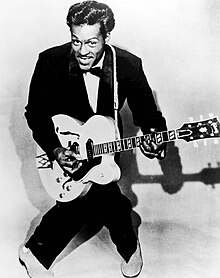
Berry in 1957 |
| Background information |
| Birth name |
Charles Edward Anderson Berry |
| Born |
October 18, 1926
St. Louis, Missouri, U.S. |
| Died |
March 18, 2017 (aged 90)
St. Charles, Missouri, U.S. |
| Genres |
Rock and roll |
| Occupation(s) |
Musician, singer, songwriter |
| Instruments |
Guitar, vocals |
| Years active |
1953–2017 |
| Labels |
Chess, Mercury, Atco |
| Associated acts |
Johnnie Johnson, T-Bone Walker, Muddy Waters |
| Website |
www.chuckberry.com |
Charles Edward Anderson "Chuck" Berry(October 18, 1926 – March 18, 2017) was an American guitarist, singer and songwriter and one of the pioneers of rock and roll music. With songs such as "Maybellene" (1955), "Roll Over Beethoven" (1956), "Rock and Roll Music" (1957) and "Johnny B. Goode" (1958), Berry refined and developed rhythm and blues into the major elements that made rock and roll distinctive. Writing lyrics that focused on teen life and consumerism, and developing a music style that included guitar solos and showmanship, Berry was a major influence on subsequent rock music.[1]
Born into a middle-class African-American family inSt. Louis, Missouri, Berry had an interest in music from an early age and gave his first public performance at Sumner High School. While still a high school student he was convicted of armed robbery and was sent to a reformatory, where he was held from 1944 to 1947. After his release, Berry settled into married life and worked at an automobile assembly plant. By early 1953, influenced by the guitar riffs and showmanship techniques of the blues musician T-Bone Walker, Berry began performing with the Johnnie Johnson Trio.[2] His break came when he traveled to Chicago in May 1955 and met Muddy Waters, who suggested he contact Leonard Chess, of Chess Records. With Chess he recorded "Maybellene"—Berry's adaptation of the country song "Ida Red"—which sold over a million copies, reaching number one on Billboard magazine's rhythm and blues chart. By the end of the 1950s, Berry was an established star with several hit records and film appearances and a lucrative touring career. He had also established his own St. Louis nightclub, Berry's Club Bandstand. But in January 1962, he was sentenced to three years in prison for offenses under the Mann Act—he had transported a 14-year-old girl across state lines.[2][3][4] After his release in 1963, Berry had several more hits, including "No Particular Place to Go", "You Never Can Tell", and "Nadine". But these did not achieve the same success, or lasting impact, of his 1950s songs, and by the 1970s he was more in demand as a nostalgic performer, playing his past hits with local backup bands of variable quality.[2] His insistence on being paid in cash led in 1979 to a four-month jail sentence and community service, for tax evasion.
Berry was among the first musicians to be inducted into the Rock and Roll Hall of Fame on its opening in 1986; he was cited for having "laid the groundwork for not only a rock and roll sound but a rock and roll stance."[5] Berry is included in several of Rolling Stone magazine's "greatest of all time" lists; he was ranked fifth on its 2004 list of the 100 Greatest Artists of All Time.[6] The Rock and Roll Hall of Fame's 500 Songs That Shaped Rock and Roll includes three of Berry's: "Johnny B. Goode", "Maybellene", and "Rock and Roll Music".[7] Berry's "Johnny B. Goode" is the only rock-and-roll song included on the Voyager Golden Record.[8]
Biography and career
Early life and apprenticeship with Johnnie Johnson (1926–1954)

The Ville is centrally located in St. Louis, marked in red.
Born in St. Louis, Missouri,[9] Berry was the fourth child in a family of six. He grew up in the north St. Louis neighborhood known as The Ville, an area where many middle-class people lived. His father, Henry William Berry, was a contractor and deacon of a nearby Baptistchurch; his mother, Martha Bell (Banks), was a certified public school principal.[10] His upbringing allowed him to pursue his interest in music from an early age. He gave his first public performance in 1941 while still a student atSumner High School.[11]
In 1944, while still a student at Sumner High School, he was arrested for armed robbery after robbing three shops in Kansas City, Missouri, and then stealing a car at gunpoint with some friends.[12][13] Berry's account in his autobiography is that his car broke down and he flagged down a passing car and stole it at gunpoint with a nonfunctional pistol.[14] He was convicted and sent to the Intermediate Reformatory for Young Men at Algoa, near Jefferson City, Missouri,[9] where he formed a singing quartet and did some boxing.[12] The singing group became competent enough that the authorities allowed it to perform outside the detention facility.[15] Berry was released from the reformatory on his 21st birthday in 1947.
On October 28, 1948, Berry married Themetta "Toddy" Suggs, who gave birth to Darlin Ingrid Berry on October 3, 1950.[16] Berry supported his family by taking various jobs in St. Louis, working briefly as a factory worker at two automobile assembly plants and as a janitor in the apartment building where he and his wife lived. Afterwards he trained as a beautician at the Poro College of Cosmetology, founded by Annie Turnbo Malone.[17] He was doing well enough by 1950 to buy a "small three room brick cottage with a bath" on Whittier Street,[18] which is now listed as the Chuck Berry House on the National Register of Historic Places.[19]
By the early 1950s, Berry was working with local bands in clubs in St. Louis as an extra source of income.[17] He had been playing blues since his teens, and he borrowed both guitar riffs andshowmanship techniques from the blues musician T-Bone Walker.[20] He also took guitar lessons from his friend Ira Harris, which laid the foundation for his guitar style.[21]
By early 1953 Berry was performing with Johnnie Johnson's trio, starting a long-time collaboration with the pianist.[22] The band played mostly blues and ballads, but the most popular music among whites in the area was country. Berry wrote, "Curiosity provoked me to lay a lot of our country stuff on our predominantly black audience and some of our black audience began whispering 'who is that black hillbilly at the Cosmo?' After they laughed at me a few times they began requesting the hillbilly stuff and enjoyed dancing to it."[9]
Berry's calculated showmanship, along with a mix of country tunes and R&B tunes, sung in the style of Nat King Cole set to the music of Muddy Waters, brought in a wider audience, particularly affluent white people.[2][23]
Signing with Chess: "Maybellene" to "Come On" (1955–1962)

Berry in a 1958 publicity photo
In May 1955, Berry traveled to Chicago, where he met Muddy Waters, who suggested he contact Leonard Chess, of Chess Records. Berry thought his blues music would be of more interest to Chess, but to his surprise it was a traditional country fiddle tune, "Ida Red", as recorded by Bob Wills,[24] that got Chess's attention. Chess had seen the rhythm and blues market shrink and was looking to move beyond it, and he thought Berry might be the artist for that purpose. On May 21, 1955, Berry recorded an adaptation of the "Ida Red", under the title "Maybellene", with Johnnie Johnson on the piano, Jerome Green (from Bo Diddley's band) on the maracas, Jasper Thomas on the drums and Willie Dixon on the bass. "Maybellene" sold over a million copies, reaching number one on Billboard magazine's rhythm and blues chart and number five on its Best Sellers in Stores chart for September 10, 1955.[9][25] Berry said, "It came out at the right time when Afro-American music was spilling over into the mainstream pop." (NBC Evening News, March 18, 2017)
At the end of June 1956, his song "Roll Over Beethoven" reached number 29 on the Billboard's Top 100 chart, and Berry toured as one of the "Top Acts of '56". He and Carl Perkins became friends. Perkins said that "I knew when I first heard Chuck that he'd been affected by country music. I respected his writing; his records were very, very great." As they toured, Perkins discovered that Berry not only liked country music but also knew about as many songs as he did. Jimmie Rodgers was one of his favorites. "Chuck knew every Blue Yodel and most of Bill Monroe's songs as well", Perkins remembered. "He told me about how he was raised very poor, very tough. He had a hard life. He was a good guy. I really liked him."[26]
In late 1957, Berry took part in Alan Freed's "Biggest Show of Stars for 1957", touring the United States with the Everly Brothers, Buddy Holly, and others.[27] He was a guest on ABC's Guy Mitchell Show, singing his hit song "Rock 'n' Roll Music". The hits continued from 1957 to 1959, with Berry scoring over a dozen chart singles during this period, including the US Top 10 hits "School Days", "Rock and Roll Music", "Sweet Little Sixteen", and "Johnny B. Goode". He appeared in two early rock-and-roll movies: Rock Rock Rock (1956), in which he sang "You Can't Catch Me", and Go, Johnny, Go! (1959), in which he had a speaking role as himself and performed "Johnny B. Goode", "Memphis, Tennessee", and "Little Queenie". His performance of "Sweet Little Sixteen" at the Newport Jazz Festival in 1958 was captured in the motion pictureJazz on a Summer's Day.[28]
By the end of the 1950s, Berry was a high-profile established star with several hit records and film appearances and a lucrative touring career. He had opened a racially integrated St. Louis nightclub, Berry's Club Bandstand, and invested in real estate.[29] But in December 1959, he was arrested under the Mann Act after allegations that he had sexual intercourse with a 14-year-old Apache waitress, Janice Escalante,[30] whom he had transported across state lines to work as a hatcheck girl at his club.[31] After a two-week trial in March 1960, he was convicted, fined $5,000, and sentenced to five years in prison.[32] He appealed the decision, arguing that the judge's comments and attitude were racist and prejudiced the jury against him. The appeal was upheld,[3][33] and a second trial was heard in May and June 1961,[34] resulting in another conviction and a three-year prison sentence.[35] After another appeal failed, Berry served one and one-half years in prison, from February 1962 to October 1963.[36] He had continued recording and performing during the trials, but his output had slowed as his popularity declined; his final single released before he was imprisoned was "Come On".[37]
"Nadine" and move to Mercury (1963–1969)

Berry and his sister Lucy Ann (1965)
When Berry was released from prison in 1963 his return to recording and performing was made easier becauseBritish invasion bands—notably the Beatles and theRolling Stones—had sustained interest in his music by releasing cover versions of his songs,[38][39] and other bands had reworked some of them, such as the Beach Boys' 1963 hit "Surfin' U.S.A.", which used the melody of Berry's "Sweet Little Sixteen".[40] In 1964 and 1965 Berry released eight singles, including three that were commercially successful, reaching the top 20 of theBillboard 100: "No Particular Place to Go" (a humorous reworking of "School Days", concerning the introduction of seat belts in cars),[41] "You Never Can Tell", and the rocking "Nadine".[42]Between 1966 and 1969 Berry released five albums for Mercury Records, including his first live album, Live at Fillmore Auditorium, in which he was backed by the Steve Miller Band.[43][44]
While this was not a successful period for studio work,[45] Berry was still a top concert draw. In May 1964, he had made a successful tour of the UK,[41] but when he returned in January 1965 his behavior was erratic and moody, and his touring style of using unrehearsed local backing bands and a strict nonnegotiable contract was earning him a reputation as a difficult and unexciting performer.[46] He also played at large events in North America, such as the Schaefer Music Festival, in New York City's Central Park in July 1969, and the Toronto Rock and Roll Revival festival in October.[47]
Back to Chess: "My Ding-a-Ling" to White House concert (1970–1979)
Berry helped give life to a subculture ... Even "My Ding-a-Ling", a fourth-grade wee-wee joke that used to mortify true believers at college concerts, permitted a lot of twelve-year-olds new insight into the moribund concept of "dirty" when it hit the airwaves ...
Robert Christgau[48]
Berry returned to Chess from 1970 to 1973. There were no hit singles from the 1970 album Back Home, but in 1972 Chess released a live recording of "My Ding-a-Ling", a novelty song which he had recorded in a different version as "My Tambourine" on his 1968 LP From St. Louie to Frisco.[49] The track became his only number-one single. A live recording of "Reelin' and Rockin'", issued as a followup single in the same year, was his last Top 40 hit in both the US and the UK. Both singles were included on the part-live, part-studio album The London Chuck Berry Sessions (other albums of London sessions were recorded by Chess's mainstay artists Muddy Waters and Howlin' Wolf). Berry's second tenure with Chess ended with the 1975 album Chuck Berry, after which he did not make a studio record until Rock It for Atco Records in 1979, which would be his last studio album for 38 years.[50]
In the 1970s Berry toured on the strength of his earlier successes. He was on the road for many years, carrying only hisGibson guitar, confident that he could hire a band that already knew his music no matter where he went. AllMusic said that in this period his "live performances became increasingly erratic, ... working with terrible backup bands and turning in sloppy, out-of-tune performances" which "tarnished his reputation with younger fans and oldtimers" alike.[29] In March 1972 he was filmed, at theBBC Televsion Theatre in Shepherds Bush, for Chuck Berry in Concert[51] part of a 60-date tour backed by the band Rocking Horse.[52] Among the many bandleaders performing a backup role with Berry in the 1970s were Bruce Springsteen and Steve Miller when each was just starting his career. Springsteen related in the documentary film Hail! Hail! Rock 'n' Roll that Berry did not give the band a set list and expected the musicians to follow his lead after each guitar intro. Berry neither spoke to nor thanked the band after the show. Nevertheless, Springsteen backed Berry again when he appeared at the concert for the Rock and Roll Hall of Fame in 1995. At the request of Jimmy Carter, Berry performed at the White House on June 1, 1979.[44]
Berry's touring style, traveling the "oldies" circuit in the 1970s (often being paid in cash by local promoters) added ammunition to the Internal Revenue Service's accusations that Berry had evaded paying income taxes. Facing criminal sanction for the third time, Berry pled guilty to tax evasion and was sentenced to four months in prison and 1,000 hours of community service—performing benefit concerts—in 1979.[53]
Last years on the road (1980–2017)

Berry performing live in 1997
Berry continued to play 70 to 100 one-nighters per year in the 1980s, still traveling solo and requiring a local band to back him at each stop. In 1986, Taylor Hackfordmade a documentary film, Hail! Hail! Rock 'n' Roll, of a celebration concert for Berry's sixtieth birthday, organized by Keith Richards.[54] Eric Clapton, Etta James, Julian Lennon, Robert Cray and Linda Ronstadt, among others, appeared with Berry on stage and in the film. During the concert, Berry played a Gibson ES-355, the luxury version of the ES-335 that he favored on his 1970s tours. Richards played a black Fender TelecasterCustom, Cray a Fender Stratocaster and Clapton aGibson ES 350T (de), the same model that Berry used on his early recordings.[55]
In the late 1980s, Berry bought The Southern Air, a restaurant in Wentzville, Missouri.[56] In 1990 he was sued by several women who claimed that he had installed a video camera in the ladies' bathroom. Berry claimed that he had the camera installed to catch red-handed a worker who was suspected of stealing from the restaurant. Though his guilt was never proved in court, Berry opted for a class action settlement with 59 women. His biographer, Bruce Pegg, estimated that it cost Berry over $1.2 million plus legal fees.[57] During this time Berry began using Wayne T. Schoeneberg as his legal counsel. Reportedly, a police raid on his house found videotapes of women using the restroom, and one of the women was a minor. Also found in the raid were 62 grams of marijuana. Felony drug and child-abuse charges were filed. In order to avoid the child-abuse charges, Berry agreed to plead guilty to misdemeanor possession of marijuana. He was given a six-month suspended jail sentence and two years' unsupervised probation and was ordered to donate $5,000 to a local hospital.[58]
In November 2000, Berry faced legal issues when he was sued by his former pianist Johnnie Johnson, who claimed that he co-wrote over 50 songs, including "No Particular Place to Go", "Sweet Little Sixteen" and "Roll Over Beethoven", that credit Berry alone. The case was dismissed when the judge ruled that too much time had passed since the songs were written.[59]
In 2008, Berry toured Europe, with stops in Sweden, Norway, Finland, the United Kingdom, the Netherlands, Ireland, Switzerland, Poland and Spain. In mid-2008, he played at the Virgin Festival in Baltimore, Maryland.[60] During a concert on New Year's Day 2011 in Chicago, Berry, suffering from exhaustion, passed out and had to be helped off stage.[61]
Berry lived in Ladue, Missouri, approximately 10 miles (16 km) west of St. Louis.[62] He regularly performed one Wednesday each month at Blueberry Hill, a restaurant and bar located in theDelmar Loop neighborhood of St. Louis, from 1996 to 2014.
Berry announced on his 90th birthday that his first new studio album since Rock It in 1979, entitled Chuck, would be released in 2017.[63] His first new record in 38 years, it features his children, Charles Berry Jr. and Ingrid, on guitar and harmonica, with songs "covering the spectrum from hard-driving rockers to soulful thought-provoking time capsules of a life's work" and dedicated to his wife of 68 years, Themetta Berry.[64]
Death
Police in St. Charles County, Missouri, were called to Berry's house on March 18, 2017, where he was found unresponsive. He was pronounced dead at the scene, aged 90.[65][66]
Legacy
While no individual can be said to have invented rock and roll, Chuck Berry comes the closest of any single figure to being the one who put all the essential pieces together. It was his particular genius to graft country & westernguitar licks onto a rhythm & blueschassis in his very first single, "Maybellene".
Rock and Roll Hall of Fame[67]
A pioneer of rock and roll, Berry was a significant influence on the development of both the music and the attitude associated with the rock music lifestyle. With songs such as "Maybellene" (1955), "Roll Over Beethoven" (1956), "Rock and Roll Music" (1957) and "Johnny B. Goode" (1958), Berry refined and developed rhythm and blues into the major elements that made rock and roll distinctive, with lyrics successfully aimed to appeal to the early teenage market by using graphic and humorous descriptions of teen dances, fast cars, high school life, and consumer culture,[2] and utilizing guitar solos andshowmanship that would be a major influence on subsequent rock music.[1] Thus Berry, the songwriter, invented rock as a music that gave his teenage listeners dreams of wishes fulfilled and good times. (New York Times, March 19, 2017, p.3) Berry contributed three things to rock music: an irresistible swagger, a focus on the guitar riff as the primary melodic element and an emphasis on songwriting as storytelling.[68] His records are a rich storehouse of the essential lyrical, showmanship and musical components of rock and roll. In addition to the Beatles and the Rolling Stones, a large number of significant popular-music performers have recorded Berry's songs.[2]Though not technically accomplished, his guitar style is distinctive—he incorporated electronic effects to mimic the sound of bottleneck blues guitarists and drew on the influence of guitar players such as Carl Hogan,[69] and T-Bone Walker[2] to produce a clear and exciting sound that many later guitarists would acknowledge as an influence in their own style.[58] Berry's showmanship has been influential on other rock guitarists,[70] particularly his one-legged hop routine,[71] and the "duck walk",[72] which he first used as a child when he walked "stooping with full-bended knees, but with my back and head vertical" under a table to retrieve a ball and his family found it entertaining; he used it when "performing in New York for the first time and some journalist branded it the duck walk."[73][74]
The rock critic Robert Christgau considers Berry "the greatest of the rock and rollers",[75] whileJohn Lennon said, "if you tried to give rock and roll another name, you might call it 'Chuck Berry'."[76] Ted Nugent said, "If you don't know every Chuck Berry lick, you can't play rock guitar."[77] Bob Dylan called Berry "the Shakespeare of rock 'n' roll".[78] Ringo Starr of the Beatles, and Mick Jagger and Richards of the Rolling Stones tweeted their tributes. Springsteen tweeted, "Chuck Berry was rock's greatest practitioner, guitarist, and the greatest pure rock 'n' roll writer who ever lived."[79][80]
When asked what caused the explosion of the popularity of rock 'n roll that took place in the 1950s, with him and a handful of others, mainly him, Berry said, "Well, actually they begin to listen to it, you see, because certain stations played certain music. The music that we, the blacks, played, the cultures were so far apart, we would have to have a play station in order to play it. The cultures begin to come together, and you begin to see one another's vein of life, then the music came together."[81]
Among the honors Berry received were the Grammy Lifetime Achievement Award in 1984[83] and theKennedy Center Honors in 2000.[84] He was ranked seventh on Time magazine's 2009 list of the 10 best electric guitar players of all time.[85] On May 14, 2002, Berry was honored as one of the first BMI Icons at the 50th annual BMI Pop Awards. He was presented the award along with BMI affiliates Bo Diddley and Little Richard.[86] In August 2014, Berry was made a laureate of the Polar Music Prize.[87]
Berry is included in several of Rolling Stone magazine's "Greatest of All Time" lists. In September 2003, the magazine ranked him number 6 in its list of the "100 Greatest Guitarists of All Time".[88] In November his compilation album The Great Twenty-Eight was ranked 21st inRolling Stone's 500 Greatest Albums of All Time.[89] In March 2004, Berry was ranked fifth on the list of "The Immortals – The 100 Greatest Artists of All Time".[6][90] In December 2004, six of his songs were included in "Rolling Stone's 500 Greatest Songs of All Time": "Johnny B. Goode" (#7), "Maybellene" (#18), "Roll Over Beethoven" (#97), "Rock and Roll Music" (#128), "Sweet Little Sixteen" (#272) and "Brown Eyed Handsome Man" (#374).[91] In June 2008, his song "Johnny B. Goode" was ranked first in the "100 Greatest Guitar Songs of All Time".[92]
The journalist Chuck Klosterman has argued that in 300 years Berry will still be remembered as the rock musician who most closely captured the essence of rock and roll.[93]
https://en.wikipedia.org/wiki/Chuck_Berry


.png)
.jpg)


