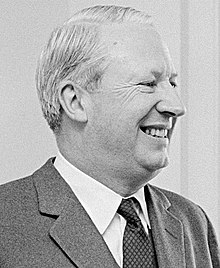
Sir Edward Richard George Heath,KG, MBE (9 July 1916 – 17 July 2005), often known as Ted Heath, was Prime Minister of the United Kingdom from 1970 to 1974 andLeader of the Conservative Party from 1965 to1975.
Born in Kent, Heath studied at Oxford University and served in the Second World War. He was first elected to Parliament in1950 for Bexley, and was the Chief Whip from 1955 to 1959. Entering the Cabinet as Minister of Labour in 1959, he was later promoted toLord Privy Seal and later became President of the Board of Trade. In 1965, Heath was elected leader of the Conservative Party, retaining that position despite losing the 1966 election.
Heath became Prime Minister after winning the1970 election. In 1971 he oversaw the decimalisation of British coinage and in 1972, he reformed Britain's system of local government, reducing the number of local authorities and creating a number of new metropolitan counties. Possibly most significantly, he took Britain into the European Economic Community in 1973. Heath's Premiership also oversaw the height of The Troubles in Northern Ireland, with the suspension of the Stormont Parliament and the imposition of direct British rule. Unofficial talks with Provisional Irish Republican Army(IRA) delegates were unsuccessful, as was theSunningdale Agreement of 1973, which caused the Ulster Unionist Party to withdraw from the Conservative whip.
Heath also tried to curb the trade unions with the Industrial Relations Act 1971, and had hoped to deregulate the economy and make a transfer from direct to indirect taxation. However, rising unemployment in 1972 caused Heath to reflate the economy, attempting to control the resulting high inflation by a prices and incomes policy. Two miners' strikes, in 1972 and at the start of 1974, damaged the government, the latter causing the implementation of the Three-Day Week to conserve energy. Heath eventually called anelection for February 1974 to obtain a mandate to face down the miners' wage demands, but this instead resulted in a hung parliament in which Labour, despite winning fewer votes, had four more seats than the Tories. Heath resigned as Prime Minister after trying in vain to form a coalition with theLiberal Party.
Despite losing a second general election in October that year, Heath vowed to continue as leader of his party. In February 1975, however, his former Education Secretary Margaret Thatcher challenged and defeated Heath to win the leadership. Returning to the backbenches, Heath became an active critic of Thatcher's policies as leader and, from 1979, as Prime Minister. He remained a backbench MP until retiring in 2001, serving as the Father of the House for his last nine years in Parliament. Outside of politics, Heath was a world-class yachtsman and a musician of near-professional standard. He was also one of only four British Prime Ministers never to have married.
Early life[edit]
Edward Heath (known as "Teddy" as a young man) was born at 54 Albion Road, Broadstairs, Kent on 9 July 1916, the son of William George Heath, a carpenter and builder, and Edith Anne Heath (née Pantony), a maid. His father was later a successful small businessman. He was educated at Chatham House Grammar School in Ramsgateand in 1935 with the aid of a county scholarship he went up to study at Balliol College, Oxford. A talented musician, he won the college's organ scholarship in his first term (he had previously tried for the organ scholarships at St Catharine's College, Cambridge, and Keble College, Oxford) which enabled him to stay at the university for a fourth year; he eventually graduated with a Second Class Honours BA in Philosophy, Politics and Economics in 1939.
In later years, Heath's peculiar accent – with its "strangulated" vowel sounds, combined with his non-Standard pronunciation of "l" as "w" and "out" as "eout" – was satirised by theMonty Python's Flying Circus in the audio sketch "Teach Yourself Heath" (originally recorded for their 1972 LP Monty Python's Previous Record but not released at the time).[1]Heath's biographer John Campbell speculates that his speech, unlike that of his father and younger brother, who both spoke with Kent accents, must have undergone "drastic alteration on encountering Oxford", although retaining elements of Kent speech.
While at university Heath became active in Conservative politics. On the key political issue of the day, foreign policy, he opposed the Conservative-dominated government of the day ever more openly. His first Paper Speech (i.e. a major speech listed on the order paperalong with the visiting guest speakers) at the Oxford Union, in Michaelmas 1936, was in opposition to the appeasement of Germany by returning her colonies, confiscated after theFirst World War.[citation needed] In June 1937 he was elected President of the Oxford University Conservative Association as a pro-Spanish-Republican candidate, in opposition to the pro-Franco John Stokes (later a Conservative MP). In 1937–38 he was also chairman of the national Federation of University Conservative Associations, and in the same year (his third at university) he was Secretary then Librarian of the Oxford Union. At the end of the year he was defeated for the Presidency of the Oxford Union by another Balliol candidate, Alan Wood, on the issue of whether the Chamberlain government should give way to a left-wing Popular Front. On this occasion Heath supported the government.
In his final year Heath was President of Balliol College Junior Common Room, an office held in subsequent years by his near-contemporaries Denis Healey and Roy Jenkins, and as such was invited to support the Master of Balliol Alexander Lindsay, who stood as an anti-appeasement 'Independent Progressive' candidate against the official Conservative candidate, Quintin Hogg, in the Oxford by-election, 1938. Heath, who had himself applied to be the Conservative candidate for the by-election,[2] accused the government in an October Union Debate of "turning all four cheeks" to Adolf Hitler, and was elected as President of the Oxford Union in November 1938, sponsored by Balliol, after winning the Presidential Debate that "This House has No Confidence in the National Government as presently constituted". He was thus President in Hilary term 1939; the visiting Leo Amerydescribed him in his diaries as "a pleasant youth".
As an undergraduate, Heath travelled widely in Europe. His opposition to appeasement was nourished by his witnessing first-hand a Nuremberg Rally in 1937, where he met top Nazis Hermann Göring, Joseph Goebbels and Heinrich Himmler at an SS cocktail party. He later described Himmler as "the most evil man I have ever met".[3] In 1938 he visitedBarcelona, then under attack from Spanish Nationalist forces during the Spanish Civil War. In the summer of 1939 he again travelled across Germany, returning to Britain just before the declaration of war.[citation needed]
Second World War[edit]
Heath spent the winter of 1939–40 on a debating tour of the United States before being called up. On 22 March 1941, he received an emergency commission as a second lieutenant in the Royal Artillery.[4] During the war he initially served with heavy anti-aircraft guns around Liverpool (which suffered heavy German bombing in May 1941) and by early 1942 was regimental adjutant, with the war substantive rank of captain. Later, as a temporary major commanding a battery of his own, he provided artillery support in theNorth-West Europe Campaign of 1944-1945, for which he received a mention in dispatcheson 8 November 1945.[5]
According to his autobiography Heath participated as an Adjutant in the Normandy Landings, where he met Maurice Schumann, French Foreign Minister under Pompidou.[6]
Heath later remarked that, although he did not personally kill anybody, as the British forces advanced he saw the devastation caused by his unit's artillery bombardments. In September 1945 he commanded a firing squad that executed a Polish soldier convicted of rape and murder. He was appointed a Member of the Order of the British Empire, Military Division (MBE) on 24 January 1946.[7] He was demobilised in August 1946 and promoted to the substantive rank of lieutenant-colonel on 1 May 1947.[8] Heath joined the Honourable Artillery Company as a lieutenant-colonel on 1 September 1951,[9] in which he remained active throughout the 1950s, rising to Commanding Officer of the Second Battalion; a portrait of him in full dress uniform still hangs in the HAC's Long Room. In April 1971, as Prime Minister, he wore his lieutenant-colonel's insignia to inspect troops[citation needed].
Post war, 1945–1950[edit]
Before the war Heath had won a scholarship to Gray's Inn and had begun making preparations for a career at the Bar, but after the war he instead passed top into the Civil Service. He then became a civil servant in the Ministry of Civil Aviation (he was disappointed not to be posted to the Treasury, but declined an offer to join the Foreign Office, fearing that foreign postings might prevent him from entering politics).[10] He joined a team under (later, Dame) Alison Munro tasked with drawing up a scheme for British airports using some of the many WW2 RAF bases, and was specifically charged with planning the home counties. Years later she attributed his evident enthusiasm for Maplin Airport to this work. Then much to the surprise of civil service colleagues, he sought adoption as the prospective parliamentary candidate for Bexley and resigned in November 1947.
After working as News Editor of the Church Times from February 1948 to September 1949,[11] Heath worked as a management trainee at the merchant bankers Brown, Shipley & Co. until his election as Member of Parliament (MP) for Bexley in the February 1950 general election. In the election he defeated an old contemporary from the Oxford Union,Ashley Bramall, with a majority of 133 votes.
Member of Parliament (1950–1965)[edit]
Heath made his maiden speech in the House of Commons on 26 June 1950, in which he appealed to the Labour Government to participate in the Schuman Plan. As MP for Bexley, he gave enthusiastic speeches in support of the young, unknown candidate for neighbouring Dartford, Margaret Roberts, soon to become Margaret Thatcher.
In February 1951, Heath was appointed as an Opposition Whip by Winston Churchill. He remained in the Whip's Office after the Conservatives won the 1951 general election, rising rapidly to Joint Deputy Chief Whip, Deputy Chief Whip and, in December 1955, Government Chief Whip under Anthony Eden. Journalist Geoffrey Wheatcroft has observed that "Of all government jobs, this requires firmness and fairness allied to tact and patience and Heath's ascent seems baffling in hindsight".[12] Because of the convention that Whips do not speak in Parliament, Heath managed to keep out of the controversy over the Suez Crisis.
On the announcement of Eden's resignation, Heath submitted a report on the opinions of the Conservative MPs regarding Eden's possible successors. This report favoured Harold Macmillan and was instrumental in eventually securing Macmillan the premiership in January 1957.[citation needed] Macmillan later appointed Heath Minister of Labour, a Cabinet Minister – as Chief Whip Heath had attended Cabinet but had not been formally a member – after winning the October 1959 election.
In 1960 Macmillan appointed Heath Lord Privy Seal with responsibility for the negotiations to secure the UK's first attempt to join the European Economic Community (as theEuropean Community was then called). After extensive negotiations, involving detailed agreements about the UK's agricultural trade with Commonwealth countries such as New Zealand, British entry was vetoed by the French President, Charles de Gaulle, at a press conference in January 1963 – much to the disappointment of Heath, who was a firm supporter of European common market membership for the United Kingdom. However, he would oversee a successful application when serving in a higher position a decade later.[13]
After this setback, a major humiliation for Macmillan's foreign policy, Heath was not a contender for the party leadership on Macmillan's retirement in October 1963. Under Prime Minister Sir Alec Douglas-Home he was President of the Board of Trade and Secretary of State for Industry, Trade and Regional Development, and oversaw the abolition of retail price maintenance.
Leader of the Opposition (1965–1970)[edit]
Heath as Leader of the Opposition, 1966.
After the Conservative Party lost the general election of 1964, the defeated Home changed the party leadership rules to allow for a MP ballot vote, and then resigned. The following year, Heath – who was Shadow Chancellor at the time, and had recently won favourable publicity for leading the fight against Labour's Finance Bill – unexpectedly won the party's leadership contest, gaining 150 votes toReginald Maudling's 133 and Enoch Powell's 15.[14] Heath became the Tories' youngest leader and retained office after the party's defeat in the general election of 1966.
Heath sacked Enoch Powell from the Shadow Cabinet in April 1968, shortly after Powell made his controversial"Rivers of Blood" speech which criticised Commonwealthimmigration to the United Kingdom. Heath never spoke to Powell again.[15]
Prime Minister (1970–1974)[edit]
With another general election approaching in 1970 a Conservative policy document emerged from the Selsdon Park Hotel that, according to some historians,[16] offered monetarist and free-market oriented policies as solutions to the country's unemployment and inflation problems. Heath stated that the Selsdon weekend only reaffirmed policies that had actually been evolving since he became leader of the Conservative Party. The prime minister, Harold Wilson, thought the document a vote-loser and dubbed it the product ofSelsdon Man – after the supposedly prehistoric Piltdown Man[17] – in order to portray it as reactionary. But Heath's Conservative Party won the general election of 1970 – 330 seats to Labour's 287.[18] It was the only occasion since 1945 in which one party with a working majority had been replaced in a single election by another party with a working majority.[lease clarify" href="https://en.wikipedia.org/wiki/Wikipedia lease_clarify">clarification needed]
The new cabinet included Margaret Thatcher (Education and Science), William Whitelaw(Leader of the House of Commons) and the former prime minister Alec Douglas-Home(Foreign and Commonwealth Affairs).
During Heath's first year in office, higher charges were introduced for school meals, spectacles, dentistry, and prescriptions. Entitlement to state Sickness Benefit was also changed so that it would only be paid after the first three days of sickness.[19] As a result of the squeeze in the education budget, Margaret Thatcher acted on the late Iain Macleod's wishes by ending the provision of free school milk for 8- to 11-year-olds (the preceding Labour Government having removed it from secondary schools three years before), for which the tabloid press christened her "Thatcher the Milk Snatcher".[20] Despite these measures, however, the Heath Government encouraged a significant increase in welfare spending, and Thatcher blocked Macleod's other posthumous Education policy: the abolition of the Open University, which had recently been founded by the preceding Labour Government.[21]
Provision was made under the National Insurance (Old Persons’ and Widows’ Pensions and Attendances Allowances) Act 1970 for pensions to be paid to old people who had been excluded from the pre-1948 pension schemes and were accordingly excluded from the comprehensive scheme that was introduced in 1948. About 100,000 people were affected by this change, half of whom were receiving Supplementary Benefit under the social security scheme. The Act also made improvements to the Widows’ Pension scheme by introducing a scale that started at 30 shillings a week for women widowed at the age of 40 and rose to the full rate of £5 at the age of 50.[22]
Considerable support was provided for nursery school building, and a long-term capital investment programme in school building was launched.[citation needed] A Family Fund was set up to provide assistance to families with children who had congenital conditions,[23]while new benefits were introduced benefiting hundreds of thousands of disabled persons whose disabilities had been caused neither by war nor by industrial injury. An Attendance Allowance was introduced for those needing care at home, together with Invalidity Benefitfor the long-term sick, while a higher Child Allowance was made available where invalidity allowance was paid. Widow's Benefits were introduced for those aged between forty and fifty years of age, improved subsidies for slum clearance were made available, while Rent Allowances were introduced for private tenants.[19] In April 1971, the right to education was given to all children with Down’s syndrome for the first time.[24]
The school leaving age was raised to 16,[25] while Family Income Supplement was introduced to boost the incomes of low-income earners.[26] Families who received this benefit were exempted from NHS charges while the children in such families were eligible for Free School Meals. Non-contributory pensions were also introduced for all persons aged eighty and above,[27] while the Social Security Act 1973 was passed which introduced benefit indexation in the United Kingdom for the first time by index-linking benefits to prices to maintain their real value.[28]
In Great Britain, Scottish and Welsh nationalism also grew as political forces, while thedecimalisation of British coinage, begun under the previous Labour Government, was completed eight months after Heath came to power. The Central Policy Review Staff was established by Heath in February 1971,[29] while the 1972 Local Government Act changed the boundaries of Britain's counties and created "Metropolitan Counties" around the major cities (e.g. Merseyside around Liverpool): this caused significant public anger. Heath did not divide England into regions, choosing instead to await the report of the Crowther Commission on the constitution; the ten Government Office Regions were eventually set up by the Major government in 1994.
Heath's time in office was as difficult as that of all British prime ministers in the 1970s. The government suffered an early blow with the death of Chancellor of the Exchequer Iain Macleod on 20 July 1970; his replacement was Anthony Barber. Heath's planned economic policy changes (including a significant shift from direct to indirect taxation) remained largely unimplemented: the Selsdon policy document was more or less abandoned as unemployment increased considerably by 1972. By January that year, the unemployment rate reached a million, the highest level for more than two decades. Opposed to unemployment on moral grounds, Heath encouraged a famous "U-Turn" in economic policy that precipitated what became known as the "Barber boom." This was a two-range process involving the budgets of 1972 and 1973, the former of which pumped £2.5 billion into the economy in increased pensions and benefits and tax reductions. By early 1974, as a result of this Keynesian economic strategy, unemployment had fallen to under 550,000. The economic boom did not last, however, and the Heath Government implemented various cuts that led to the abandonment of policy goals such as a planned expansion of nursery education.[19]
Heath attempted to rein in the increasingly militant trade union movement, which had so far managed to stop attempts to curb their power by legal means. His Industrial Relations Act 1971 set up a special court under the judge Lord Donaldson, whose imprisonment of striking dockworkers was a public relations disaster that the Thatcher Government of the 1980s would take pains to avoid repeating (relying instead on confiscating the assets of unions found to have broken new anti-strike laws). Heath's attempt to confront trade union power resulted in a political battle, hobbled as the government was by inflation and high unemployment. Especially damaging to the government's credibility were the two miners' strikes of 1972 and 1974, the latter of which resulted in much of the country's industry working a Three-Day Week in an attempt to conserve energy. The National Union of Mineworkers won its case but the energy shortages and the resulting breakdown of domestic consensus contributed to the eventual downfall of his government.
As mentioned above, Heath's government oversaw two years of a steep rise in unemployment, which they later successfully reversed. His Labour predecessor as prime minister, Harold Wilson, had inherited an unemployment count of around 400,000 at the time of his general election win of October 1964 but seen unemployment peak at 631,000 during the spring of 1967, though it had fallen to 582,000 by the time Heath won power in June 1970. Like Wilson and Labour, Heath and the Tories were pledged to "full employment" but within a year it became clear that they were losing that battle, as the official unemployment count crept towards 1,000,000 and some newspapers suggested that it was even higher. In January 1972, it was officially confirmed that unemployment had risen above 1,000,000 – a level not seen for more than 30 years.[30] Various other reports around this time suggested that unemployment was higher still, with The Times newspaper claiming that "nearly 3,000,000" people were jobless by March of that year.[31]

Heath and Queen Elizabeth II with U.S. President Richard Nixon and First Lady Pat Nixon during the Nixons' 1970 visit to the United Kingdom
Foreign policy[edit]
Upon entering office in June 1970, Heath immediately set about trying to reverse Wilson's policy of ending Britain's military presence East of Suez.[32] Heath took the United Kingdom into Europe with the European Communities Act 1972 in October (21 Eliz. II c.68).[33] He publicly supported the massive US bombing of Hanoi and Haiphong in April 1972.[34]
In October 1973, he placed a British arms embargo on all combatants in the Arab-IsraeliYom Kippur war, which mostly affected the Israelis by preventing them obtaining spares for their Centurion tanks. Heath refused to allow US intelligence gathering from British bases in Cyprus, resulting in a temporary halt in the US signals intelligence tap.[35] He also refused permission for the US to use any British bases for resupply.[36]
He favoured links with the People's Republic of China, visiting Mao Zedong in Beijing in 1974 and 1975 and remaining an honoured guest in China on frequent visits thereafter and forming a close relationship with Mao's successor Deng Xiaoping. Heath also maintained a good relationship with US President Richard Nixon and figures in the Iraqi Ba'ath Party.
Northern Ireland[edit]
Heath governed during a bloody period in the history of the Northern Ireland Troubles. OnBloody Sunday in 1972, 14 men were killed by British soldiers during a civil rights march inDerry. In early 1971 Heath sent in a Secret Intelligence Service officer, Frank Steele, to talk to the IRA and find out what common ground there was for negotiations. Steele had carried out secret talks with Jomo Kenyatta ahead of the British withdrawal from Kenya.[37] In July 1972, Heath permitted his Secretary of State for Northern Ireland, William Whitelaw, to hold unofficial talks in London with an IRA delegation by Seán Mac Stiofáin. In the aftermath of these unsuccessful talks, the Heath government pushed for a peaceful settlement with the democratic political parties.
The 1973 Sunningdale Agreement, which proposed a power-sharing deal, was strongly repudiated by many Unionists and the Ulster Unionist Party who withdrew its MPs at Westminster from the Conservative whip. The proposal was finally brought down by the Loyalist Ulster Workers' Council strike in 1974 (although by then Heath was no longer in office).
Heath was targeted by the IRA for introducing internment in Northern Ireland. In December 1974, the Balcombe Street ASU threw a bomb onto the first-floor balcony of his home in Wilton Street, Belgravia where it exploded. Heath had been conducting a Christmas carol concert at Broadstairs and arrived home 10 minutes after the bomb exploded. No one was injured in the attack, but a landscape portrait painted by Winston Churchill – given to Heath as a present – was damaged.[38]
In January 2003, Heath gave evidence to the Saville Inquiry and stated that he had never sanctioned unlawful lethal force in Northern Ireland.
Fall from power[edit]
1974 general election[edit]
Heath tried to bolster his government by calling a general election for 28 February 1974, using the election slogan "Who governs Britain?". The result of the election was inconclusive with no party gaining an overall majority in the House of Commons; the Tories had the most votes but Labour had slightly more seats. Heath began negotiations withJeremy Thorpe, leader of the Liberal Party but, when these failed, he resigned as Prime Minister on 4 March 1974, and was replaced by Wilson's minority Labour government, eventually confirmed, though with a tiny majority, in a second election in October of the same year.[39]
The Centre for Policy Studies, a Conservative group closely involved with the 1970 Selsdon document, began to formulate a new monetarist and free-market policy, initially led by Sir Keith Joseph. Although Margaret Thatcher was associated with the CPS she was initially seen as a potential moderate go-between by Heath's lieutenant James Prior.
Rise of Thatcher[edit]
Heath came to be seen as a liability by many Conservative MPs, party activists and newspaper editors. His personality was cold and aloof, annoying even to his friends. Alan Watkins observed in 1991 that his "brusqueness, his gaucherie, his lack of small or indeed any talk, his sheer bad manners" were among the factors costing him the support of Conservative backbenchers in the subsequent Conservative Party (UK) leadership election, 1975.[40]
He resolved to remain Conservative leader, even after two general election defeats in one year, and at first it appeared that by calling on the loyalty of his front bench colleagues he might prevail. In the weeks following the second election defeat, Heath came under tremendous pressure to concede a review of the rules and agreed to establish a commission to propose changes and to seek re-election. There was no clear challenger after Enoch Powell had left the party and Keith Joseph had ruled himself out after controversial statements implying that the working classes should be encouraged to use more birth control. Joseph's close friend and ally Margaret Thatcher, who believed an adherent to CPS philosophy should stand, joined the leadership contest in his place alongside the outsider Hugh Fraser. Aided by Airey Neave's campaigning amongst back-bench MPs – whose earlier approach to William Whitelaw had been rebuffed out of loyalty to Heath – she emerged as the only serious challenger.[41]
The new rules permitted new candidates to enter the ballot in a second round of voting should the first be inconclusive, so Thatcher's challenge was considered by some to be that of a stalking horse. Neave deliberately understated Thatcher's support in order to attract wavering votes from MPs who were keen to see Heath replaced even though they did not necessarily want Thatcher to replace him.[42][43]
On 4 February 1975, Thatcher defeated Heath in the first ballot by 130 votes to 119, with Fraser coming in a distant third with 16 votes. This was not a big enough margin to give Thatcher the 15% majority necessary to win on the first ballot, but having finished in second place Heath immediately resigned and did not contest the next ballot. His favoured candidate, William Whitelaw, lost to Thatcher in the second vote one week later (Thatcher 146, Whitelaw 79, Howe 19, Prior 19, Peyton 11).[44] The vote polarized along right-left lines, with in addition the region, experience and education of the MP having their effects. Heath and Whitelaw were stronger on the left, among Oxbridge and public school graduates, and in MPs from Northern England or Scotland.[45]
Thatcher had promised Heath a seat in the Shadow Cabinet, and planned to offer him whatever post he wanted. His advisors agreed he should wait at least six months, so he declined. He never relented and his refusal was called "the incredible sulk."[46] Thatcher nonetheless visited Heath at his home shortly after her election as leader, and had to stay for coffee with his PPS Tim Kitson so that the waiting press would not realize how brief the visit had been. Heath claimed that he had simply declined her request for advice about how to handle the press, whilst Thatcher claimed that she offered him any Shadow Cabinet position he wanted and asked him to lead the Conservative campaign in the upcoming EEC referendum, only to be rudely rebuffed.[47]
Later career (1975–2001)[edit]
Heath for many years persisted in criticism of the party's new ideological direction. At the time of his defeat he was still popular with rank and file Conservative members and was warmly applauded at the 1975 Party Conference. He played a leading role in the 1975 referendum campaign in which Britain voted to remain part of the EEC and remained active on the international stage, serving on the Brandt Commission investigation into developmental issues, particularly on North-South projects (Brandt Report).
His relations with Thatcher remained negative, and in 1979–80 he turned down her offers of ambassador to the U.S. and secretary-general of NATO.[48] He continued as a central figure on the left of the party and, at the 1981 Conservative Party conference, openly criticised the government's economic policies – namely monetarism, which had seen inflation rise from 13% in 1979 to 18% in 1980 then fall to 4% by 1983,[49] but had seen unemployment double from around 1,500,000 to a postwar high of 3,300,000 during that time.[50] In 1990 he flew to Baghdad to attempt to negotiate the release of aircraft passengers and other British nationals taken hostage when Saddam Hussein invadedKuwait. After Black Wednesday in 1992 he stated in the House of Commons that government should build a fund of reserves to counter currency speculators.
In the 1960s Heath had lived at a flat in the Albany, off Piccadilly; at the unexpected end of his premiership he took the flat of a Conservative MP Tim Kitson for some months. In February 1985 Heath moved to Salisbury, where he resided until his death 20 years later. In 1987 he was nominated in the election for the Chancellorship of the University of Oxfordbut lost to Roy Jenkins as a result of splitting the Conservative vote with Lord Blake.
Heath continued to serve as a back bench MP for the London constituency of Old Bexley and Sidcup and was, from 1992, the longest-serving MP ("Father of the House") and the oldest British MP. As Father of the House he oversaw the election of two Speakers of the Commons, Betty Boothroyd and Michael Martin. Heath was created a Knight of the Garteron 23 April 1992.[51] He retired from Parliament at the 2001 general election. He and Tony Benn were the last two serving MPs to have been elected under George VI, with Heath being the only one to have served continuously since 1950.
Parliament broke with precedent by commissioning a bust of Heath while he was still alive.[52] The 1993 bronze work, by Martin Jennings, was moved to the Members' Lobby in 2002. On 29 April 2002, in his 86th year, he made a public appearance at Buckingham Palace alongside the then prime minister Tony Blair and the three other surviving former prime ministers, as well as relatives of deceased prime ministers, for a dinner which was part of the Golden Jubilee of Elizabeth II. This was to be one of his last public appearances, as the following year saw a decline in his health.[53]
Illness and death[edit]
In August 2003, at the age of 87, Heath suffered a pulmonary embolism while on holiday in Salzburg, Austria. He never fully recovered, and owing to his declining health and mobility made very few public appearances in the final two years of his life. His last public appearance was at the unveiling of a set of gates to Sir Winston Churchill at St Paul's Cathedral on 30 November 2004.
In his final public statement Heath paid tribute to James Callaghan who died on 26 March 2005, saying that Callaghan had been "...a major fixture in the political life of this country during his long and varied career. When in opposition he never hesitated to put firmly his party's case. When in office he took a smoother approach towards his supporters and opponents alike...We have lost a major figure from our political landscape".[54]
Heath died from pneumonia on the evening of 17 July 2005, at the age of 89. He was cremated on 25 July 2005 at a funeral service attended by 1,500 people. The day after his death the BBC Parliament channel showed the BBC results coverage of the 1970 election. A memorial service was held for Heath in Westminster Abbey on 8 November 2005 which was attended by two thousand people. Three days later his ashes were interred inSalisbury Cathedral. In a tribute to him, the then Prime Minister Tony Blair stated "He was a man of great integrity and beliefs he held firmly from which he never wavered".[55]
Arundells[edit]
In January 2006, it was announced that Heath had left his house and contents to the value of £5 million in his will, most of it to a charitable foundation to conserve his 18th-century house, Arundells, opposite Salisbury Cathedral, as a museum to his career. The house is open to the public for guided tours from March to October, and displayed is a large collection of personal effects as well as Heath's personal library, photo collections and paintings by Winston Churchill.[56]
In his will Heath, who had had no descendants, left only two legacies: £20,000 to his brother's widow, and £2,500 to his housekeeper.[57]
https://en.wikipedia.org/wiki/Edward_Heath





 圖片附件: Edward_Heath英首相.JPG (2015-8-6 08:47, 70.68 KB) / 下載次數 435