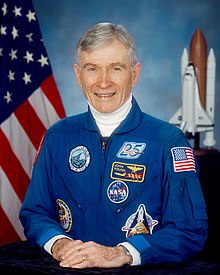
| John Watts Young |
 |
| NASA Astronaut |
| Nationality |
American |
| Born |
John Watts Young
September 24, 1930
San Francisco, California, U.S. |
| Died |
January 5, 2018 (aged 87)
Houston, Texas, U.S. |
|
Other occupation |
Naval Aviator, test pilot |
|
|
Georgia Institute of Technology, B.S. 1952 |
| Rank |
 Captain, USN Captain, USN |
|
Time in space |
34d 19h 39m |
| Selection |
1962 NASA Group 2 |
|
|
3 |
|
Total EVA time |
20h 14m 14s |
| Missions |
Gemini 3, Gemini 10, Apollo 10,Apollo 16, STS-1, STS-9 |
|
Mission insignia |
      |
| Retirement |
December 31, 2004 |
| Awards |
   |
John Watts Young (September 24, 1930 – January 5, 2018) was an American astronaut, naval officer and aviator,test pilot, and aeronautical engineer, who became the ninth person to walk on the Moon as Commander of the Apollo 16mission in 1972. Young enjoyed the longest career of any astronaut, becoming the first person to fly six space missions (with seven launches[1]) over the course of 42 years of active NASA service.[2] He was the only person to have piloted, and been commander of, four different classes of spacecraft: Gemini, the Apollo Command/Service Module, the Apollo Lunar Module, and the Space Shuttle.[3][4]
In 1965, Young flew on the first manned Gemini mission, and commanded another Gemini mission the next year. In 1969 during Apollo 10, he became the first person to fly solo around the Moon. He drove the Lunar Roving Vehicle on the Moon's surface during Apollo 16, and is one of only three people to have flown to the Moon twice. He also commanded two Space Shuttle flights, including its first launch in 1981, and served as Chief of the Astronaut Office from 1974–1987. Young retired from NASA in 2004. He died on January 5, 2018.[5]
Biography[edit]
Early years and education[edit]
Young was born in San Francisco, California, on September 24, 1930, to parents William Hugh Young and Wanda Howland Young.[6] At 18 months old, due to the Great Depression, he moved with his family to Georgia, then toOrlando, Florida, where he attended grade school and later Orlando High School until graduating in 1948.[7][8]
Young was a Boy Scout and earned the rank of Second Class.[9]
Young earned a Bachelor of Science degree with highest honors in Aeronautical Engineering from the Georgia Institute of Technology in 1952; while attending, he became a member of the national military honor society Scabbard and Blade and Sigma Chi fraternity.[10][11]
Navy service[edit]
— Young, describing an air-to-air missile test in which he and another pilot approached each other at Mach 3 - risking destruction of both aircraft.[12]
After graduating from Georgia Tech in 1952, Young entered the United States Navy through the Navy ROTCand was commissioned on June 6, 1952, as an ensign.[6] He served as fire control officer on the destroyerUSS Laws until June 1953 and completed a tour in the Sea of Japan during the Korean War. Following this assignment, he was sent to flight training. In January 1954, he was designated a Navy helicopter pilot.[6] After receiving his aviator wings on December 20, 1954, he was assigned to Fighter Squadron 103 (VF-103) for four years, flying Grumman F-9 Cougars from USS Coral Sea and Vought F-8 Crusaders from USS Forrestal.[13]
After training at the United States Naval Test Pilot School in 1959 with the Class 23, Young was assigned to the Naval Air Test Center at Naval Air Station Patuxent River, Maryland, for three years. His test projects included evaluations of the XF8U-3 Crusader III and F-4 Phantom II fighter weapons systems. In 1962, he set two world time-to-climb records while flying his Phantom II, attaining 3,000 meters (9,843 ft) from a standing start in 34.523 seconds and 25,000 meters (82,021 ft) from a standing start in 227.6 seconds.[6] He also served as maintenance officer of Fighter Squadron 143 (VF-143) from April to September 1962.[2]
Fellow astronaut Charles Bolden described Young and Robert "Hoot" Gibson as the two best pilots he had met during his aviation career: "Never met two people like them. Everyone else gets into an airplane; John and Hoot wear their airplane. They're just awesome".[14] Young retired from the Navy as a Captain in September 1976, after 25 years.[13]
He logged more than 15,275 hours flying time in props, jets, helicopters, and rocket jets; more than 9,200 hours in T-38s; and 835 hours in spacecraft during six space flights.[2]
NASA career[edit]
Project Gemini[edit]

Young, age 34, as pilot of Gemini 3

Young following splashdown of Gemini 10
Joining NASA in 1962, Young was the first of the Astronaut Group 2 to fly in space, replacing Thomas P. Stafford as pilot of Gemini 3 when Alan Shepard, the original command pilot, was grounded due to Ménière's disease. Making the first manned flight of the Gemini spacecraft with Gus Grissom in 1965, Young scored another space "first" by smuggling a corned beef sandwich onto the spacecraft—a feat for which he was reprimanded.[15]
Young then trained as backup pilot for Gemini 6A, but after the "sandwich episode", for a time it seemed that NASA was not sure what to do with him. Other Group 2 astronauts with flight experience were quickly moved to the Apollo program, while astronauts such as Scott Carpenter and Gordon Cooper were sidelined for lesser infractions. The assignment of Gemini 7 backup command pilot Ed White to Apollo, created an opening for Young as commander of Gemini 10 in 1966. The mission was the first to perform a rendezvous with two Agena target vehicles; and his pilot,Michael Collins, performed two spacewalks.[16]
Apollo program[edit]

Young in an Apollo 10 crew portrait
In 1966, Young was assigned to an Apollo crew as Command Module pilot, with CommanderThomas Stafford and Lunar Module pilot Eugene Cernan. This crew was assigned as backup to the second manned Apollo mission, planned before the Apollo 1 fire. After that fire, both crews were assigned to the first actual manned mission, Apollo 7, which flew in October 1968.[2] In May 1969, this crew flew to the Moon on Apollo 10. While Stafford and Cernan flew the Lunar Module in lunar orbit for the first time, Young flew the Command Module solo. Apollo 10 set the record for the highest speed attained by any manned vehicle at 39,897 kilometres per hour (24,791 mph) during its return to Earth on May 26, 1969.[17][18]
Young was backup commander of Apollo 13, the troubled mission in which the Moon landing was aborted because of an explosion in the Service Module. He had a central role in rescuing the Apollo 13 crew by participating in the team that developed procedures to stretch the Lunar Module consumables and reactivate the Command Module systems prior to re-entry.[citation needed]
By rotation, Young became commander of Apollo 16, and was an enthusiastic student of geology while preparing for the mission. Apollo 16's lunar landing was almost aborted when a malfunction was detected in the SPS engine control system in the Service Module. On the surface, Young took three moonwalks in the Descartes Highlands with Charles Duke on April 21, 22 and 23, 1972, making Young the ninth person to walk on the surface of the Moon, while Ken Mattingly flew the Command Module in lunar orbit. Young set a speed record with the Lunar Rover. He carried with him the badge and flag of the Sigma Chi fraternity, now on display at Sigma Chi's headquarters in Evanston, Illinois.[citation needed]
Young's final assignment in Apollo was as the backup commander for Cernan on Apollo 17.
Space Shuttle program[edit]
As a commander, Young made the shuttle landing
In January 1973 Young was made Chief of the Space Shuttle Branch of the Astronaut Office. In January 1974, he became Chief of the Astronaut Office after the retirement of Alan Shepard.[19]
Young flew two missions of the Space Shuttle, including commanding the program's 1981 maiden orbital flight, STS-1, andSTS-9 in 1983, which carried the first Spacelab module.[19] He was in line to make a record seventh flight on STS-61-J to deploy the Hubble Space Telescope in 1986, but the Challenger disaster earlier that year had delayed NASA's schedule.[20]
Young was openly critical of NASA management following the Challenger disaster,[citation needed] and in April 1987 was made Special Assistant to JSC Director Aaron Cohen for Engineering, Operations and Safety.[2] NASA denied that his criticism triggered the move.[citation needed] In February 1996, he was assigned as Associate Director (Technical) JSC.[2]
During his NASA career, Young logged more than 15,000 hours of training, mostly in simulators, to prepare for positions on eleven spaceflights in prime and backup crew positions.[2]
Retirement[edit]
Young worked for NASA for 42 years and announced his retirement on December 7, 2004. He retired on December 31, 2004, at the age of 74, but continued to attend the Monday Morning Meeting at the Astronaut Office at JSC for several years thereafter.[21]
On April 12, 2006, Young appeared at the 25th anniversary of the STS-1 launch at the Kennedy Space Center Visitor Complex, along with pilot Robert Crippen. The two spoke of their experiences during the flight.[22]
In 2012, Young published an autobiography, Forever Young.[23]
Personal life[edit]
Young married Barbara White of Savannah, Georgia, and had two children with her, Sandra and John.[10] They were divorced in 1972 after 16 years.[24] He later married Susy Feldman,[24] and lived in El Lago, Texas, a suburb of Houston. He died on January 5, 2018 in Houston of complications from pneumonia, at the age of 87.[25][26]
Recognition[edit]
Military and NASA insignia and decorations[edit]
Awards and honors[edit]
Organizations[edit]
Media portrayals[edit]
In the 1995 film, Apollo 13, Young was played by Ben Marley.[33] In the 1998 HBO miniseries, From the Earth to the Moon, he was played by John Posey.[34]
Young is one of the astronauts featured in the documentary film and book, In the Shadow of the Moon; the Discovery Channel series, When We Left Earth; and the documentary film, The Wonder of It All.
https://en.wikipedia.org/wiki/John_Young_(astronaut)


 ine;cpos:1;subsec:hl-view;uuid:7bc9f72f-8601-3eee-bfea-c49c05f0ee73;tar:lineit.line.me" data-sharetype="line">p;slk:Facebook;cpos:2;subsec:hl-view;uuid:7bc9f72f-8601-3eee-bfea-c49c05f0ee73;tar:www.facebook.com" data-sharetype="facebook">p;slk:Email;cpos:3;subsec:hl-view;uuid:7bc9f72f-8601-3eee-bfea-c49c05f0ee73;tar:" data-sharetype="mail">


.jpg)


