


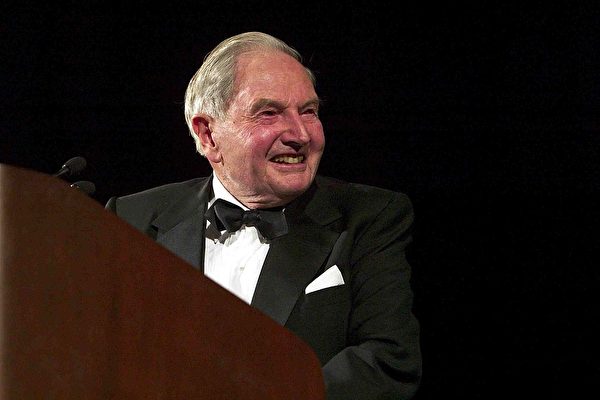
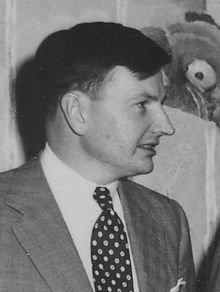
David Rockefeller (June 12, 1915 – March 20, 2017) was an American banker who was chairman and chief executive of Chase Manhattan Corporation. He was the oldest living member of the Rockefeller family and family patriarchsince July 2004, the child of John D. Rockefeller Jr. andAbby Aldrich Rockefeller, and the grandchild of John D. Rockefeller and Laura Spelman Rockefeller.
Contents
Early life
Rockefeller was born in New York City, and grew up in an eight-story house at 10 West 54th Street, the tallest private residence ever built in the city.[1] He was the youngest of six children born to financier John Davison Rockefeller Jr. and socialite Abigail Greene "Abby" Aldrich. John Jr. was the only son of Standard Oil co-founder John Davison Rockefeller Sr. and schoolteacher Laura Celestia "Cettie" Spelman. Abby was a daughter of Senator Nelson Wilmarth Aldrich and Abigail Pearce Truman "Abby" Chapman. David's five elder siblings were Abby (1903–1976), John III(1906–1978), Nelson (1908–1979), Laurance (1910–2004), and Winthrop (1912–1973). The home contained rare, ancient, medieval and Renaissance treasures collected by his father—with some, such as the Unicorn Tapestries, held in an adjoining building at 12 West 54th Street. On the seventh floor was his mother's private modern art gallery. The property was subsequently donated by David's father as a site for a sculpture garden that is now part of the Museum of Modern Art. The house was demolished by the family in the early 1960s to make way for Museum of Modern Art. This was conceived and planned for by his mother Abby. He spent much time as a child at the family estate Kykuit, where, in his memoirs, he recalls visits by associates of his father, including General George C. Marshall, the adventurer Admiral Richard Evelyn Byrd (whose Antarctic expeditions had been funded by the family), and the aviator Charles Lindbergh.[2] Summer vacations were spent at the Eyrie, a 100-room house in Seal Harbor on the southeast shore of Mount Desert Island, in Maine.
Rockefeller attended the experimental Lincoln School at 123rd Street in Harlem. The school was the brainchild of Abraham Flexner, who had structured the institution after the educational philosophy ofJohn Dewey. It opened in 1916 and was operated by the Teachers College at Columbia University, with crucial funding in its early years from the Rockefellers' General Education Board, a philanthropic educational institution later rolled into the Rockefeller Foundation. In 1936, Rockefeller graduated cum laude from Harvard University. He also studied economics for a year at Harvard and then a year at the London School of Economics (LSE). It was at LSE that he first met future President John F. Kennedy (although he had earlier been his contemporary at Harvard) and once dated Kennedy's sister Kathleen.[3] During his time abroad, Rockefeller briefly worked in the London branch of what was to become the Chase Manhattan Bank. Having returned to the United States to complete his graduate studies, in 1940 he received a Ph.D. from the University of Chicago. His dissertation was entitled Unused Resources and Economic Waste. After completing his studies in Chicago, he became secretary to New York Mayor Fiorello La Guardia for eighteen months in a "dollar a year" public service position. Although the mayor pointed out to the press that Rockefeller was only one of 60 interns in the city government, his working space was, in fact, the vacant office of the deputy mayor.[4] From 1941 to 1942, Rockefeller was assistant regional director of the United States Office of Defense, Health and Welfare Services. After war broke out, he enlisted in the U.S. Army and entered Officer Candidate School in 1943; he was ultimately promoted toCaptain in 1945. During World War II he served in North Africa and France (he spoke fluent French) for military intelligence setting up political and economic intelligence units. For seven months he also served as an assistant military attaché at the American Embassy in Paris. During this period, he would call on family contacts and Standard Oil executives for assistance.[5]
Career at the Chase Bank
In 1946, Rockefeller joined the staff of the longtime family-associated Chase National Bank.[6] The chairman at that time was Rockefeller's uncle Winthrop W. Aldrich.[7] The Chase Bank was primarily a wholesale bank,[8] dealing with other prominent financial institutions and major corporate clients such as General Electric (which had, through its RCA affiliate, leased prominent space and become a crucial first tenant of Rockefeller Center in 1930). The bank also is closely associated with and has financed the oil industry, having longstanding connections with its board directors to the successor companies of Standard Oil, especially Exxon Mobil. Chase National subsequently became the Chase Manhattan Bank in 1955[6] and shifted significantly into consumer banking. It is now called JPMorgan Chase.[9]
Rockefeller started as an assistant manager in the foreign department. There he financed international trade in a number of commodities, such as coffee, sugar and metals. This position also maintained relationships with more than 1,000 correspondent banks throughout the world. He served in other positions and became president in 1960. He was both chairman and chief executive of Chase Manhattan from 1969 to 1980 and remained chairman until 1981. He was also, as recently as 1980, the single largest individual shareholder of the bank, holding 1.7% of its shares.[10]
In 1954, Rockefeller became chairman of the committee charged with deciding the location of the bank's new headquarters. The following year his decision to erect the building in the Wall Street area was accepted; it was subsequently seen as a decision that directly revived the City's downtown financial district. In 1960 the headquarters was completed under his direction at One Chase Manhattan Plaza, on Liberty Street in downtown Manhattan, directly across from the Federal Reserve Bank of New York. At 60 stories, it was at that time the largest bank building in the world; it also had, five floors below ground, the largest bank vault then in existence.
In the 1960s, Rockefeller and other businessmen formed the Chase International Advisory Committee (IAC) which by 2005 consisted of twenty-eight prominent businessmen from nineteen nations throughout the world, many of whom were his personal friends. Rockefeller subsequently became chairman until he retired from that position on the IAC in 1999. After the Chase's merger with J. P. Morgan, this committee was renamed the International Council, and contains prominent figures such as Henry Kissinger, Riley P. Bechtel (of the Bechtel Group), Andre Desmarais, George Shultz, Tony Blair, the current chairman.[11] Historically, prominent figures on the IAC have includedGianni Agnelli (a longtime associate, who spent thirty years on the Committee), John Loudon(chairman of Royal Dutch-Shell), C. Douglas Dillon, David Packard, Lee Kuan Yew and Henry Ford II.[12]
Under his term as CEO, Chase spread internationally and became a central pillar in the world's financial system; Chase has a global network of correspondent banks that has been estimated to number about 50,000, the largest of any bank in the world. In 1973, Chase established the first branch of an American bank in Moscow, in the then Soviet Union. That year Rockefeller traveled to China, resulting in his bank becoming the National Bank of China's first correspondent bank in the U.S.[citation needed]
In November 1979, while chairman of the Chase Bank, Rockefeller became embroiled in an international incident when he and Henry Kissinger, along with John J. McCloy and Rockefeller aides, persuaded President Jimmy Carter through the United States Department of State to admit the Shah of Iran, Mohammad Reza Pahlavi, into the United States for hospital treatment forlymphoma. This action directly precipitated what is known as the Iran hostage crisis and placed Rockefeller under intense media scrutiny (particularly from The New York Times) for the first time in his public life.[13]
Political life
In a private capacity Rockefeller met with and advised every American President since Eisenhower and at times even served as an unofficial emissary on high-level business.[14] President Jimmy Carter offered him the position of United States Secretary of the Treasury but he declined.[15] He at an earlier point declined an offer from his brother Nelson to appoint him to Robert F. Kennedy's Senate seat after Kennedy was assassinated in June 1968, a post Nelson also offered to their nephew John Davison "Jay" Rockefeller IV.[16] On account of his personal, political, and professional connections and his family name, Rockefeller has been able to act as bridge to various interests around the world, including Saddam Hussein and Communist leaders such as Fidel Castro,Nikita Khrushchev, and Mikhail Gorbachev.[citation needed]
In Henry Kissinger, Rockefeller found a political operative with an international and domestic perspective similar to his. They first met in 1954, when Kissinger was appointed a director of a seminal Council on Foreign Relations study group on nuclear weapons, of which David was a member.[17][18] The relationship developed to the point that Kissinger was invited to sit on the board of trustees of the Rockefeller Brothers Fund. Rockefeller consulted with Kissinger on numerous occasions, as for example in the Chase Bank's interests in Chile and the possibility of the election of Salvador Allende in 1970,[19] and fully supported his "opening of China" initiative in 1971 as it afforded banking opportunities for the Chase Bank.[20]
Though a lifelong Republican and party contributor, like his father in the dynastic line, he was a committed member of the moderate "Rockefeller Republicans" that arose out of the political ambitions and public policy stance of his brother Nelson. In 2006 he teamed up with formerGoldman Sachs executives and others to form a fund-raising group based in Washington,Republicans Who Care, that supported moderate Republican candidates over more ideological contenders.[21]
Rockefeller also reportedly had connections to the Central Intelligence Agency (CIA)[citation needed]. As well as knowing Allen Dulles and his brother John Foster Dulles—who was an in-law of the family[22]—since his college years,[23] it was in Rockefeller Center that Allen Dulles had set up his WWII operational center after Pearl Harbor, liaising closely with MI6 which also had their principal U.S. operation in the Center.[24] He also knew and associated with the former CIA director Richard Helms, as well as Archibald Bulloch Roosevelt Jr., a Chase Bank employee and former CIA agent whose first cousin CIA agent Kermit Roosevelt, Jr. was involved in the Iran coup of 1953.[25] Also, in 1953, he had befriended William Bundy, a pivotal CIA analyst for nine years in the 1950s, who became the Agency liaison to the National Security Council, and a subsequent lifelong friend.[26]Moreover, in Cary Reich's biography of his brother Nelson, a former CIA agent states that David was extensively briefed on covert intelligence operations by himself and other Agency division chiefs, under the direction of David's "friend and confidant", CIA Director Allen Dulles.[27]
Additionally, he served as the only member of the Advisory Board for the Bilderberg Group.[28][29]
Policy groups

Throughout his life, Rockefeller participated in and even created a number of policy groups aimed at responding to domestic and international concerns. In 1947, Rockefeller was invited to join the board of the Carnegie Endowment for International Peace; serving on the board were such figures as Alger Hiss, John Foster Dulles(chairman), Dwight D. Eisenhower, and IBM President Thomas J. Watson. He accepted the prestigious appointment and was subsequently instrumental in relocating the Endowment's headquarters to a site opposite the new United Nations headquarters building, with aChase Bank branch on the ground floor.[30] In 1964, along with other prominent American business figures such as Sol Linowitz, Rockefeller founded the non-profit International Executive Service Corps which was established to help bring about prosperity and stability in developing nations through the growth of private enterprise.[31] In 1967, he formed The Business Committee for the Arts, Inc. (BCA), which is a national not-for-profit based in New York that established the annual Business in the Arts Awards, awarded to businesses that have formed exemplary partnerships with the arts community; this organization is co-sponsored by Forbes magazine.[32] In 1979, he formed the Partnership for New York City, another not-for-profit membership organization consisting of a select group of two hundred CEOs ("Partners") from New York City's top corporate, investment and entrepreneurial firms. They are elected annually and committed to working closely with government, labor and the nonprofit sector to enhance the economy and maintain New York City's position as the global center of commerce, culture and innovation. Through its roster of blue-chip corporations, Rockefeller sat at the core of a network of the most powerful and influential businessmen and women in corporate America.[33] In 1992, he was selected as a leading member of the Russian-American Bankers Forum, an advisory group set up by the head of the Federal Reserve Bank of New York to advise Russia on the modernization of its banking system, with the full endorsement of President Boris Yeltsin.[34]
On the world stage, influenced by the globalist perspective of his father, Rockefeller involved himself in a number of policy organizations focused on improving international relations. Rockefeller began a lifelong association with the Council on Foreign Relations (CFR) when he joined as a director in 1949, the youngest member appointed to that position yet. He would later become head of the nominating committee for future membership and after that the chairman of this foreign policy think-tank.[35] In 1965, Rockefeller and other businessmen formed the Council of the Americas to stimulate and support economic integration in the Americas. In 1992, at a Council sponsored forum, Rockefeller proposed a "Western Hemisphere free trade area", which subsequently became theFree Trade Area of the Americas in a Miami summit in 1994. His and the Council's chief liaison to President Bill Clinton in order to garner support for this initiative was through Clinton's chief of staff,Mack McLarty, whose consultancy firm Kissinger McLarty Associates is a corporate member of the Council, while McLarty himself is on the board of directors.[36]
Displeased with the refusal of the Bilderberg meetings to include Japan, Rockefeller helped found the Trilateral Commission in July 1973.[37] Zbigniew Brzezinski, the National Security Advisor under Carter and fierce advocate for international cooperation, became the inaugural United States director.[citation needed]
The Clinton Administration had close to a dozen Commission members, including Clinton himself; both Gerald Ford and George H. W. Bush had consulted the think tank.[38] Addressing this and other claims proffered by traditional media, far-left and far-right academics, and many conspiracy theorists, in Rockefeller's 2002 autobiography Memoirs he wrote: "For more than a century ideological extremists at either end of the political spectrum have seized upon well-publicized incidents such as my encounter with Castro to attack the Rockefeller family for the inordinate influence they claim we wield over American political and economic institutions. Some even believe we are part of a secret cabal working against the best interests of the United States, characterizing my family and me as internationalists and of conspiring with others around the world to build a more integrated global political and economic structure—one world, if you will. If that's the charge, I stand guilty, and I am proud of it."[citation needed]
Rockefeller patriarch
After the war and alongside his work at Chase, Rockefeller took a more active role in his family's business dealings. Working with his brothers in the two floors of Rockefeller Center known as Room 5600, he reorganized the family's myriad business and philanthropic ventures. The men kept regular "brothers' meetings" where they made decisions on matters of common interest and reported on noteworthy events in each of their lives. David served as secretary to the group, making notes of each meeting. The notes are now in the family archive and will be released in the future.[39] Following the deaths of his brothers, Winthrop (1973), John III (1978), Nelson (1979), andLaurance (2004), David became sole head of the family (with the important involvement of his elder son, David Jr).
David ensured that selected members of the fourth generation, known generically as the cousins, became directly involved in the family's institutions. This involved inviting them to be more active in the Rockefeller Brothers Fund, the principal foundation established in 1940 by the five brothers and their one sister. The extended family also became involved in their own philanthropic organization, formed in 1967 and primarily established by third-generation members, called the Rockefeller Family Fund.[citation needed]
The extended family demonstrated their influence in the 1989 sale of Rockefeller Center toMitsubishi Real Estate. This action freed up part of the family fortune for reinvestment in more lucrative fields. The Trust has expanded beyond business in New York and is now far more diverse in their interests. Nevertheless, under David, overall family and institutional cohesion has been maintained to a remarkable degree (more so than any other late 19th century wealthy family).[40]
In 2000, Rockefeller presided over the final sale of Rockefeller Center to Jerry Speyer's Tishman Speyer Properties, along with the Crown family of Chicago, which ended the more than 70 years of direct family financial association with the landmark New York complex. It later turned out that he had a long association with Jerry Speyer through the Museum of Modern Art, so there was still an enduring partnership in operation, though not directly financial in nature.[41]
In 2003, he served as "honorary member" of the Jury for the World Trade Center Site Memorial Competition. This was appropriate as he had created and chaired the original Downtown-Lower Manhattan Association in 1960 that had initiated the Center, along with major backing from his brother, Nelson Rockefeller, who was the Governor of New York at the time, as well as with the New York power broker Robert Moses.[42]
Rockefeller has always limited his giving to institutions directly or indirectly related to the family; for example, in 2005, at age ninety, he gave $100 million to the Museum of Modern Art and $100 million to Rockefeller University, two of the most prominent family institutions; as well as $10 million to Harvard and $5 million to Colonial Williamsburg. In 2006, he pledged $225 million to theRockefeller Brothers Fund upon his death, the largest gift in the Fund's history. The money will be used to create the David Rockefeller Global Development Fund, to support projects that improve access to health care, conduct research on international finance and trade, fight poverty, and support sustainable development, as well as to a program that fosters dialogue between Muslim and Western nations.[43] Rockefeller donated $100 million to Harvard University in 2008.[44] The New York Times estimated in November 2006 that his total charitable donations amount to $900 million over his lifetime, a figure that was substantiated by a monograph on the family's overall benefactions, entitled The Chronicle of Philanthropy.[45] According to his doctors, he wasn't diagnosed with any cancer and has peacefully reached his centenary.[46]
He published Memoirs in 2002, the only time a member of the Rockefeller family has written an autobiography.[47]
Wife and children
He married Margaret "Peggy" McGrath (1915–1996) on September 7, 1940. She was the daughter of a partner in a prominent Wall Street law firm. They had six children:
- David Rockefeller Jr. (born July 24, 1941) – vice chairman, Rockefeller Family & Associates (the family office, Room 5600); chairman of Rockefeller Financial Services; Trustee of the Rockefeller Foundation; former chairman of the Rockefeller Brothers Fund and Rockefeller & Co., Inc., among many other family institutions.
- Abigail Aldrich "Abby" Rockefeller (born 1943) – economist and feminist. Eldest and most rebellious daughter, she was drawn to Marxism and was an ardent admirer of Fidel Castro and a late 1960s/early 1970s radical feminist[48] who belonged to the organization Female Liberation, later forming a splinter group called Cell 16.[49] An environmentalist and ecologist, she was an active supporter of the women's liberation movement.
- Neva Rockefeller (born 1944) – economist and philanthropist. She is director of the Global Development and Environment Institute; trustee and vice chair of the Rockefeller Brothers Fund and Director of the Rockefeller Philanthropy Advisors.
- Margaret Dulany "Peggy" Rockefeller (born 1947) – founder of the Synergos Institute in 1986; Board member of the Council on Foreign Relations; serves on the Advisory Committee of the David Rockefeller Center for Latin American Studies at Harvard University.
- Richard Gilder Rockefeller (1949–2014)[50] – physician and philanthropist; chairman of the United States advisory board of the international aid group Doctors Without Borders; trustee and chair of the Rockefeller Brothers Fund.
- Eileen Rockefeller (born 1952) – venture philanthropist; Founding Chair of Rockefeller Philanthropy Advisors, established in New York City in 2002.
Death & Legacy
Rockefeller died in his sleep from congestive heart failure on March 20, 2017 at the age of 101 at his home in Pocantico Hills, New York [51] He was able to establish Chase Bank as an international business with his shrewd marketing and business skills, his substantial economic capabilities, and his diplomatic missions with other world leaders.
Wealth
As of November 2016, his net worth was estimated to be US $3.1 billion, which ranked him among the 200 richest people in the world.[52] Initially, most of his wealth had come to him via the family trusts that his father had set up, which were administered by Room 5600 and the Chase Bank. In turn, most of these trusts were held as shares in the successor companies of Standard Oil, as well as diverse real estate investment partnerships, such as the expansive Embarcadero Center in San Francisco, which he later sold for considerable profit, retaining only an indirect stake. In addition, he was or had been a partner in various properties such as a 4,000-acre (16 km2) resort development in the Virgin Islands and a cattle ranch in Argentina, as well as a 15,500-acre (63 km2) sheep ranch in Australia.[53]
Another major source of asset wealth was his formidable art collection, ranging from impressionistto postmodern, which he developed through the raising of his mother Abby and her establishment, with two associates, of the Museum of Modern Art in New York in 1929. He was not a collector of most modern art himself but, as chairman and honorary chairman, never hindered MoMA's acquisition of the newer works. He donated many works to MoMA over the decades and more will go there after his death.[54]
Residences
Rockefeller's principal residence was at "Hudson Pines", on the family estate in Pocantico Hills, New York. He also had a Manhattan residence at East 65th Street, as well as a country residence (known as "Four Winds") at a farm in Livingston, New York (Columbia County), where his wife raised Simmenthal beef cattle.[55] He also maintained a summer home on Mount Desert Island off the Maine coast. In May 2015, as part of celebrations to mark his 100th birthday, Rockefeller donated one thousand acres of land in Seal Harbor to the Mount Desert Land and Garden Preserve. The lands to be transferred stretch from the Preserve’s present property on Eliot Mountain, eastward to Barr Hill and the Stanley Brook Road, with the exception of the Abby Aldrich Rockefeller Garden and some other properties, which will be made public in the future.[56]
The Kykuit area of the family estate is the location of The Pocantico Conference Center of theRockefeller Brothers Fund (RBF)—set up by David and his four brothers in 1940—which was created when the Fund leased the area from the National Trust for Historic Preservation in 1991. Known as the "Playhouse", it provides a setting where the Fund and other nonprofit organizations and public sector institutions can bring together people of diverse backgrounds and perspectives to engage on critical world issues.[57]